Call Center Interview Questions: What to Expect and How to Prepare
A walk through the screening call, the role-play, the typing and system tests, and the behavioural questions hiring managers actually ask contact centre staff.
Quick answer
- Prepare for a live role-play: a scripted angry customer, a cancellation request, or an upsell after a complaint, scored on tone and listening as much as resolution.
- Have two stories ready about staying composed under criticism — self-control is listed as a key work style for this occupation (O*NET OnLine, undated) and is almost always probed directly.
- Be ready for practical tests: typing speed, navigating a CRM while talking, and reading a knowledge-base article aloud and summarising it.
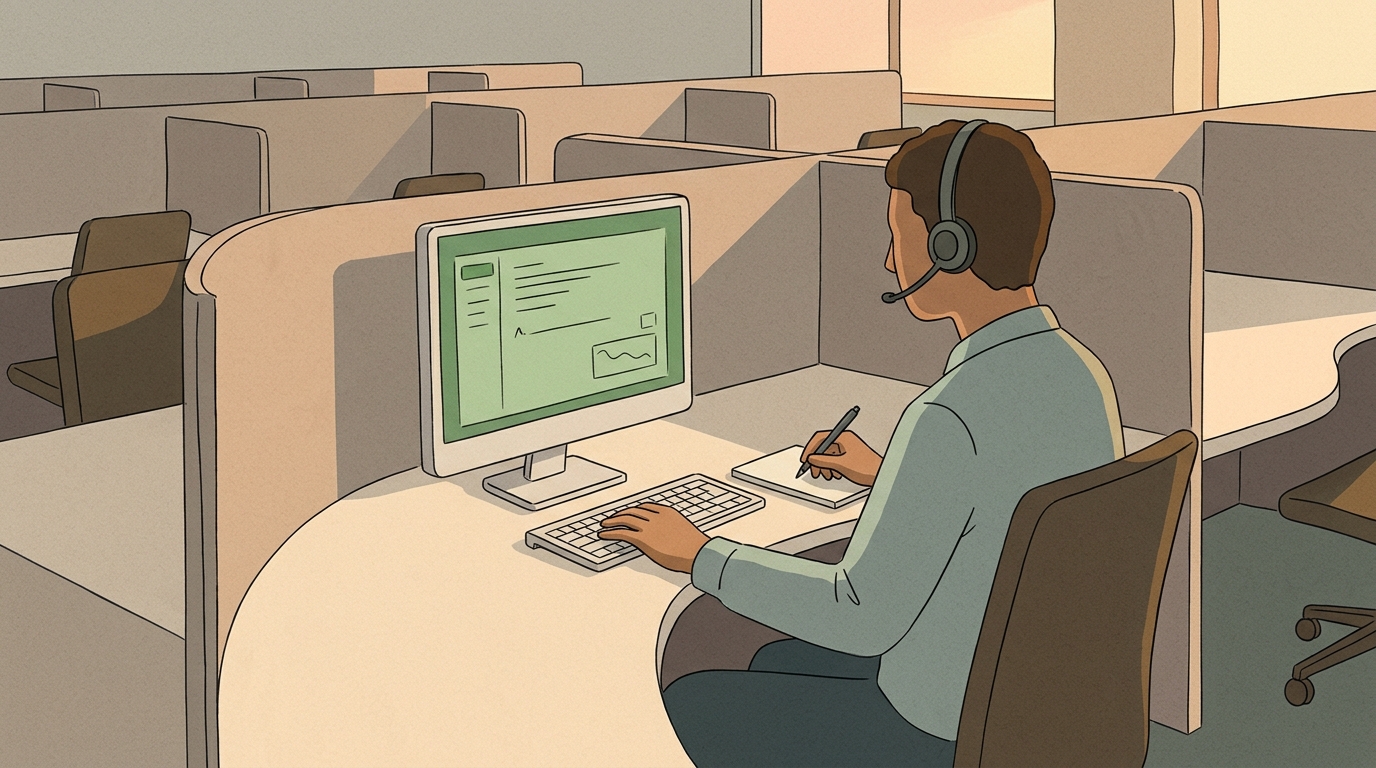
Call centre interviews are usually short, structured and practical. Expect a phone or video screen first, then a round that tests how you sound and behave under pressure — often a role-play with a difficult customer, sometimes a typing or system-navigation test — with scoring against a fixed set of competencies rather than a free-flowing conversation.
The bar to enter is lower than in many fields: among survey respondents for this occupation, the plurality said new hires need a high school diploma or equivalent (ONET OnLine, undated), and the work is classified in Job Zone 1-2, meaning very little to some preparation is needed (ONET OnLine, undated). That means the interview carries most of the weight, and it is testing temperament more than credentials.
What This Interview Usually Covers
Most call centre hiring runs in two or three rounds and moves fast, because teams often recruit in intakes to fill a training class with a fixed start date.
Round one is usually a phone screen with a recruiter, ten to twenty minutes. It is partly a test in itself — they are listening to your clarity, pace and phone manner. Expect questions about shift availability, commute or home-office setup, and why you want phone work.
Round two is the substantive one. It may be one-on-one with a team leader, or a panel of a team leader plus a quality or training specialist. Common components:
- A live role-play. You handle a complaint, a cancellation, or a confused caller while the interviewer plays the customer.
- Behavioural questions scored against a competency grid, so answers that name a situation and an outcome score better than general statements.
- A practical test: typing speed, basic numeracy, or navigating a demo system while answering questions.
- A reading or comprehension check, since reading comprehension is listed among the essential skills for this occupation (O*NET OnLine, undated).
Some employers, especially in finance and insurance and retail trade — the top industries employing this occupation (O*NET OnLine, sourced from U.S. Bureau of Labor Statistics, 2025) — add a background or credit check before an offer. Group assessment days are common in large outsourcing centres and rare in small in-house teams.
Common Questions and Sample Answers
Why do you want to work in a call centre?
Sample answer
I was working weekend shifts on a supermarket service desk handling returns and price disputes. My task was to resolve each query without escalating to the duty manager. I started writing down the three questions that solved most disputes and used them in order rather than improvising. Over about four months I escalated only two cases out of roughly 400. I realised the part I enjoyed was the conversation itself, not the shop floor, so phone-based service is where I want to build.
Tell me about a time you dealt with an angry customer.
Sample answer
A customer's delivery had missed a birthday and he was shouting within ten seconds of connecting. My task was to keep the call from being abandoned and get a resolution he'd accept. I let him finish without interrupting, repeated his timeline back in my own words, then told him exactly what I could do — refund the delivery fee and reship with next-day tracking. He accepted and stayed on to confirm the address. The call ran nine minutes against a team average of six, but it closed without a complaint being logged.
How do you handle criticism from a supervisor?
Sample answer
During my second month, a quality reviewer scored one of my calls 68 out of 100 for failing to confirm the customer's identity before discussing the account. My task was to lift that to the team standard of 85. I asked to listen back to the recording with her, wrote the verification steps on a sticky note on my monitor, and used the same wording on every call for two weeks. My next three reviews came in at 88, 91 and 90.
How do you keep accurate notes while talking to a customer?
Sample answer
In a previous role our ticketing system required a summary within sixty seconds of the call ending. My task was to log notes a colleague could pick up cold. I built a four-line template — reason, action taken, promise made, follow-up date — and typed it while the customer was speaking rather than after. Callbacks where the second agent had to re-ask the whole story dropped noticeably over a quarter; my team leader cited my notes as the format we rolled out to new starters.
Describe a time you had to say no to a customer.
Sample answer
A caller wanted a refund fourteen days outside the policy window and threatened to post about it. My task was to hold the policy without losing him. I acknowledged the specific inconvenience, explained the window in one sentence without repeating the word "policy" three times, then offered the two things I could do: a replacement part at no charge and free return postage. He took the replacement. He later gave the interaction a 4 out of 5 on the follow-up survey, which my supervisor flagged as a good hold on a hard call.
How do you hit targets without rushing people off the phone?
Sample answer
My team had an average handle time target of five minutes and a quality target that penalised interruptions. My task was to meet both. I cut my own talk time instead of the customer's — I stopped re-explaining things they'd already confirmed and prepared my system screens during the greeting. Over six weeks my handle time fell from 6:10 to 5:05 while my quality score held at 90. Nobody got cut off mid-sentence to achieve it.
Tell me about a time you worked with a difficult teammate.
Sample answer
A colleague on my pod routinely transferred complex billing calls to me without warning the customer. My task was to stop it without creating a dispute on the floor. I asked him over a break what made those calls hard, and it turned out he'd never been shown the billing adjustment screen. I walked him through it in about fifteen minutes between shifts. Transfers to me from him dropped to roughly one a week, and he later ran the same walkthrough for two new starters.
How do you stay composed on a bad day?
Sample answer
On a day when our payment system went down, I took around fifty calls about failed transactions. My task was to keep the same tone on call fifty as on call one. I used the thirty seconds between calls to stand up, drink water and read the one-line outage update so my explanation stayed current. I logged three calls for supervisor callback rather than guessing. My quality scores that day matched my monthly average, and I didn't take an unscheduled break.
Mistakes That Cost Candidates the Job
- Treating the role-play as a joke — laughing, breaking character, or saying "well obviously I'd just refund them" instead of actually speaking the words you'd use on the call.
- Interrupting the interviewer's scripted customer to jump to a solution. Active listening is listed as one of six essential skills for this occupation, defined as giving full attention to what others are saying and not interrupting at inappropriate times (O*NET OnLine, undated), and the role-play exists to measure it.
- Badmouthing a previous employer's customers when asked why you left, especially phrases like "people were idiots."
- Saying you want the role because "it's easy" or "anyone can do it." On-the-job training for this Job Zone ranges from a few days to one year (O*NET OnLine, undated), and trainers want people who will finish the programme.
- Being vague about availability. If you can't work the advertised shift pattern, weekends or a rotating roster, say so at the screen rather than discovering it in week two.
- Ignoring the admin side. Keeping records of customer interactions, recording details of inquiries, complaints or comments and actions taken is a listed task for this occupation (O*NET OnLine, undated), so answers that only cover the talking half look incomplete.
- Reciting job-ad language — "I'm a people person" — with no example attached. Replace it with one call you handled and what changed as a result.
- Taking the interview call from a noisy street or a bad connection. If it's a phone screen, you are being assessed on audio quality from the first second.
Frequently asked questions
What should I wear to a call centre interview?
Wear business casual: a collared shirt or blouse, clean plain trousers or a skirt, closed shoes. Contact centre floors are rarely formal, but interviewers notice effort. For a video round, sit facing a window or lamp, test your microphone beforehand, and keep the background plain.
Should I bring up pay in the interview?
Let them raise it first, then ask how the package is structured — base hourly or salaried, shift differentials for nights and weekends, and whether bonuses are tied to quality scores or sales. Check current rates for your area on your national statistics agency's occupational pay data and on live job ads for the same shift pattern.
How do I prepare for the typing or system test?
Do three timed typing tests on a free online tool the week before and note your words-per-minute with punctuation included, not just raw speed. Then practise typing a four-line call summary while listening to a podcast — that split attention is what the test is really measuring.
How soon should I follow up?
Send a short email within 24 hours to whoever scheduled you, naming one specific thing from the conversation. If you've heard nothing by the date they gave, or by seven days if they gave none, call or email once. Intakes move quickly, so a prompt nudge is normal.
Is it worth applying if the occupation is projected to shrink?
Yes. Employment in this occupation is projected to decline over the 2025-2035 period, while total projected job openings from growth and replacement needs are still substantial (O*NET OnLine, sourced from U.S. Bureau of Labor Statistics, 2025). Target finance, insurance and retail employers, the top industries for this occupation, and treat the role as an entry point into service operations.
Sources
- O*NET OnLine — 43-4051.00 - Customer Service Representatives

Written by
Marisol steers Jobladderhq's coverage of hiring trends and the strange rituals of modern recruiting. She's drawn to the gap between what job ads promise and what the work actually feels like. Her editing hand favors clarity over jargon, always.