
Choosing Between Event Planning and Hospitality Management as a Career Changer
Two hospitality-adjacent paths with different schedules, entry routes and certifications — how to weigh them before you hand in your notice.
Quick answer
- Faster entry: **event planning** — the Certified Meeting Professional (CMP) is open to anyone who joins the Events Industry Council and passes its written exam, while the Certified Hotel Administrator (CHA) is restricted to general managers, owner/operators, multi-property executives and qualifying assistant GMs (American Hotel & Lodging Educational Institute).
- Steadier week-to-week schedule: **hospitality management** — hotels run rotating shifts year-round, whereas planners may work many more hours than usual during a meeting or convention (U.S. Bureau of Labor Statistics, 2025).
- Bigger field to job-hunt in: **event planning** — 172,100 meeting, convention and event planner jobs in 2025 against 54,800 lodging manager jobs (U.S. Bureau of Labor Statistics, 2025).
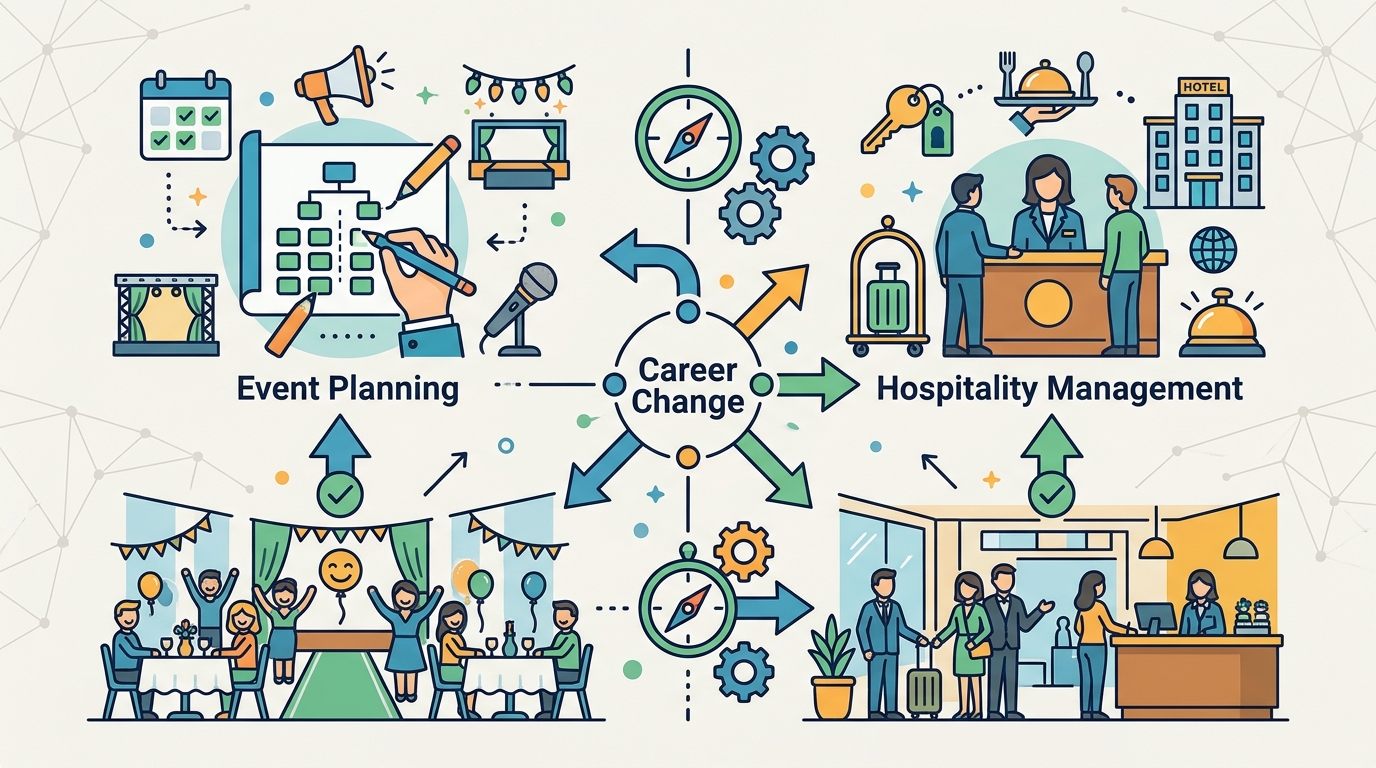
Event planning and hospitality management overlap in reputation and diverge in practice. Event planning is project work with heavy peaks: you meet clients, solicit bids from venues and suppliers, and run the event onsite (U.S. Bureau of Labor Statistics, 2025). Lodging management is running a building that never closes — inspecting rooms and grounds, hiring and training staff, setting budgets and approving expenditures (U.S. Bureau of Labor Statistics, 2025).
For a career changer the real decision is schedule tolerance and entry route, not glamour. Plan on a 6 to 18 month transition, including a stretch at lower earnings while you build industry-specific experience.
Side-by-Side Comparison
Figures below are United States data. Outside the US, check your national statistics body — the Office for National Statistics, Statistics Canada or the Australian Bureau of Statistics — because pay, titles and qualification routes differ by country, and in federal systems licensing rules differ by state or province.
| Dimension | Event planning | Hospitality (lodging) management |
|---|---|---|
| Entry route | BLS lists a typical entry-level education for meeting, convention and event planners (U.S. Bureau of Labor Statistics, 2025); most changers start in a coordinator role | Three paths: a high school diploma plus several years of experience in a lodging facility, a bachelor's degree in hospitality or hotel management, or an associate's degree or certificate in hotel management (U.S. Bureau of Labor Statistics, 2025) |
| Transition time | 6–12 months from coordinator to running events independently | 12–24 months from supervisor to assistant manager; longer if you start on the front desk |
| Median pay | Published as a median annual wage as of May 2025 (U.S. Bureau of Labor Statistics, 2025) — look up the current figure in the Occupational Outlook Handbook | Published as a median annual wage as of May 2025 (U.S. Bureau of Labor Statistics, 2025) — expect wide variation by property size and location |
| Size of field | 172,100 jobs in 2025, with a 2025–35 outlook published by BLS | 54,800 jobs in 2025, with a 2025–35 outlook published by BLS |
| Schedule and physical demands | Office-based between events; long onsite days at hotels and conference centres, plus travel to event sites (U.S. Bureau of Labor Statistics, 2025) | Mostly full time with evenings, weekends and holidays; some managers are on call 24 hours a day (U.S. Bureau of Labor Statistics, 2025) |
| Main certification | Certified Meeting Professional (CMP): join the Events Industry Council, then pass a written exam on meeting management | Certified Hotel Administrator (CHA), limited to GMs, owner/operators, multi-property executives, or AGMs holding the Certified Rooms Division Executive credential |
| Typical starting age for changers | Late 20s to 50s | Late 20s to 50s; night and on-call rotations are the practical filter |
What Each Job Looks Like Day to Day
Event planning. A normal week is client calls, spreadsheets and supplier chasing. You meet clients to pin down the purpose of the event, then solicit bids from venues and service providers and compare them line by line. You inspect venues in person — ceiling heights, loading access, power, room flow — and coordinate catering, audiovisual and transport. On event days the work turns physical: onsite early, monitoring activities, fixing problems quietly, working many more hours than usual (U.S. Bureau of Labor Statistics, 2025). Afterwards you review event bills against contracts.
Hospitality management. A lodging manager's day is anchored to the building. You inspect guest rooms, public areas and grounds for cleanliness and repair, and coordinate front-desk activities — arrivals, complaints, overbooking, the handover that went badly at 3am. The people side is constant: you interview, hire, train and sometimes fire staff, and roster around holidays nobody wants. You set budgets and approve expenditures, from laundry contracts to a booking terminal (U.S. Bureau of Labor Statistics, 2025), often across evenings, weekends and on-call nights.
Which Fits Your Background
- Retail store manager: hospitality management. Rostering, stock control, inspections and hiring map almost directly onto a lodging manager's budget and staffing duties.
- Elementary teacher: event planning. Timetables, school productions and competing demands translate into run-sheets, supplier coordination and onsite problem-solving.
- Executive assistant or office administrator: event planning. Venue sourcing, bid comparison and bill reconciliation are what you already do for one executive, scaled to a few hundred attendees.
- Restaurant shift supervisor or head server: hospitality management. Shift work and guest recovery are core hotel operations, and years in a lodging facility count toward the experience-based entry path (U.S. Bureau of Labor Statistics, 2025).
- Nonprofit fundraiser or membership coordinator: event planning. Galas and donor trips are the same craft as corporate meetings, and your supplier contacts come with you.
- Registered nurse or paramedic leaving clinical work: hospitality management. You already tolerate nights, weekends and on-call rotations — the main reason others quit the role.
- Caring for family around school hours: event planning, with caution. Planning weeks can be office-based, but event weeks are long and often away from home.
How to Decide and Test the Waters
- Work one real event before you resign. Volunteer on the operations crew of a conference or charity gala — registration, speaker handling, load-out. Two or three events over a few months tells you whether 14-hour onsite days energise or flatten you.
- Take weekend or seasonal hotel shifts. Front desk, night audit or banquet work for 8 to 12 weeks is the cheapest honest test of lodging management, and it starts the "several years of experience in a lodging facility" clock BLS describes as one entry route (U.S. Bureau of Labor Statistics, 2025).
- Shadow both roles for a day each. Ask a planner for a site-inspection day and a hotel manager for a morning walk-through. Say plainly that you are changing careers and want 90 minutes.
- Price the credentials. The CMP requires Events Industry Council membership and then a written exam, each with its own fee and study time. The CHA opens only once you reach general manager, owner/operator, multi-property executive or AGM with the Certified Rooms Division Executive credential — a later goal, not an entry ticket. Confirm current fees with each body.
- Model the income gap. Most changers step back to coordinator or supervisor level, so plan for 6 to 18 months of lower earnings plus certification and travel costs, measured against the May 2025 median annual wages BLS publishes for both occupations.
- Name the age question. If you are 45 to 60, expect interviewers to assume you will not accept evenings, weekends, holidays or 24-hour on-call cover. Answer it with the volunteer or casual shifts you have already worked.
Frequently asked questions
Which career is easier to enter without a hospitality degree?
Hospitality management has the clearer non-degree route: BLS names three entry paths for lodging managers — a high school diploma plus several years of experience in a lodging facility, a bachelor's degree in hospitality or hotel management, or an associate's degree or certificate in hotel management (U.S. Bureau of Labor Statistics, 2025). Event planning has no equivalent experience-only ladder spelled out, but it is the far larger field at 172,100 jobs in 2025 against 54,800 lodging manager jobs, so there are more coordinator openings to apply for.
I am 52. Is it realistic to start either of these now?
Yes, and the structure of both jobs is why. Lodging management explicitly rewards prior experience in a facility, which favours people who have already managed staff and budgets; event planning rewards supplier judgement built over years. The obstacle for applicants aged 45 to 60 is the assumption you will refuse evenings, weekends, holidays or 24-hour on-call cover (U.S. Bureau of Labor Statistics, 2025). Plan a 12 to 24 month transition and gather evidence — volunteer event shifts, a season of weekend hotel work — before interviews.
Which has the worse hours, and what will the switch cost me?
The load differs in shape. Lodging managers work full time with evenings, weekends and holidays built in, and some are on call 24 hours a day; planners work office hours between projects but may work many more hours than usual during a meeting or convention, with travel to event sites (U.S. Bureau of Labor Statistics, 2025). Financially, budget 6 to 18 months of reduced earnings in either path, plus CMP fees (Events Industry Council membership and a written exam), and compare both May 2025 median annual wages in the Occupational Outlook Handbook before deciding.
Sources
- U.S. Bureau of Labor Statistics — Meeting, Convention, and Event Planners : Occupational Outlook Handbook (2025)
- U.S. Bureau of Labor Statistics — Lodging Managers : Occupational Outlook Handbook (2025)

Written by
Wyatt covers work outside the office: construction, logistics, repair, and the people who keep things running. He's skeptical of career advice that assumes everyone sits at a desk.


