
Flight Attendant Pay: Average Salary, Range, and What Affects It
Cabin crew pay is built from flight-hour rates, per diem and seniority steps, so a headline median hides the gap between first-year and senior crew.
Quick answer
- US flight attendants earned a median annual wage of $63,580 in May 2025 (U.S. Bureau of Labor Statistics) — above the $50,980 median for all occupations that month (BLS, May 2025).
- Experience moves pay a long way: PayScale figures reported by Money put average entry-level total compensation (0–5 years) at around $38,000 and late-career at around $61,000, while the BLS 90th percentile was $97,170 (BLS Occupational Employment and Wage Statistics, May 2022).
- Advertised 'salaries' rarely match take-home in year one: most of the pay is a per-flight-hour rate, so scheduled hours, reserve status and premiums matter as much as the annual headline figure.
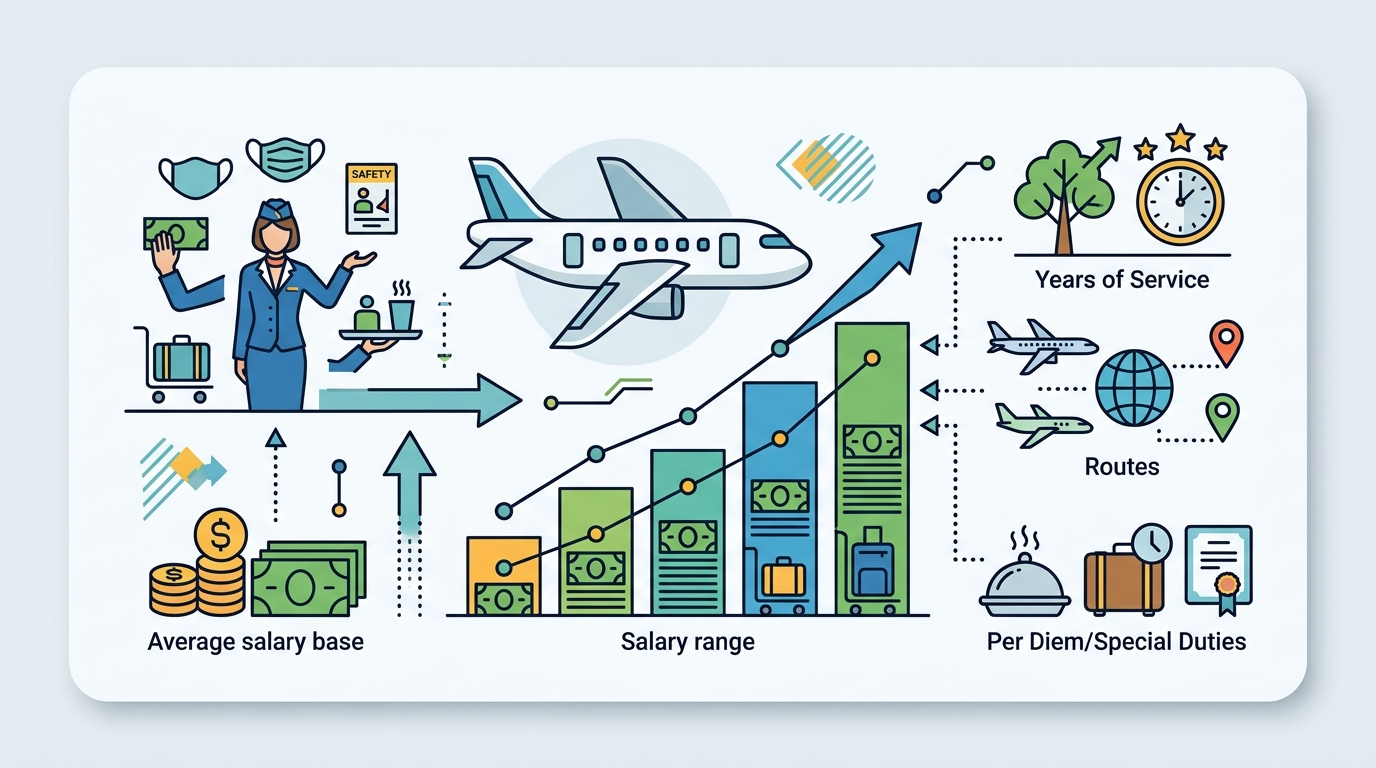
In the United States, flight attendants had a median annual wage of $63,580 in May 2025 (U.S. Bureau of Labor Statistics). Half earned more than that and half earned less, with the lowest-paid tenth at $37,690 a year (BLS Occupational Employment and Wage Statistics, May 2022) and the highest-paid tenth above $136,430 (Assessment.com, citing BLS, May 2025).
The detailed figures below are US ones, because that is where the published occupational wage data used here comes from. If you are working or job-hunting elsewhere, the structure of the pay — a flight-hour rate, seniority steps, per diem and premiums — tends to be similar, but the amounts are set by each country's airlines and contracts, so check your own national statistics office or labour ministry and the relevant union agreement.
What This Job Pays
The median annual wage for flight attendants in the United States was $63,580 in May 2025, according to the U.S. Bureau of Labor Statistics. Median means the midpoint: half of flight attendants earned more, half earned less. For context, the BLS put the median annual wage across all occupations at $50,980 in the same month.
The spread is wide. In the BLS Occupational Employment and Wage Statistics series for Flight Attendants (SOC 53-2031), May 2022, the percentile estimates were:
- 10th percentile: $37,690 a year
- 25th percentile: $47,760
- 50th percentile (median): $63,760
- 75th percentile: $82,410
- 90th percentile: $97,170
- Mean (average) annual wage: $67,020, across estimated employment of 108,480
More recent reporting of the May 2025 BLS data says the highest-paid 10% of flight attendants earned more than $136,430 a year (Assessment.com, citing BLS, May 2025). CareerExplorer describes the US range as starting from $35,110 and reaching $136,430, with an average of $63,580 (CareerExplorer, undated).
One thing to be clear about: BLS wage estimates are wage and salary earnings, and they do not separate out per diem or other allowances. PayScale-sourced numbers quoted in this guide are described as total compensation, which can fold in bonuses and other cash pay — for example, an average of around $38,000 for entry-level flight attendants with zero to five years of experience (PayScale, reported by Money, undated).
That distinction matters more here than in most jobs, because cabin crew are typically paid an hourly rate for flight hours rather than a flat annual salary, with per diem paid separately to cover time away from base. Two people on the same contract rate can finish the year far apart if one flew reserve with light months and the other picked up trips. Always ask what the first-year flight-hour rate is, how many hours a line typically holds, and what is guaranteed.
Salary by Experience and Location
The table below sets out published figures only, with the source and year attached to each. Where a source publishes a state average but no figure is available to quote here, the row says where to look it up rather than guessing a number.
| Stage, place or point in the range | Published figure | Source and year |
|---|---|---|
| Entry-level, 0–5 years (US average total compensation) | $38,000 a year | PayScale, reported by Money (undated) |
| Lowest-paid 10% (US) | $37,690 a year | BLS Occupational Employment and Wage Statistics, May 2022 |
| 25th percentile (US) | $47,760 a year | BLS OEWS, May 2022 |
| Mid-career / national midpoint (US) | $63,580 a year | U.S. Bureau of Labor Statistics, May 2025 |
| National midpoint, earlier OEWS release | $63,760 a year (median); $67,020 mean | BLS OEWS, May 2022 |
| Late-career average (US) | $61,000 a year | PayScale, reported by Money (undated) |
| Experienced, 75th percentile (US) | $82,410 a year | BLS OEWS, May 2022 |
| Experienced, 90th percentile (US) | $97,170 a year | BLS OEWS, May 2022 |
| Top 10% (US) | More than $136,430 a year | Assessment.com, citing BLS, May 2025 |
| Houston, Texas — all experience levels | $38.15 an hour (average) | Payscale, 2026 |
| Houston, Texas — early career, 1–4 years | $27.29 an hour (average total compensation) | Payscale, 2026 |
| California | State average published, updated periodically | CareerExplorer (undated) |
| New York | State average published, updated periodically | CareerExplorer (undated) |
| Texas | State average published, updated periodically | CareerExplorer (undated) |
Two notes on reading this. First, the PayScale averages reported by Money — $38,000 for zero to five years and $61,000 late-career — sit closer together than the BLS percentile spread, because averages pull in part-year and reserve earnings. The BLS 90th percentile of $97,170 (OEWS, May 2022) shows what the senior end of the range looks like, against $37,690 at the 10th percentile in the same release.
Second, location affects a flight attendant's pay differently from most jobs. Your contract rate usually follows the airline, not the base, so a crew member based in New York and one based in Texas on the same airline may be on the same hourly rate. What changes by base is cost of living, commuting, the trips available and the mix of employers operating there — which is why city and state averages, such as the Houston average of $38.15 an hour (Payscale, 2026), differ from one another and from the national median of $63,580 (BLS, May 2025).
What Affects Pay in This Field
- Seniority and years flown. This is the single biggest lever. PayScale figures reported by Money put average entry-level total compensation (0–5 years) at $38,000 and late-career at $61,000 for the same job title. The BLS percentile spread tells the same story: $37,690 at the 10th percentile against $97,170 at the 90th (BLS Occupational Employment and Wage Statistics, May 2022).
- Hours flown and trip selection. Because pay is tied to flight hours, the person who holds a high-time line earns materially more than one sitting reserve. The distance between the US median of $63,580 (BLS, May 2025) and the top 10% figure of more than $136,430 (Assessment.com, citing BLS, May 2025) is built largely from hours, premiums and years, not from a different job.
- Where you are based, and who you work for. In Houston, Texas, Payscale put the average flight attendant rate at $38.15 an hour in 2026, against $27.29 an hour for someone with one to four years in the same city (Payscale, 2026) — one market, two very different rates, driven by experience. CareerExplorer publishes state averages for California, New York and Texas (undated); check the current value for the state you would be based in before you compare offers.
- Corporate and private aviation versus scheduled airlines. The BLS does not publish a separate wage figure for corporate flight attendants; they are counted inside the same occupation, SOC 53-2031, whose median pay was $63,580 a year (Nuecareer, 2025). Corporate pay is therefore invisible in the national median, and you have to source it from job postings and operators directly.
- Union contracts. At unionised carriers, the flight-hour rate, step increases, per diem rate, minimum guarantee and premium pay are all written into the agreement rather than negotiated individually. The practical effect is that the move from $38,000 at zero to five years to $61,000 late-career (PayScale, reported by Money, undated) is scheduled, not discretionary.
- Hiring conditions. BLS projects employment of flight attendants to grow 9 percent from 2025 to 2035, much faster than the average for all occupations, with about 18,500 openings a year over the decade (BLS, 2025). Steady demand does not set your rate, but it shapes how often carriers recruit and how quickly junior crew move up a seniority list.
How This Job's Pay Compares
Flight attendant pay sits above the all-occupations midpoint but well below the flight deck. Here is how the published medians line up.
| Job title or group | Median annual wage | Source and year |
|---|---|---|
| Flight attendants | $63,580 | U.S. Bureau of Labor Statistics, May 2025 |
| All occupations (baseline) | $50,980 | U.S. Bureau of Labor Statistics, May 2025 |
| Air transportation workers (occupational group) | $108,460 | U.S. Bureau of Labor Statistics, May 2025 |
| Airline pilots and co-pilots | $239,200 (against a flight attendant median of $67,920 in the same release) | Stealth Agents, citing BLS data, May 2024 |
What to take from the comparison:
- Against the national baseline, the flight attendant median of $63,580 was ahead of the $50,980 median for all occupations in May 2025 (BLS).
- The 'air transportation workers' group median of $108,460 (BLS, May 2025) is pulled up by pilots and flight engineers. If you see that figure quoted in an article about cabin crew, it is the wrong number — the flight attendant line is $63,580 (BLS, May 2025).
- The pilot comparison is the one people most often confuse. Airline pilots and co-pilots had a median of $239,200 against $67,920 for flight attendants in the same BLS release (Stealth Agents, citing BLS, May 2024). The two jobs share an aircraft, a roster pattern and a seniority system, and almost nothing else about their pay scales or their training costs.
- Corporate flight attendants are not a separate BLS category; they fall inside the $63,580 median (Nuecareer, 2025), so compare individual operator postings rather than national data if that is the route you want.
If you are outside the United States, run the same comparison with your own national statistics office or labour ministry figures, and read the airline's collective agreement where one exists — that is where the flight-hour rate and step scale actually live.
Frequently asked questions
How much do flight attendants earn when they are starting out?
PayScale figures reported by Money put average total compensation for flight attendants with zero to five years of experience at $38,000 a year (undated), and the BLS 10th percentile was $37,690 a year (BLS Occupational Employment and Wage Statistics, May 2022). CareerExplorer gives $35,110 as the bottom of the US range (undated). In Houston, Texas, Payscale put early-career pay (1–4 years) at an average of $27.29 an hour in 2026.
Can a flight attendant earn six figures?
Some do, at the senior end. The BLS 90th percentile was $97,170 a year (OEWS, May 2022), and reporting of the May 2025 BLS data says the top 10% earned more than $136,430 (Assessment.com, citing BLS, May 2025). CareerExplorer gives $136,430 as the top of the US range (undated). Getting there generally takes years on a seniority list plus high monthly flight hours, international or premium flying, and purser or lead duties.
Are flight attendants paid for boarding and ground time?
Not always at the full rate. At many airlines, the hourly rate applies to flight hours, with boarding, delays and ground duty paid at a lower rate, at a flat amount or not at all, while per diem covers time away from base and is paid separately from wages. The rules are set in each airline's contract or collective agreement, so ask for the current flight-hour rate, the monthly minimum guarantee, the per diem rate and how boarding pay is treated before you compare two offers.
Does pay vary much between states or cities?
It varies for specific reasons: the airline's contract rate, which usually travels with the airline rather than the base; the mix of carriers and corporate operators in that market; cost of living at the base; and whether you commute to work. Payscale put the Houston, Texas average at $38.15 an hour in 2026, and CareerExplorer publishes state averages for California, New York and Texas (undated) — check the current value for your state rather than assuming the national median of $63,580 (BLS, May 2025) applies to your base.
Do corporate or private jet flight attendants earn more than airline crew?
There is no published national figure to settle it. The BLS does not report corporate flight attendants separately; it counts them within the general flight attendant occupation, SOC 53-2031, whose median was $63,580 a year (Nuecareer, 2025). To compare, look at individual operator job postings and contract-work day rates, and ask whether the figure quoted is base pay, a day rate, or total compensation including duty and travel allowances.
Where should I check current flight attendant pay in my own country?
Start with your national statistics office or labour ministry occupational wage series, which is where the US figures here come from (U.S. Bureau of Labor Statistics, May 2025). Then read the collective agreement or pay scale published by the cabin crew union at the airlines you are applying to, since that gives the actual flight-hour rate and step increases. Crowd-sourced sites such as Payscale and Glassdoor are useful for a sanity check on city-level averages — Payscale's Houston average of $38.15 an hour in 2026 is an example of that kind of data.
Sources
- U.S. Bureau of Labor Statistics — Flight Attendants : Occupational Outlook Handbook (2025-05)
- U.S. Bureau of Labor Statistics (Occupational Employment and Wage Statistics) — Occupational Employment and Wages, May 2022: 53-2031 Flight Attendants (2022-05)

Written by
Noor writes personal essays and interviews about career changes, burnout, and starting over. She's interested in the stories people tell themselves about what a job is supposed to mean.


