
How to Become a Drone Pilot: Step-by-Step Guide
From choosing the right regulator's certificate to logging your first commercial flights, here is the order to tackle it in and what the job actually involves.
Quick answer
- Minimum credential: a remote pilot certificate from the regulator where you fly — in the US, an FAA Part 107 remote pilot certificate with a small UAS rating, or operating under the direct supervision of someone who holds one (Federal Aviation Administration, undated). No degree is required.
- Realistic total time: roughly 1 to 3 months of part-time study to get certificated, and about 6 to 18 months from starting out to a first paid drone operator role.
- Real tradeoff: flying is a small share of the day next to risk assessments, battery logistics, data processing and weather cancellations, and entry costs are modest — the Part 107 knowledge test is about $175 (The Drone U, undated) plus $5 per aircraft registration (Federal Aviation Administration, undated).
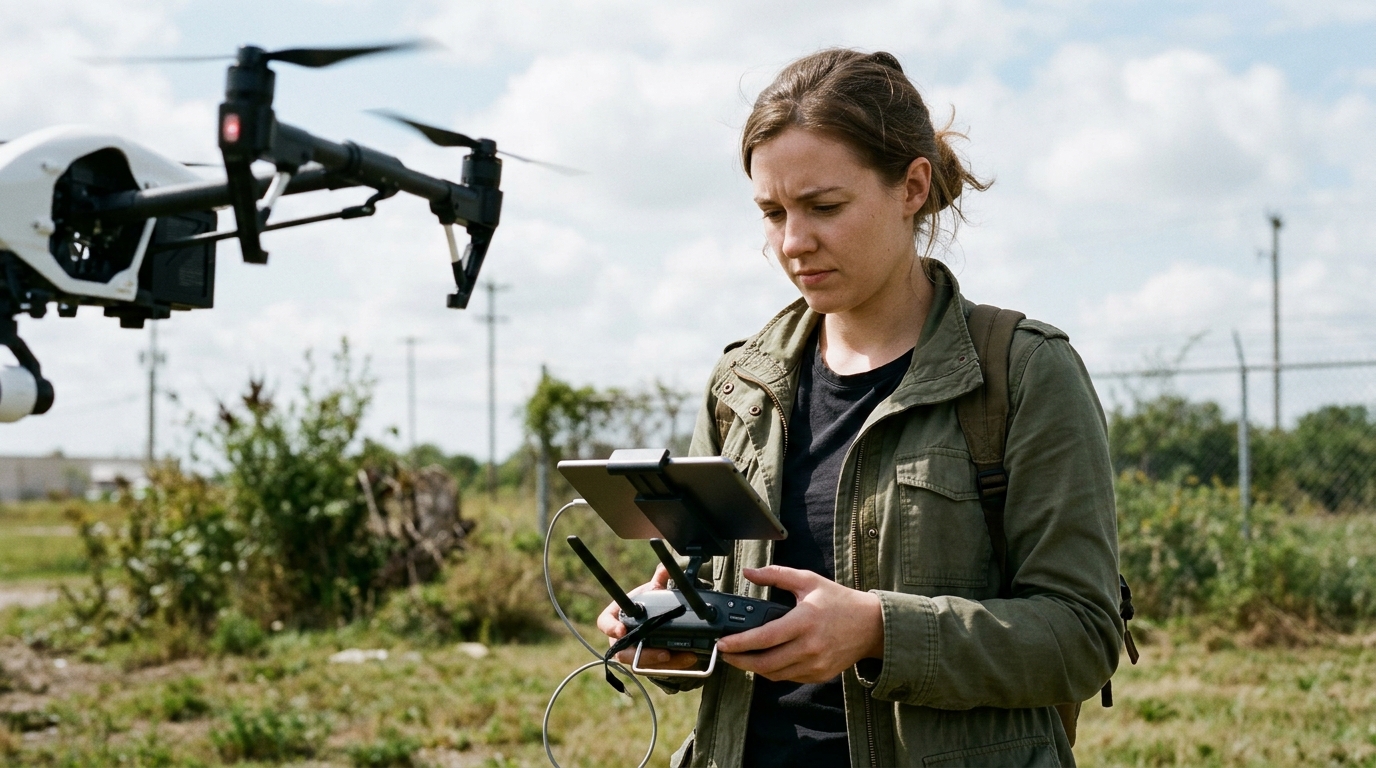
Becoming a drone pilot means passing the civil aviation regulator's test for the country you fly in, registering your aircraft, and then proving you can deliver usable data — survey images, inspection footage, mapping files — not just keep an aircraft in the air. In the United States that is the FAA's Part 107 remote pilot certificate; in the UK it is usually the CAA's General VLOS Certificate; in Canada, a Transport Canada basic or advanced certificate; in the EU, EASA open-category certificates.
The certificate is the fast part. Most people spend weeks on study and months afterwards building a portfolio and the client-facing skills that turn a licence into paid work.
Step-by-Step Path to Entry
Work out which regulator governs the airspace you intend to fly in, then follow that route — the steps are broadly parallel.
- Confirm you meet the eligibility rules. Under FAA Part 107 you must be at least 16 to qualify for a remote pilot certificate, and you need that certificate — or direct supervision by a holder — to operate the controls (Federal Aviation Administration, undated). There is no upper age limit, and you must be proficient in English and in a physical and mental condition to operate a small UAS safely (Drone Pilot Ground School, undated). The UK CAA lists the minimum age for the General VLOS Certificate (GVC) as 'None' (UK Civil Aviation Authority, undated).
- Register and take the entry-level online training. UK applicants must complete the Open category online training material and assessment and obtain a Flyer ID through the CAA's Drone and Model Aircraft Registration System (DMARES) before being accepted for GVC training (UK Civil Aviation Authority, undated). EU pilots take the EASA A1/A3 online training and theory exam, mandatory for the A1, A2 and A3 open subcategories (Drone Flight Academy, undated).
- Pass the knowledge test for your jurisdiction. In the US, sit the initial aeronautical knowledge test at one of roughly 800 FAA-approved knowledge testing centers (Drone Pilot Ground School, undated). It is a standalone certification needing no flight training or existing pilot certificate, costs about $175, and requires 70% to pass (The Drone U, undated). Holders of a Part 61 pilot certificate can instead complete a flight review in the previous 24 months plus the FAA's small UAS online training course (Federal Aviation Administration, undated). In Canada, pass the Small Basic Exam online for a Pilot Certificate – Basic Operations (Transport Canada, undated).
- Complete the practical or security requirement. US applicants receive a temporary remote pilot certificate on successful TSA security vetting, which the FAA anticipates issuing within 10 business days of a completed application (Federal Aviation Administration, undated). UK GVC trainees pass both a theoretical assessment and a practical flight assessment at a CAA-approved RAE(PC) (UK Civil Aviation Authority, undated). Canadian advanced operations require the advanced online exam, a flight review, then application through the Drone Management Portal (Transport Canada, undated).
- Register every aircraft you fly. Part 107 operators must register each drone at faadronezone.faa.gov, at $5 per aircraft (Federal Aviation Administration, undated).
- Get supervised flight hours in a named entry role. Apply as a visual observer or UAS field assistant on a survey or inspection crew, an apprentice at a land surveying or utility inspection firm, or a junior drone operator with an agricultural services contractor. Part 107 lets you operate the controls under the direct supervision of a certificate holder, which makes assistant work a genuine training route (Federal Aviation Administration, undated).
- Stay current and learn the reporting rules. Part 107 holders complete free online recurrent training every 24 calendar months (droneauthority.org, undated) and must report any operation causing serious injury, loss of consciousness, or property damage of at least $500 to the FAA within 10 days (Federal Aviation Administration, undated). A Canadian certificate does not expire, but the pilot must keep their skills up to date (Transport Canada, undated).
Education and Certification Options
No four-year degree is required on any route below. What differs is whether something is legally required to fly commercially or merely preferred by clients.
| Route | Typical duration | Approximate cost | Required or preferred |
|---|---|---|---|
| FAA Part 107 knowledge test (US), self-study | 2-6 weeks part-time study, test in one session | About $175 for the test (The Drone U, undated) | Required to operate the controls commercially, unless directly supervised by a holder (FAA, undated) |
| Online Part 107 ground school course | 2-6 weeks alongside self-study | Course fee set by the provider; test fee separate | Preferred, not required — the test needs no flight training prerequisite (The Drone U, undated) |
| Part 61 pilot certificate route (US) | Flight review within previous 24 months plus a short FAA online course | Flight review fee set by the flight school | Alternative to the knowledge test for already-certificated pilots (FAA, undated) |
| US drone registration | Minutes, online | $5 per aircraft (FAA, undated) | Required for every drone flown under Part 107 |
| UK Flyer ID and Open category online assessment | A few hours | Fee set by the CAA registration system | Required before GVC training is accepted (UK CAA, undated) |
| UK General VLOS Certificate at a CAA-approved RAE(PC) | Short course plus a practical flight assessment | Course fee set by the approved entity | Required for operations beyond the Open category; widely preferred by UK clients (UK CAA, undated) |
| Transport Canada Pilot Certificate – Basic Operations | Online Small Basic Exam; study time varies | Exam fee set by Transport Canada | Required for basic operations (Transport Canada, undated) |
| Transport Canada Advanced Operations | Online exam plus an in-person flight review | Flight review fee set by the reviewer | Required for advanced operations; a Level 1 complex tier exists above it (Transport Canada, undated) |
| EASA A1/A3 online training and theory exam (EU) | A few hours to a few days | Fee set by the national authority or provider | Mandatory for the A1, A2 and A3 open subcategories; A2 needs an additional certificate (Drone Flight Academy, undated) |
Add-ons employers prefer rather than require: photogrammetry and mapping software skills, thermography training for inspection work, and a surveying, construction or video-editing background so you can deliver the finished product, not raw footage.
Are You Ready? Readiness Checklist
Check these before you book a test or pay for a course. Each is something you can verify about yourself today.
- You meet the age rule: at least 16 for an FAA Part 107 remote pilot certificate (Federal Aviation Administration, undated), while the UK CAA lists no minimum age for the GVC (UK Civil Aviation Authority, undated).
- You are proficient in English and in a physical and mental condition to operate a small UAS safely — a stated Part 107 requirement, with no upper age limit (Drone Pilot Ground School, undated).
- You can pass a security background check: US temporary certificates are issued only after successful TSA security vetting (Federal Aviation Administration, undated).
- You have budgeted entry costs: about $175 for the Part 107 knowledge test (The Drone U, undated) plus $5 per aircraft registered at faadronezone.faa.gov (Federal Aviation Administration, undated).
- You can score 70% or higher on airspace classification, sectional charts, weather reports, loading and performance, and operating rules — the knowledge test pass mark (mzeroa.com, undated). Sit a practice test cold before committing.
- You can commit to staying current: free online recurrent training every 24 calendar months under Part 107 (droneauthority.org, undated), or maintaining skills under a Canadian certificate that does not expire (Transport Canada, undated).
- You are willing to handle incident paperwork: reporting any operation causing serious injury, loss of consciousness, or at least $500 of property damage to the FAA within 10 days (Federal Aviation Administration, undated).
- You can work outdoors in wind, cold and glare, carry cases and batteries across uneven sites, stand for hours maintaining visual line of sight, and accept jobs cancelled by weather at short notice. Site-access and insurance requirements differ by employer and country — confirm what your intended clients ask for.
Typical Timeline From Start to First Job
Elapsed times assume part-time study alongside existing work. Processing times differ by country and by how busy the authority is.
- Week 0-2: Register and take the entry-level online steps. Open an account with the relevant authority, obtain a Flyer ID through DMARES in the UK (UK Civil Aviation Authority, undated), or complete the EASA A1/A3 online training and theory exam in the EU (Drone Flight Academy, undated). Start logging practice flights in legal locations.
- Month 0-2: Study for the knowledge test. Work through airspace, charts, weather, loading and operating rules until you clear 70% consistently on practice tests (mzeroa.com, undated). Part 61 certificate holders book a flight review instead and take the FAA's small UAS online training course (Federal Aviation Administration, undated).
- Month 1-3: Pass the exam and any practical element. Sit the initial aeronautical knowledge test at an FAA-approved testing center (Drone Pilot Ground School, undated); or complete the GVC theoretical and practical flight assessments at a CAA-approved RAE(PC) (UK Civil Aviation Authority, undated); or pass the Small Basic Exam, or the advanced exam plus flight review, through Transport Canada's Drone Management Portal (Transport Canada, undated).
- Month 2-4: Receive your certificate and register your aircraft. US applicants get a temporary remote pilot certificate once TSA vetting is complete, anticipated within 10 business days of a completed application (Federal Aviation Administration, undated). Register each drone for $5 before flying commercially (Federal Aviation Administration, undated).
- Month 3-9: Build a portfolio and work supervised. Take visual observer or UAS field assistant shifts, shoot low-cost jobs for local surveyors, roofers or sports clubs, and learn one delivery skill properly — orthomosaic mapping, thermal roof inspection, or edited aerial video. Keep a flight log of hours, aircraft and conditions.
- Month 6-18: Land a first titled role. Realistic first jobs include drone operator, UAS survey technician, aerial inspection pilot, or remote pilot (agriculture) with a spraying or crop-scouting contractor. Many pilots take subcontract flying days as a sole trader before moving into a staff role.
Frequently asked questions
Can I become a drone pilot without a four-year degree?
Yes. The FAA's Part 107 knowledge test is a standalone certification requiring no flight training and no existing pilot certificate (The Drone U, undated). The UK GVC route runs through a CAA-approved RAE(PC) course and flight assessment (UK Civil Aviation Authority, undated). Degrees in surveying, geomatics or film can help you win certain contracts, but no regulator requires one.
How is drone pilot work usually paid?
Most pilots are paid one of three ways: a day rate as a freelance subcontractor, an hourly rate, or a salary in a staff role at a survey, utility, agriculture or media employer. Deliverable-based pricing, charging for the processed map or edit rather than flight time, is also common. National and regional rates differ, so check your country's official statistics agency for current published figures.
How long is a drone pilot certificate valid?
It depends on the regulator. Part 107 holders complete free online recurrent training every 24 calendar months (droneauthority.org, undated), on a 24-month recurrent aeronautical knowledge cycle (Drone Pilot Ground School, undated). A Canadian drone pilot certificate does not expire, though Transport Canada requires pilots to keep their skills up to date (Transport Canada, undated). Check your own authority before each contract.
Do I need a different certificate for more complex flying?
Usually yes. Canada has three certificate types — basic, advanced, and Level 1 complex — and which you need depends on what, how and where you want to fly (Transport Canada, undated). In the EU, the A1/A3 certificate covers those open subcategories while the A2 subcategory requires an additional certificate (Drone Flight Academy, undated). Confirm the category before quoting for a job.
Sources
- Federal Aviation Administration (FAA) — Small Unmanned Aircraft Systems (UAS) Regulations (Part 107)
- UK Civil Aviation Authority (CAA) — General VLOS Certificate (GVC)

Written by
Priya tracks wages, layoffs, and the slow shifts in what counts as a stable job. She writes for readers trying to make sense of numbers that rarely match their own experience.


