
How to Prepare for a Phone Interview
A phone screen is short, scheduled and judged entirely on your voice, so the real work is logistics, paperwork on the desk and practice out loud.
Quick answer
- One week before, read the job advertisement line by line and write out answers to common questions with real examples (CareerOneStop, U.S. Department of Labor, undated).
- Three days before, record yourself answering likely questions and have someone practice-interview you by phone (CareerOneStop, U.S. Department of Labor, undated).
- The day before, print your resume, cover letter and the job advertisement so all three sit on the desk during the call (Florida State University Career Center, undated).
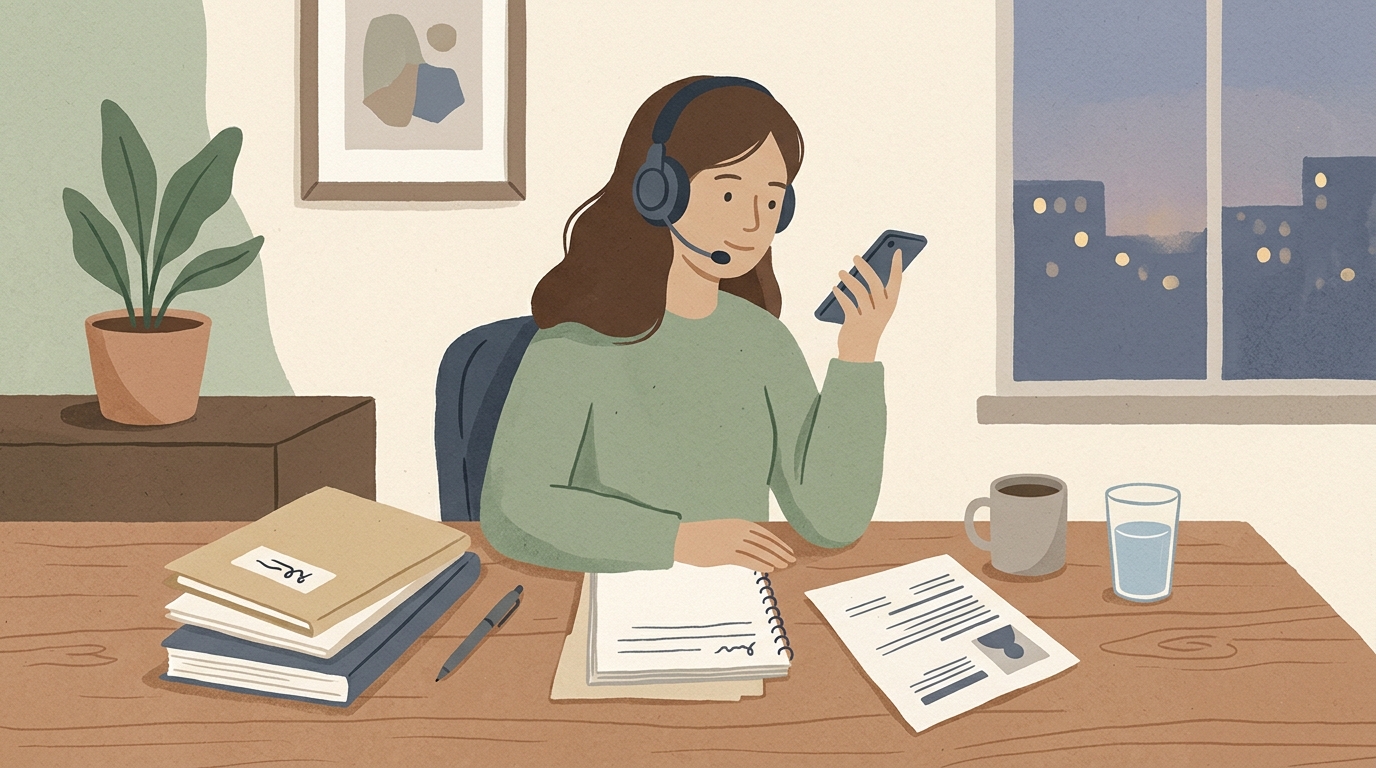
Preparing for a phone interview comes down to three things: confirming the logistics, setting up a quiet room with your documents in front of you, and rehearsing your answers out loud before the day. Employers usually call at a prearranged time, so you should clarify the time zone, the expected length, the phone number and who will be conducting the interview (Florida State University Career Center, undated).
The guide below gives you a timeline from one week out, a checklist you can tick off on the morning, and scripts for the moments that catch people out.
Your Prep Timeline
- As soon as the invitation arrives (10 minutes). Reply and confirm the details in writing. Employers typically email a video conference link, text a number to call, or schedule a time to ring you (CareerOneStop, U.S. Department of Labor, undated), so pin down the time zone, the length of the interview, the phone number and the name of the person conducting it (Florida State University Career Center, undated). Put it in your calendar with the interviewer's name in the title.
- One week before (about 90 minutes). Review the job description in full, read the employer's own website — the about page, recent news items and any annual or investor update — and write out answers to common interview questions with specific examples attached (CareerOneStop, U.S. Department of Labor, undated). Mark the requirements the advertisement repeats; those are what the screen is testing.
- Five days before (45 minutes). Build a short list of your accomplishments and a short list of questions about the job and the organisation to ask at the end (Florida State University Career Center, undated). Keep each accomplishment to a single line with a concrete result in it.
- Three days before (60 minutes). Do several practice runs: have someone practice-interview you by phone and record yourself so you can review the playback (CareerOneStop, U.S. Department of Labor, undated). Listen specifically for filler words — "ah", "err", "hum", "uhhh" and "like" are worth cutting, along with smoking, gum, eating or drinking during the real call (Florida State University Career Center, undated).
- Two days before (30 minutes). Research salary information before the call so you are ready if it comes up, and do not raise it yourself before the employer does (Florida State University Career Center, undated). Use your country's national statistics or labour market agency for occupational pay data, then compare current advertisements for the same job title in your city and write down the resulting range. An employer may ask about your current compensation to check that their budget fits your expectations (Indeed Career Guide, 2026).
- The day before (30 minutes). Print your resume, cover letter and the job advertisement (Florida State University Career Center, undated). Make sure your phone and computer are fully charged and save any passwords you might need in an easy-to-reach spot (CareerOneStop, U.S. Department of Labor, undated). Use a landline if you have one, to guard against dropped calls, and turn off call waiting (Florida State University Career Center, undated).
- Morning of, 30 minutes before (30 minutes). Set up the room, close the door so kids, pets or a television cannot interrupt, and put a clock where you can see it to monitor the time remaining (Florida State University Career Center, undated). Then be sitting by the phone at least 10 to 15 minutes early so you do not miss the call (Florida State University Career Center, undated).
Day-Of Checklist
- Printed resume, cover letter and job advertisement laid out on the desk in that order (Florida State University Career Center, undated).
- Accomplishment list, your written questions about the role, a calendar, and pen and paper beside them (Florida State University Career Center, undated).
- Interviewer's name, job title and phone number written at the top of the notepad.
- Landline chosen if you have one and call waiting switched off (Florida State University Career Center, undated); phone and computer fully charged as backup (CareerOneStop, U.S. Department of Labor, undated).
- Door closed, television off, pets in another room, and anyone else at home told the call window (Florida State University Career Center, undated).
- Clock or watch positioned in your eyeline (Florida State University Career Center, undated).
- Notifications muted on every device, extra applications and browser tabs closed, passwords saved in an easy-to-reach spot (CareerOneStop, U.S. Department of Labor, undated).
- Gum, food and drinks cleared off the desk before the call starts (Florida State University Career Center, undated).
- A plain-coloured top on rather than a patterned shirt, in case the call turns into video (CareerOneStop, U.S. Department of Labor, undated).
- Seated by the phone 10 to 15 minutes before the agreed start time (Florida State University Career Center, undated).
What to Say in Tricky Moments
Answering the call
"Good morning, Dani Okafor speaking." Then, once they introduce themselves: "Thanks for calling, Ms Harper — I've got the job advertisement in front of me and I'm ready when you are."
"Tell me about yourself"
"I'm a scheduling coordinator. Our clinic was losing bookings to no-shows, so I was asked to fix it. I set up SMS reminders and a waitlist in our booking software, and no-shows dropped sharply."
When they call at a bad moment
"Thank you for the opportunity — I'm away from my desk right now. May I call you back in about ten minutes from somewhere quiet?" (Florida State University Career Center, undated)
When salary comes up first
"I'd rather understand the role properly before we talk numbers. Do you have a range budgeted for this position?" If pressed, give the range you researched and say where it came from.
Buying a few seconds instead of filling the gap
"That's a good question — let me take a moment to pick the right example." Then pause silently. Silence reads better on a phone line than "um" or "like".
Closing the call
"Before we finish, could you tell me where I stand and what the next step is — a second phone interview, an on-site visit, and roughly what timeline?" (Florida State University Career Center, undated)
Frequently asked questions
How early should I be ready by the phone?
Be sitting by the phone at least 10 to 15 minutes before the agreed time so you do not miss the employer's call (Florida State University Career Center, undated). Use that window to close the door and lay out your printed documents.
What should I do in the first hour after the call?
Write down what you learned while it is fresh — which points clearly interested the employer, and which questions were hardest to answer (Florida State University Career Center, undated). Those notes are your prep sheet for the next round.
Do I need to send a thank-you after a phone interview?
Yes. Send a letter of appreciation, either as an email or a handwritten note, within 24 hours of the call (Florida State University Career Center, undated). Reference one specific thing the interviewer said so it does not read as a template.
What do I do if the line drops mid-interview?
Call back immediately on the number they gave you and apologise once, in a single sentence. To reduce the risk, use a landline if you have one and switch off call waiting before the call (Florida State University Career Center, undated).
Sources
- Florida State University Career Center — Preparing for a Telephone Interview
- CareerOneStop (U.S. Department of Labor) — Virtual interviews

Written by
Wyatt covers work outside the office: construction, logistics, repair, and the people who keep things running. He's skeptical of career advice that assumes everyone sits at a desk.


