How to Switch to a Career in Speech-Language Pathology, Step by Step
A route map for career changers: prerequisite coursework, a CAA-accredited master's, the Clinical Fellowship, and the licence that lets you practise.
Quick answer
- Total timeline: about 4 to 6 years from first prerequisite course to independent practice if your bachelor's is in another field, and closer to 3 to 4 years if it is already in communication sciences and disorders.
- Total cost sits in 4 buckets: leveling coursework, master's tuition, the certification exam, and the ASHA CCC-SLP application fee, which differs for certification with membership versus without (American Speech-Language-Hearing Association, undated), plus an annual renewal charged at different rates for certified members and non-members.
- Biggest risk: an income gap of roughly 24 to 30 months during full-time study — build a savings runway of at least 12 months of core living expenses before you resign.
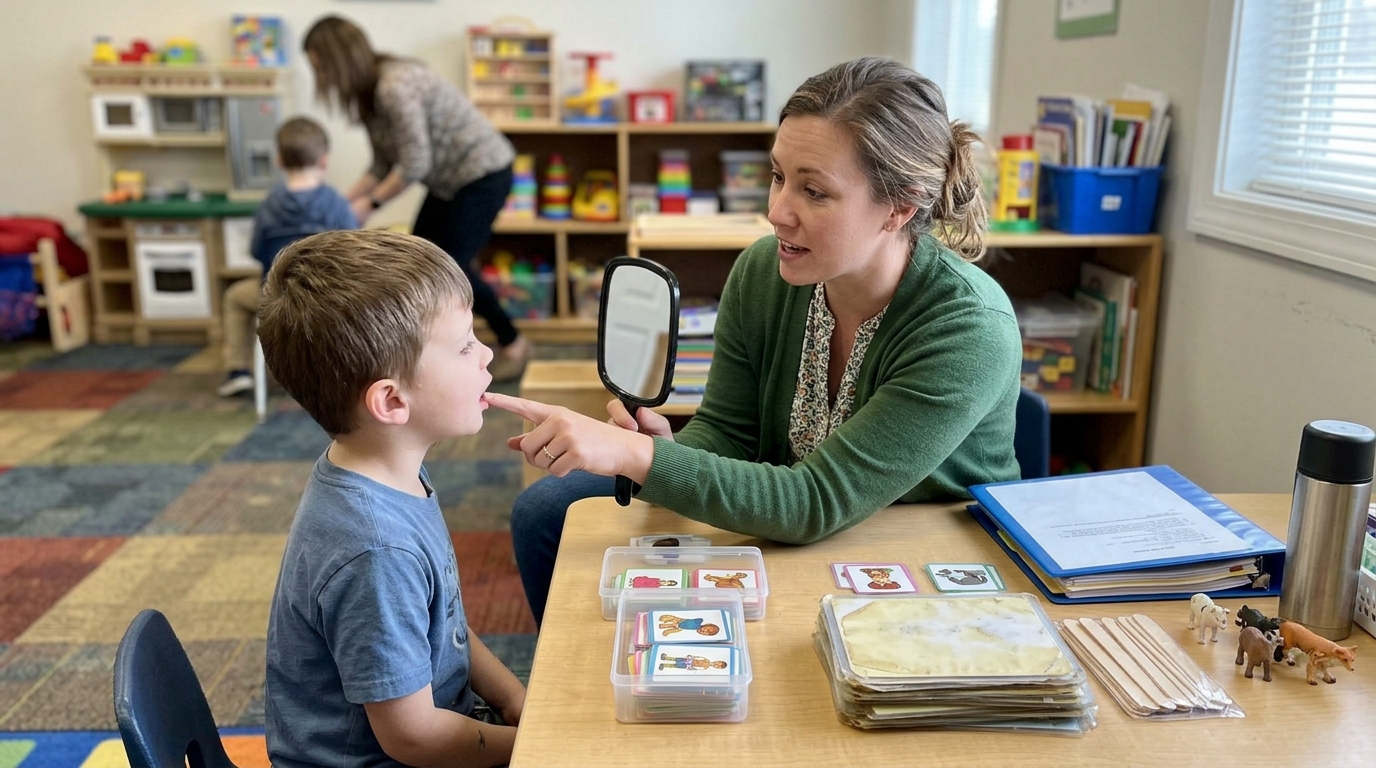
Moving into speech-language pathology is a multi-year change, not a short retrain. In the United States the usual entry-level qualification is a master's degree, and every state requires speech-language pathologists to be licensed, with requirements that vary by state (U.S. Bureau of Labor Statistics, 2025). Certification as a CCC-SLP additionally requires a master's from a program accredited by the Council on Academic Accreditation in Audiology and Speech-Language Pathology (American Speech-Language-Hearing Association, undated).
If you are starting from a bachelor's degree in another field, plan on roughly four to six years from your first prerequisite class to practising independently. Outside the US the title, regulator and training route differ — check your own country's regulator before you follow any of the timings below.
The Transition Timeline
Month ranges assume you hold a bachelor's degree in an unrelated field and study prerequisites part-time while working. They overlap on purpose: applications happen while coursework is still running. Confirm actual lengths with each institution, since a master's in this field takes a set length of postbaccalaureate study published by the program (U.S. Bureau of Labor Statistics, 2025).
- Months 1-3 — Still employed, researching. Keep your salary and benefits. Shadow clinicians in at least two settings (school, hospital, early intervention, skilled nursing), read the licensure rules for the state you intend to work in, and compare your transcript against admission prerequisites.
- Months 4-12 — Prerequisites, still employed. Post-baccalaureate leveling or certificate programs exist for people who hold a bachelor's in another field and want to apply to graduate study in speech-language pathology (Lehman College, CUNY, undated). Most career changers take these part-time, evenings or online.
- Months 10-16 — Applications and the money plan. Apply only to programs accredited by the Council on Academic Accreditation in Audiology and Speech-Language Pathology, since CCC-SLP certification requires a master's from a CAA-accredited university (American Speech-Language-Hearing Association, undated). In parallel, set your resignation date and savings target.
- Months 17-40 — Graduate study. Most people leave their job or drop to part-time hours here. Placements run alongside coursework, and supervised clinical experience gained during the program counts toward licensure (U.S. Bureau of Labor Statistics, 2025).
- Months 38-44 — Exam, graduation and paperwork. Certification requires graduating from an accredited program, passing an exam, and completing a fellowship supervised by a certified speech-language pathologist (U.S. Bureau of Labor Statistics, 2025). State licence and ASHA applications run at the same time.
- Months 44-56 — Clinical Fellowship. Paid work under a mentor who holds the CCC. ASHA sets a minimum duration and total hours, and the experience is divided into three segments, each one-third of the total, with required observation and mentorship activities in each (American Speech-Language-Hearing Association, undated). There is also a set window from initiating certification in which you must begin and complete it.
- Months 56-68 — First year in the new role. You hold the licence. Caseload and pay structure depend on setting: school contracts are usually salaried on an academic-year calendar, hospital and skilled nursing roles are often hourly, home health frequently per-visit. For current US wage data, check the Bureau of Labor Statistics Occupational Outlook Handbook and OEWS tables; elsewhere use your national statistics agency.
Step-by-Step Plan
- Months 1-3, still employed. Pull your undergraduate transcript and have an admissions adviser mark which prerequisites you are missing, before you spend money on anything else.
- Months 1-3, still employed. Contact the licensure board in the state where you plan to work. Information on state licensing board requirements is available from CareerOneStop, and for specific requirements you contact the state's medical or health licensure board directly (U.S. Bureau of Labor Statistics, 2025). Requirements vary by state, so a colleague's answer from another state is not your answer.
- Months 1-3, still employed. Arrange observation in two settings. Ask practising clinicians about the documentation load, not just the therapy.
- Months 4-12, still employed. Enrol part-time in post-baccalaureate leveling coursework (Lehman College, CUNY, undated). Keep your income and benefits running — this is the cheapest stage and the easiest to abandon if you change your mind.
- Months 10-16, still employed. Apply only to CAA-accredited master's programs (American Speech-Language-Hearing Association, undated), and ask your employer about reduced hours or unpaid leave before assuming you must resign.
- Months 17-40, after leaving or on reduced hours. Complete the master's and its placements. Keep a running log of supervised hours; both the state board and ASHA will want it, and reconstructing it later is painful.
- Months 38-44, after leaving. Sit the certification exam and submit the state licence and ASHA applications. The CCC-SLP application fee differs depending on whether you apply with membership or without (American Speech-Language-Hearing Association, undated), so read the current fee schedule first.
- Months 44-56, after leaving. Secure a Clinical Fellowship post and confirm in writing that your mentor holds the CCC. Plan the three required segments with your mentor at the start, because each must carry its own observation and mentorship activities (American Speech-Language-Hearing Association, undated).
- Months 56-68. Budget for annual renewal, charged at different rates for certified ASHA members and certified non-members (American Speech-Language-Hearing Association, undated), and decide whether year one is in schools, medical or early intervention — that shapes your pay structure more than experience does.
Where your previous job helps. Elementary teachers already run small-group sessions, write goals and handle parent meetings. Nurses and nursing aides know charting, infection control and how a care team works. Retail and restaurant managers have scheduled staff, de-escalated upset people and hit productivity targets. Special education paraprofessionals and SLP assistants usually need the fewest prerequisites of anyone. Say this explicitly in your application essay.
Before You Quit Your Job Checklist
Each item is a yes or no. If any answer is no, you are not ready to resign.
- Savings runway. At least 12 months of core living expenses in a separate account for full-time study, or at least 6 months if you keep working part-time — checked against a real budget.
- Admission offer in hand. A written offer from a program accredited by the Council on Academic Accreditation in Audiology and Speech-Language Pathology (American Speech-Language-Hearing Association, undated). Not an application submitted — an offer.
- Prerequisites signed off. An adviser has confirmed in writing that no leveling coursework is outstanding.
- Licensure requirements confirmed. You hold the written requirements from your state's board, obtained through that board or via CareerOneStop (U.S. Bureau of Labor Statistics, 2025), including the supervised-experience and exam rules.
- Certification decision made. You know whether your state requires the CCC or only the licence. Holding the Certificate of Clinical Competence is voluntary; state licensure is mandatory to practise (American Speech-Language-Hearing Association, undated). Many employers ask for the CCC anyway.
- Backup income named. A specific second income for the study years: per-diem work in your current field, tutoring, or, where your state allows it, the assistants pathway, which carries its own initial certification fee and annual renewal fee (American Speech-Language-Hearing Association, undated).
- Fee budget printed. The current ASHA fee schedule, the exam fee and published tuition in one document, totalled.
- Household agreement in writing. Everyone affected has agreed to a defined income gap — commonly 24 to 30 months — and to who covers what.
- Fellowship market checked. At least 5 employers within commuting distance that hire Clinical Fellows supervised by CCC-holding mentors.
On age. Career changers in their 40s and 50s regularly enter these programs, and the honest question is not capability but whether the sums repay in time: weigh the 4- to 6-year runway against your intended retirement date. Employment of speech-language pathologists is projected to grow much faster than the average for all occupations from 2025 to 2035, with openings projected each year on average over the decade (U.S. Bureau of Labor Statistics, 2025) — that demand is why cohorts and employers take on entrants well past their twenties. Expect your fellowship mentor to be younger than you.
Certifications and Costs
Fees change, and tuition differs enormously between institutions and between in-state and out-of-state status. Treat this as a list of what to price, then get current figures from ASHA, your state board and each program.
| Requirement | Provider or Path | Cost | Time to Complete |
|---|---|---|---|
| State licensing requirements lookup | Your state's medical or health licensure board; information also from CareerOneStop (U.S. Bureau of Labor Statistics, 2025) | Free | An afternoon |
| Observation and informational interviews | Local clinicians in schools, hospitals, early intervention | Free, aside from travel | 10-20 hours over 1-3 months |
| Prerequisite coursework | Post-baccalaureate leveling or certificate program for holders of a bachelor's in another field (Lehman College, CUNY, undated) | Per-credit tuition; check the published rate | Usually 2-4 part-time semesters |
| Master's degree | University program accredited by the Council on Academic Accreditation in Audiology and Speech-Language Pathology (American Speech-Language-Hearing Association, undated) | Largest single cost; compare published and in-state tuition | A set length of postbaccalaureate study set by the program (U.S. Bureau of Labor Statistics, 2025) |
| Certification exam | Required alongside graduating from an accredited program and completing a supervised fellowship (U.S. Bureau of Labor Statistics, 2025) | Published exam fee — check the current schedule | One test date, plus 6-10 weeks of study |
| Clinical Fellowship | Paid post under a CCC-holding mentor; minimum duration and hour total set by ASHA, in three equal segments (American Speech-Language-Hearing Association, undated) | Paid employment, not a cost | ASHA's stated minimum; begin and complete within the set window from initiating certification |
| CCC-SLP certification application | American Speech-Language-Hearing Association | Separate fees for certification with membership and without (American Speech-Language-Hearing Association, undated) | Processing time after the fellowship |
| Annual certification renewal | American Speech-Language-Hearing Association | Different annual rates for certified members and certified non-members (American Speech-Language-Hearing Association, undated) | Annual |
| Assistants pathway (SLPA), interim or backup | American Speech-Language-Hearing Association, where your state permits it | Initial certification fee plus annual renewal fee (American Speech-Language-Hearing Association, undated) | Shorter than the master's route; check state rules |
Frequently asked questions
I'm 48. Is it realistic to start now?
Realistic, but run the arithmetic first. From the Months 1-3 research stage to the end of the Clinical Fellowship is commonly 4 to 6 years, so starting at 48 means practising independently around 52 to 54. Employment is projected to grow much faster than the average for all occupations from 2025 to 2035, with openings projected each year on average over the decade (U.S. Bureau of Labor Statistics, 2025). For people in their late 40s and 50s the real constraint is the 12-month savings runway on the checklist, not the hiring market.
Can I keep my job while I study?
Usually through the prerequisite stage at Months 4-12, and rarely through the master's itself. Placements run on weekday hospital and school schedules, which is why the timeline assumes you leave or drop to part-time hours around Month 17 and face an income gap of roughly 24 to 30 months. Tick the 'backup income named' checklist item before you resign — per-diem work in your current field is often easiest to arrange.
Do I need the CCC-SLP if my state already licenses me?
Holding the Certificate of Clinical Competence is voluntary, while state licensure is mandatory to practise, and licensure requirements vary by state (American Speech-Language-Hearing Association, undated; U.S. Bureau of Labor Statistics, 2025). That makes the 'certification decision made' checklist item a real decision, since the CCC carries an application fee and an annual renewal fee that differ for members and non-members. Many employers ask for it regardless, so check job adverts in your area before skipping it.
Will I earn less than I do now?
Assume a pay cut during the Clinical Fellowship at Months 44-56, since fellows are paid as supervised new entrants. Pay afterwards depends on setting: school posts are typically salaried on an academic-year calendar, hospital and skilled nursing posts often hourly, home health frequently per visit. For current US figures check the Bureau of Labor Statistics Occupational Outlook Handbook and OEWS wage tables; outside the US, use your national statistics agency.
Sources
- American Speech-Language-Hearing Association (ASHA) — FAQs: Certification in Speech-Language Pathology
- American Speech-Language-Hearing Association (ASHA) — A Guide to the ASHA Clinical Fellowship Experience
Written by
Noor writes personal essays and interviews about career changes, burnout, and starting over. She's interested in the stories people tell themselves about what a job is supposed to mean.