Is Becoming a Wind Turbine Technician a Good Career Change?
Months of training rather than years, a tower climb before most people finish their coffee, and a trade where published wage scales are easy to look up.
Quick answer
- Entry is a postsecondary nondegree award, not a degree (U.S. Bureau of Labor Statistics, 2025); among current technicians 34.4% hold a certificate and 28.7% finished at high school (O*NET 31.0 database via BLS Employment Projections 2025-2035).
- Plan 6 to 18 months end to end: a certificate of about one year full-time, plus GWO Basic Safety Training, which takes 5 days (gotradeschools.com, 2026) — and budget for an income gap roughly the length of your course, or close to zero on a paid apprenticeship such as the 3-year Rampion Windfarm scheme (RWE).
- Fitness is the real gate, not age: you need to climb towers repeatedly and carry parts weighing 50 pounds or more (Trade-schools.net citing BLS, 2025).
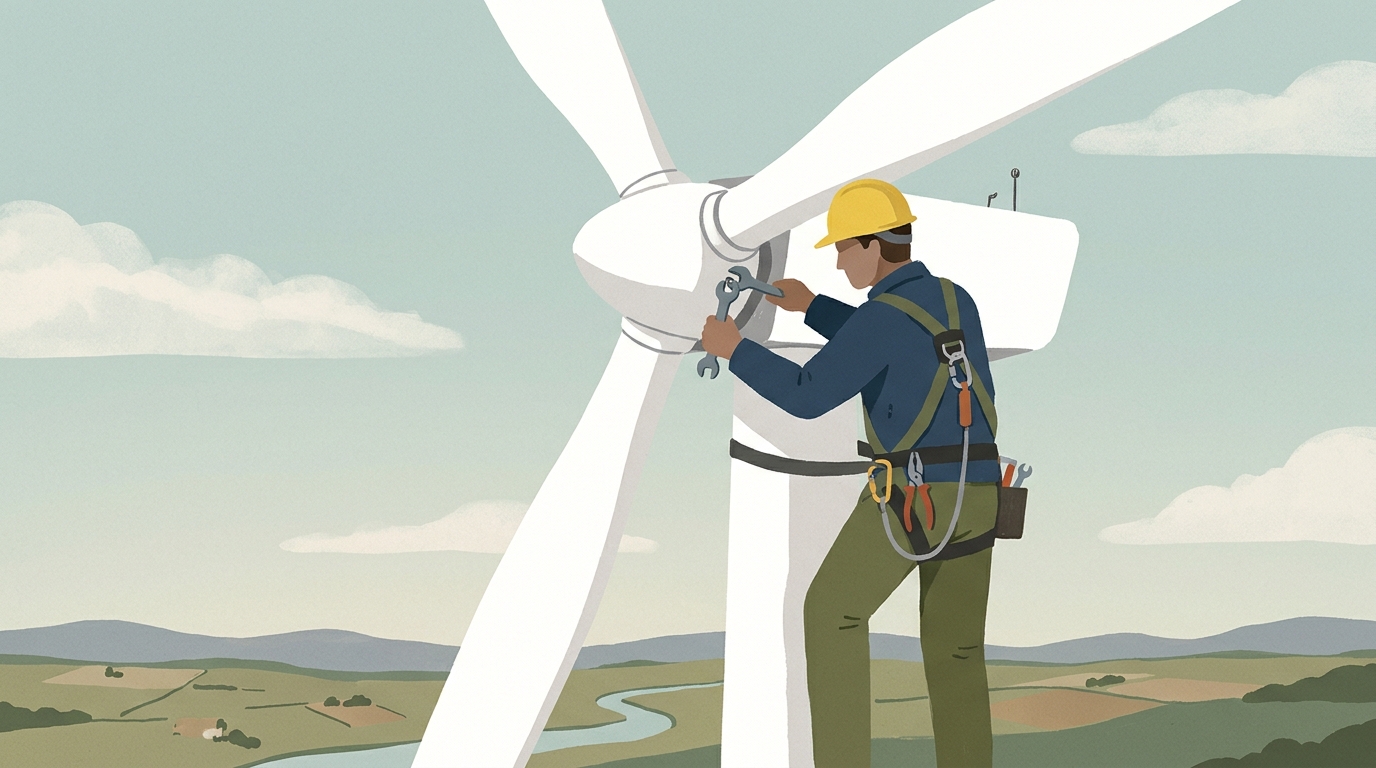
For a lot of people switching in their 30s, 40s and 50s, wind turbine technician work is a realistic change: the usual entry requirement is a postsecondary nondegree award rather than a degree (U.S. Bureau of Labor Statistics, 2025), and college certificate programmes run in months — about one year full-time at Spokane Community College, or roughly 28 to 32 weeks part-time for the George Brown College Wind Turbine Technician Certificate in Canada.
The tradeoffs are physical and domestic rather than academic. You climb towers, carry tools and parts that can weigh 50 pounds or more (Trade-schools.net citing BLS, 2025), and most technicians surveyed by O*NET usually work more than 40 hours a week — often away from home.
What the Work Actually Involves
A scheduled maintenance day usually starts on the ground. Expect 20 to 30 minutes of toolbox talk, weather check, lockout/tagout and harness inspection before anyone goes up, then a climb or lift ride of 10 to 30 minutes depending on the tower and whether the service lift is working.
Once you are in the nacelle, a six-month service is typically 3 to 5 hours of methodical work: torque checks on bolts, greasing bearings, changing filters and oil samples, checking brake pads, blade and hub inspection, and photographing anything that needs a follow-up. You work in pairs, in a space the size of a small van, at height, in whatever temperature the day gives you.
Fault work is different and less predictable. ONET lists diagnosing generator and control-system problems and testing electrical components with multimeters and oscilloscopes among the core tasks of the job (ONET OnLine, U.S. Department of Labor). A single fault call can be 1 to 4 hours of tracing a converter fault, swapping a sensor or resetting a pitch system — and sometimes a second climb after lunch because the first fix did not hold.
The last 30 to 60 minutes of the day goes into the maintenance system: work orders closed, parts used, photos uploaded, defects raised. Add travel. Site-based technicians may drive 30 to 90 minutes between turbines; travelling technicians work rotations away from home. In O*NET's survey of people doing the job, a majority usually work more than 40 hours a week, and storm or outage season pushes that higher.
Who This Career Change Suits
- Diesel or heavy equipment mechanics — you already diagnose hydraulics, gearboxes and lubrication systems, which is most of a turbine drivetrain service.
- Electricians and industrial sparks — the control and converter side of the job is electrical fault-finding with multimeters and oscilloscopes, exactly as O*NET describes it.
- Ex-military vehicle, avionics or marine engineering technicians — procedure-driven maintenance, permit systems and working in pairs transfer almost directly, and service leavers in their 30s and 40s are a common intake for turbine training.
- Offshore, oil and gas or shipyard workers — you are already used to rotations, confined spaces, working at height and safety-critical paperwork.
- Elevator, escalator and crane technicians — height, fall-arrest equipment and machine rooms are familiar; the climb is the main novelty.
- Arborists, riggers, steeplejacks and rope access workers — comfort with harnesses and rescue drills is a genuine advantage, since you must be able to recover a casualty from a tower.
- HVAC and refrigeration engineers — reading schematics, scheduled servicing and lone decision-making on a customer site all carry over.
- People who want fewer screens and more weather — but only if you can climb repeatedly and carry tools and parts weighing 50 pounds or more (Trade-schools.net citing BLS, 2025).
Transferable Skills That Carry Over
| Prior Career | Skill | How It Applies Here |
|---|---|---|
| Diesel mechanic (transport) | Gearbox, hydraulic and lubrication servicing | Drivetrain, pitch and yaw systems are serviced on the same logic; torque specs and oil sampling are daily work |
| Electrician (construction) | Schematic reading, safe isolation, fault tracing | Diagnosing generator and control problems and testing components with multimeters and oscilloscopes (O*NET OnLine) |
| Military technician (defence) | Permit-to-work discipline, maintenance logs | Lockout/tagout, work orders and audit trails are central to turbine O&M |
| Offshore roustabout or deck crew (energy) | Rotation working, confined space, working at height | Prepares you for travelling technician roles and for GWO Basic Safety Training, which takes 5 days (gotradeschools.com, 2026) |
| HVAC technician (building services) | Customer-site autonomy, scheduled servicing | Most turbine work is planned maintenance on a fixed interval with a two-person crew |
| Warehouse or production supervisor (manufacturing) | Parts control, shift planning, incident reporting | Useful for site lead and scheduler roles that technicians move into after a few years |
| Farm machinery operator (agriculture) | Field repairs with limited parts, mechanical improvisation | Remote sites, long drives and fixing what you have in the van are normal |
How to Get Started
- Read the official occupational profile for your country first. In the US, the Bureau of Labor Statistics Occupational Outlook Handbook publishes the entry requirement (a postsecondary nondegree award), the median annual wage for May 2025, the number of jobs held in 2025 and the projected growth rate for 2025-2035. In the UK, Canada and Australia, use the national statistics agency and the public careers service for equivalent current figures — do not rely on recruiter blogs for pay.
- Test the physical side before you spend anything. Book a climbing wall session or a ladder-and-harness taster, and check the weight and fitness limits of the fall-arrest equipment used by training providers. Carrying 50 pounds or more up a tower is part of the job description (Trade-schools.net citing BLS, 2025).
- Decide between the college route and the apprenticeship route. Wind Turbine Technician is an approved occupation for a Registered Apprenticeship through the U.S. Department of Labor; in the UK there is a Wind Turbine Operation and Maintenance Modern Apprenticeship at SCQF Level 6, and schemes such as the Rampion Windfarm apprenticeship (RWE) run 3 years and ask for 5 GCSEs at grade 4/C or above including Science, Maths and English, leading to an NVQ Level 3 Diploma.
- Shortlist two or three real programmes and compare published duration and tuition. Examples include the Wind Turbine Technician Academy at Kalamazoo Valley Community College (full-time, with published tuition and a stated starting wage range), the Spokane Community College Wind Turbine Technology Certificate at about one year, and the George Brown College Wind Turbine Technician Certificate Program at roughly 28 to 32 weeks part-time. Confirm current fees directly with the college.
- Book GWO Basic Safety Training. It takes 5 days and must be renewed on a set cycle (gotradeschools.com, 2026). Many employers will not shortlist you without it, and some fund it after hire — ask before you pay.
- Add a recognised certification where it fits your target work. O*NET lists Small Wind Associate from the North American Board of Certified Energy Practitioners and Small Wind Installer - Level 1 from ETA International for this occupation.
- Apply across all four employer types, not just the big wind companies. Technician employment splits roughly as wind electric power generation 42%, self-employed 15%, power and communication line construction 15% and industrial machinery repair 12% (BLS OEWS data via jobdescription.org, 2025).
- Take the first travelling role you are offered if you can. Rotation and commissioning crews hire newly qualified technicians most readily; after 12 to 24 months on the road, site-based posts near home become realistic.
Costs and Time Commitment
| Item | Typical Cost | Typical Time |
|---|---|---|
| College certificate (e.g. Spokane Community College Wind Turbine Technology Certificate) | Published in-state tuition and fees — check the college's current fee page | About 1 year full-time |
| Part-time certificate (George Brown College Wind Turbine Technician Certificate Program) | Set full amount if paid upfront — confirm with the college | About 28 to 32 weeks part-time |
| GWO Basic Safety Training | Provider-set fee; sometimes employer-funded after hire | 5 days, then renewal on a fixed cycle |
| Certification exam (NABCEP Small Wind Associate or ETA International Small Wind Installer - Level 1) | Fee set by the certifying body — check its current schedule | A few weeks of study; one exam sitting |
| Apprenticeship route (US Registered Apprenticeship; UK Modern Apprenticeship at SCQF Level 6; RWE Rampion scheme) | Paid employment, so little or no tuition outlay | 3 years for the Rampion scheme; check duration for each programme |
| Income gap while training full-time | Your current take-home pay, lost | About 12 months if you train full-time; 0 to 3 months if you apprentice or train part-time while working |
| Boots, PPE, medical and driving requirements | Partly employer-supplied; budget for your own boots and medical | 1 to 4 weeks to arrange |
| Total realistic transition | Course fees plus the income gap above | 6 to 18 months from first enquiry to first paid shift, or 3 years via a full apprenticeship |
Frequently asked questions
Am I too old to start at 45 or 50?
Age itself is not the barrier in this trade; the climb is. You must be able to go up a tower repeatedly and carry tools and parts weighing 50 pounds or more (Trade-schools.net citing BLS, 2025), and harness and rescue equipment has stated weight limits. What works in your favour after 40 is that entry needs only a postsecondary nondegree award (U.S. Bureau of Labor Statistics, 2025), so retraining is a 1-year certificate rather than a 4-year degree, and employers value the mechanical and safety habits a career changer already has.
Do I need a degree or an electrical qualification first?
No. Among people doing the job, 34.4% hold a certificate, 28.7% finished at high school, 21.8% have some college and 15.1% hold an associate's degree (O*NET 31.0 database via BLS Employment Projections 2025-2035). Apprenticeship entry can be more formal — the 3-year Rampion Windfarm scheme (RWE) asks for 5 GCSEs at grade 4/C or above including Science, Maths and English — so check the specific requirements of each route.
How do I find out what the job actually pays where I live?
Pay is usually a salaried or hourly rate plus overtime, travel allowances and sometimes a rotation or offshore uplift, so the headline figure rarely tells the whole story. For the US, the Bureau of Labor Statistics publishes the median annual wage for wind turbine service technicians for May 2025 along with 10th and 90th percentile figures, and the Kalamazoo Valley Community College Wind Turbine Technician Academy publishes a starting wage range for its graduates. Outside the US, check the national statistics agency rather than recruitment advertising.
Is the work only at big wind farms?
No. Employment splits roughly 42% in wind electric power generation, 15% self-employed, 15% in power and communication line construction and 12% in industrial machinery repair (BLS OEWS data via jobdescription.org, 2025). That matters when you apply, because line construction and machinery repair employers will often look at a mechanic or electrician who has GWO Basic Safety Training but no turbine-specific experience yet.
What should I expect from the hours and the travel?
In O*NET's survey of people in the job, a majority usually work more than 40 hours a week. Commissioning and travelling technician roles often run fixed rotations away from home, and outage seasons add overtime. If you have school-age children or care responsibilities, work out the rota pattern before you commit to a 1-year course.
Sources
- U.S. Bureau of Labor Statistics — Wind Turbine Technicians : Occupational Outlook Handbook (2025)
- Trade-schools.net (citing BLS) — Wind Turbine Technician Career: What the Work Is Really Like (2025)

Written by
Priya tracks wages, layoffs, and the slow shifts in what counts as a stable job. She writes for readers trying to make sense of numbers that rarely match their own experience.