
Teacher Interview Questions: What to Expect and How to Prepare
From the panel on the day to the sample lesson they watch you teach, here is how schools actually test candidates and what to rehearse first.
Quick answer
- Plan for a taught lesson, not just talk: most online teaching jobs require a practice-teaching demo as part of the interview process (Bridge Education Group (BridgeUniverse TEFL Blog), 2021-07-14), and most schools ask for an observed lesson with a real class.
- Rehearse four scenario answers out loud with a timer: a disruptive student, a mixed-ability class, an angry parent, and a safeguarding concern.
- For a remote interview, sign in early to test audio and equipment and review the lesson plan (Bridge Education Group (BridgeUniverse TEFL Blog), 2021-07-14), and have a working headset ready — some companies, including VIPKid, require clear headset audio before hiring (same source).
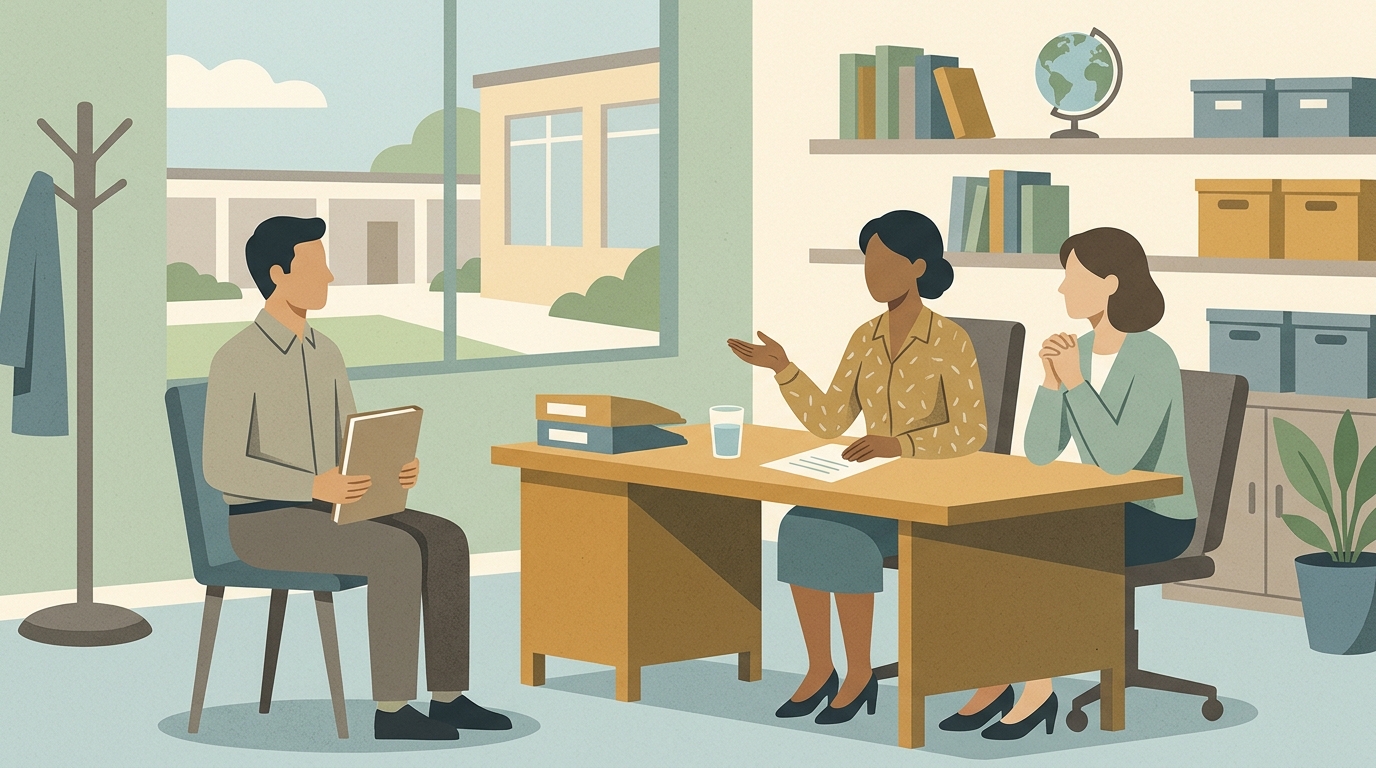
A teacher interview is rarely one conversation. Expect a panel of two to four people, a sample or demo lesson that is watched and scored, and scenario questions on behaviour, differentiation and child protection — often all on the same day.
The format varies by country, school type and whether the role is classroom-based or online, so confirm the running order with whoever schedules you rather than guessing.
What This Interview Usually Covers
Most teaching interviews combine three parts: a taught lesson, a formal panel, and informal contact with staff or students.
The panel usually includes the head teacher or principal, a department or year leader, and sometimes a governor, board member or ministry representative. Some systems add a student panel. Private and international schools often set a written task — marking a sample script, or drafting a reply to a parent email.
The taught lesson is the part candidates underestimate. You may be given a class, a topic and a short slot, then observed by two or three staff scoring against the school's lesson-observation criteria.
Online teaching hires work differently. Most online teaching jobs require a practice-teaching demo as part of the interview process, the interviewer will most likely play the role of the student, and some companies let you submit a recorded demo instead of teaching live (Bridge Education Group (BridgeUniverse TEFL Blog), 2021-07-14). Demos are scored partly on how you balance teacher talk time and student talk time for the learner's level (same source).
Rounds, references and background checks are set by the employer and by national or state regulation — ask which stage you are at.
Common Questions and Sample Answers
Why do you want to teach at this school?
Name something only this school offers — a programme, an intake, a timetable model.
Sample answer
At my last school I ran a reading-recovery group for 12 students in Year 7 who were two or more years behind. My task was to raise decoding accuracy before the end-of-year assessment. I built a 20-minute daily routine using paired reading and phonics cards, tracked on a shared spreadsheet. Ten of the 12 moved up at least one reading band. Your whole-staff literacy programme runs across subjects, which is where I want to take that work next rather than running it alone.
Tell us about a lesson that did not go to plan.
Show the diagnosis, not just the recovery.
Sample answer
I planned a group investigation on circuits for 28 students with six sets of equipment. Two sets failed in the first five minutes and the class drifted. I still needed the objective met in 35 minutes. I stopped the activity, demonstrated one circuit under the visualiser, and switched groups to predict-then-check on paper while I rotated the four working sets. Eighteen of 28 exit tickets were correct. I now test equipment the afternoon before and keep a paper fallback task in the folder.
How do you manage persistent low-level disruption?
Describe a routine, not a personality.
Sample answer
One Year 9 class lost roughly ten minutes of every lesson to calling out. My task was to cut that without constant removals. I introduced a three-step routine: silent entry with a five-question starter on the board, a named non-verbal cue, then a 30-second corridor conversation. I logged every incident for four weeks. Removals fell from seven a fortnight to one, and we began teaching within two minutes of the bell.
How do you teach a class with a wide ability range?
Give one concrete planning mechanism.
Sample answer
My Year 10 class spanned four grade boundaries, including three students with reading ages below ten. I had to get all of them through the same assessed task. I built every worksheet with a common core question, a scaffolded version and an extension, and pre-taught six key terms to the lowest group on Monday mornings with the teaching assistant. By the mock, every student attempted the extended-response question and the class average rose by nine marks out of 60.
Describe a difficult conversation with a parent.
Sample answer
A parent emailed at 9pm accusing me of singling out her son after he was kept behind. My task was to resolve it without escalating. I did not reply that night. Next morning I checked the behaviour log, phoned within 24 hours, opened by asking what her son had told her, then walked through the three logged incidents and proposed a weekly report card. After four weeks his detentions were at zero and she emailed the head of year to say so.
What would you do if a student told you something that worried you?
Show that you follow the school's procedure rather than improvising. Titles differ by country — designated safeguarding lead, child protection officer, counsellor.
Sample answer
A student stayed behind and said she did not want to go home that weekend. My task was to record and pass on, not investigate. I listened without asking leading questions, told her I could not keep it private, wrote the account in her words on the school's reporting form within the hour, and handed it to the designated safeguarding lead the same day. She took it from there. I confirmed only that my record was logged, which is what the policy asked of me.
How do you keep students talking rather than talking at them?
Essential in an online demo, where companies assess the balance of teacher talk time and student talk time for the learner's level (Bridge Education Group (BridgeUniverse TEFL Blog), 2021-07-14).
Sample answer
My beginner online classes were running at roughly 80 percent teacher talk. My task was to flip that within a month. I rewrote my openers as questions, used flashcard prompts and a hand puppet instead of explanations, and counted my own talk time by recording three lessons. By week four the students were speaking for more than half the lesson, and all 14 of my regular students rebooked that term.
Mistakes That Cost Candidates the Job
- Teaching the demo lesson at the panel instead of at the students — talking through what you would do rather than running the activity with the class or with the interviewer, who in an online demo will most likely play the student (Bridge Education Group (BridgeUniverse TEFL Blog), 2021-07-14).
- Overrunning the sample lesson so there is no plenary, which reads as poor timing management to every observer in the room.
- Answering the safeguarding question by promising to keep a child's secret, or saying you would speak to the parent first, instead of naming the school's reporting route.
- Badmouthing a previous head teacher, or describing a former class as "feral", when asked why you are leaving.
- Answering behaviour questions with values only — "I build relationships" — with no routine, no log and no number attached.
- Turning up to an online demo with laptop speakers and no props: companies such as VIPKid require a proper headset with clear audio before they will hire, and candidates are advised to bring props related to the lesson (Bridge Education Group (BridgeUniverse TEFL Blog), 2021-07-14).
- Asking no questions at the end, or asking only about holidays and pay before anything about the students, curriculum or induction.
Frequently asked questions
What should I wear?
For an in-person interview, wear what the school's own staff wear on a formal day — usually business dress. For an on-camera interview or demo, dress conservatively; a bright-coloured T-shirt or any solid-colour top works (Bridge Education Group (BridgeUniverse TEFL Blog), 2021-07-14). Avoid fine stripes and busy patterns on camera.
How do I prepare for the sample lesson?
Ask for the year group, class size, topic, time slot and any students with support plans. Print your plan, prepare one no-tech fallback activity, and rehearse the opening two minutes aloud with a timer. Teach For America publishes guidance on preparing for the sample teaching lesson in its interview.
Can I ask about pay in the interview?
Wait until the panel raises it or you reach offer stage. Teacher pay is usually set by a published scale — district, state, ministry or union agreement — rather than negotiated freely. Find your system's current scale on the employer's or education authority's website before the day.
Should I follow up afterwards?
Yes. Send one short email within 24 hours to the panel chair, thanking them, naming one thing from the day, and attaching any document they asked for. One email is enough. If they gave a decision date, wait until the day after it before chasing.
What if I am asked to record a demo instead of teaching live?
Take it. Some online tutoring companies offer a recorded demo as an alternative to a live one (Bridge Education Group (BridgeUniverse TEFL Blog), 2021-07-14). Record in a quiet, well-lit room, keep to the brief's time limit exactly, address an imagined student by name, and watch it back once before submitting.
Sources
- Bridge Education Group (BridgeUniverse TEFL Blog) — What's a Demo Lesson for a Teaching Interview? - Bridge (2021-07-14)
- Teach For America — How to Prepare for the Sample Teaching Lesson During Our Interview

Written by
Noor writes personal essays and interviews about career changes, burnout, and starting over. She's interested in the stories people tell themselves about what a job is supposed to mean.


