What Does a UX Researcher Do? Duties, Skills, and Salary Explained
UX research sits between people using a product and the team building it, turning observed behaviour into decisions designers and engineers can act on.
Quick answer
- Entry usually means a bachelor's degree (3-4 years); O*NET rates the work Job Zone Four.
- For US median pay, use the BLS 2025 figure for Web and Digital Interface Designers (SOC 15-1255).
- BLS projects employment growth for that occupation from 2024 to 2034 (U.S. Bureau of Labor Statistics, 2025).
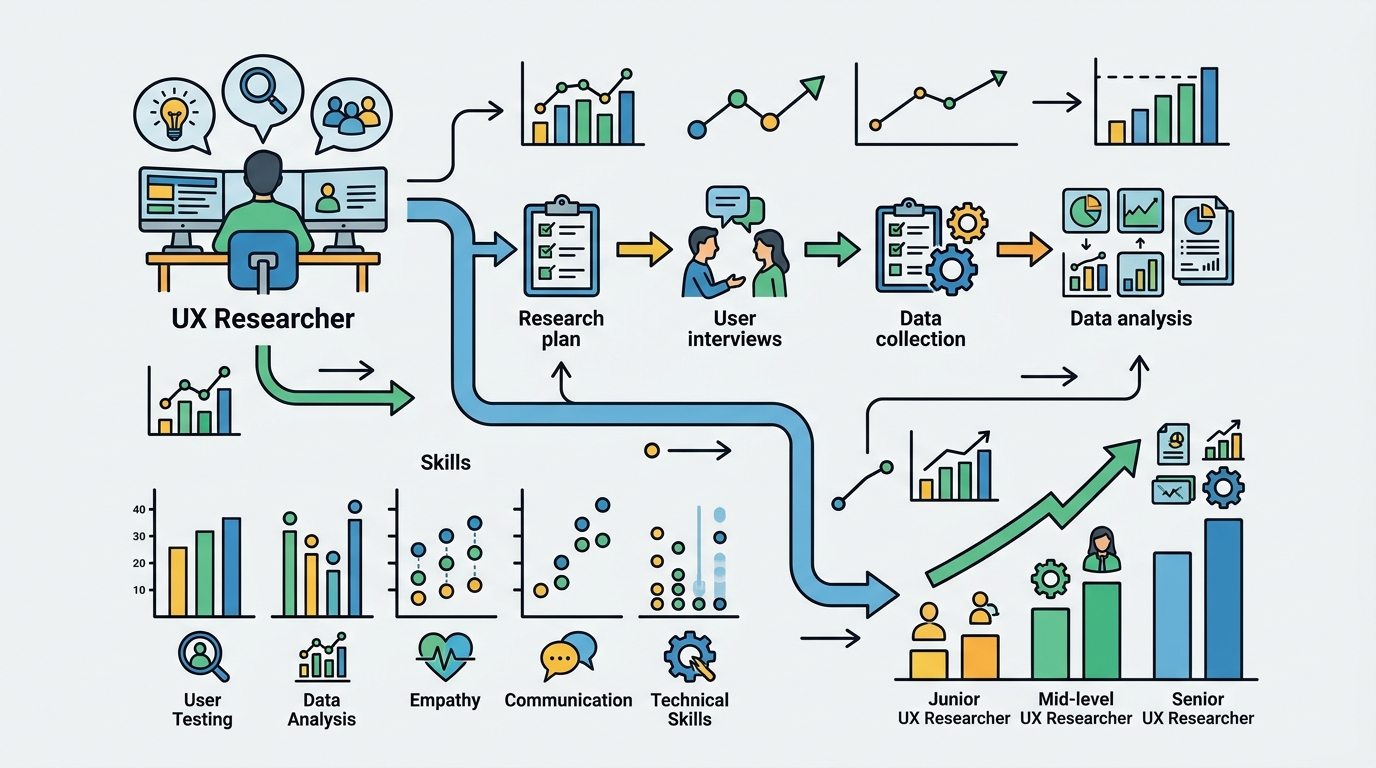
A UX researcher plans and runs studies with real or potential users, then turns what those people say and do into evidence a product team can act on. O*NET OnLine (U.S. Department of Labor) lists conducting user research and analysing user feedback as a core task for the occupation, and classifies it as Job Zone Four — work that requires considerable preparation, usually a degree plus practice.
The job mixes interviewing, usability testing, analysis and a lot of persuasion. Pay varies by country, employer and seniority, and in the United States there is no federal occupation code specifically for UX researcher — the closest match is Web and Digital Interface Designers, SOC 15-1255 (U.S. Bureau of Labor Statistics / cs-recruiters.com salary guide, undated).
What This Job Involves Day to Day
There is no single shift pattern, but a weekday on a product team tends to have a shape.
9 a.m. You check overnight responses to a screener survey. Six people qualified for Thursday's usability sessions, two dropped out, and you message the recruiting vendor to backfill. Recruitment admin is a genuine part of the job, not an afterthought.
9:45 a.m. You open the Figma prototype the designer updated last night and click through it yourself, checking that every path in your test script actually works. You fix two dead ends in the script rather than letting participants hit a broken screen.
11 a.m. First session. You run it over Zoom with recording and transcription on, sharing the prototype and asking the participant to narrate what they expect to happen before they click. You stay quiet while they struggle — the struggle is the data. A product manager watches silently in the observer room and types notes into a shared channel.
1 p.m. Back-to-back sessions through the afternoon, with ten minutes between each to tag observations in a research repository such as Dovetail.
4 p.m. You review tags across six sessions, spot that four people missed the same confirmation step, and draft a short findings note with two video clips attached.
5 p.m. Fifteen minutes with the designer to agree what to change before the next round. On other days this slot is a stakeholder debrief, a survey build, or an interview study with no prototype in sight.
An Intel posting for a User Experience Researcher (Technical) role (via O*NET OnLine job posting archive, April 2022) listed specific research methods among its minimum qualifications, which is typical — employers often name the methods they expect you to run unsupervised.
Common Tasks and Responsibilities
- Conduct user research and analyse user feedback, which O*NET OnLine (U.S. Department of Labor) lists as a core task for the occupation.
- Select the research method that fits the question — interviews, diary study, usability test, survey — rather than defaulting to one, a core accountability in a UX Researcher job description published by the University of Southern California.
- Write screeners and recruit participants who match the target segment, then manage scheduling, consent and incentives.
- Build or adapt prototypes and test materials so participants have something concrete to react to, also listed in that University of Southern California description.
- Moderate usability sessions without leading participants, probing on hesitation and error rather than on opinion.
- Tag, code and synthesise qualitative data across sessions to separate one person's quirk from a repeated pattern.
- Present findings with evidence — clips, quotes, task-failure counts — and recommend specific design changes.
- Maintain a research repository so past studies are searchable and not re-run by accident.
- Support day-to-day study logistics, note-taking and analysis alongside a senior researcher, as listed in a posted UX Research Associate job description (via O*NET OnLine job posting archive, undated).
Salary and Job Outlook by Experience Level
No single figure covers this role worldwide, and the United States has no federal occupation code specifically for UX researcher — the closest match is Web and Digital Interface Designers, SOC 15-1255 (U.S. Bureau of Labor Statistics / cs-recruiters.com salary guide, undated). Use the sources in the table to look up current numbers for your country, state or city.
| Career stage | Typical years of experience | Where to check current pay |
|---|---|---|
| Entry-level (research associate, junior researcher) | 0-2 years | BLS median annual pay for Web and Digital Interface Designers, 2025 [1]; national lower-percentile figures rather than the median |
| Mid-career (UX researcher, user researcher) | 3-7 years | UXPA median salary for the 'User Researcher' title, 2024 survey [2]; Glassdoor median total pay and base pay range for UX Researcher, 2026 [3] |
| Experienced / senior (senior, lead, principal) | 8+ years | Levels.fyi total compensation for the UX Researcher title, self-reported, 2026 [4]; UXPA 2024 breakdowns by education level [2] |
[1] U.S. Bureau of Labor Statistics, 2025 — national figure; state and metro pay differ. [2] User Experience Professionals' Association (UXPA International) salary survey, 2024, which also reports how median salaries across UX titles changed from 2022 to 2024 and the highest median salary by education level among respondents. [3] Glassdoor, 2026, self-reported. [4] Levels.fyi, 2026, self-reported total compensation including equity and bonus.
Outside the United States, check your national statistics agency and local UX salary surveys; US dollar figures will not translate. On outlook, the U.S. Bureau of Labor Statistics (2025) publishes an employment projection for Web and Digital Interface Designers covering 2024 to 2034 — look up the current growth rate there rather than relying on secondhand summaries.
Skills and Traits That Fit This Work
- Question discipline. You can turn "do users like the new dashboard?" into something testable, such as whether people can find last month's invoice without help.
- Moderating restraint. When a participant goes silent and hovers over the wrong button, you count to five instead of rescuing them.
- Qualitative analysis. You can read forty pages of transcript and defend why three comments are a pattern and a fourth is noise.
- Comfort with quantitative basics. You know when a survey sample is too small to report a percentage and say so before the slide is built.
- Writing that survives forwarding. Your findings note makes sense to an engineer who did not watch a single session.
- Diplomacy under disagreement. When a stakeholder's favourite feature tests badly, you present the evidence without turning it into a personal argument.
- Operational patience. You accept that a week can disappear into recruiting, rescheduling and consent paperwork, and you plan timelines accordingly.
How to Get Started
- Get the baseline degree. ONET OnLine (U.S. Department of Labor) reports respondent data on typical education for this occupation and places it in Job Zone Four, meaning considerable preparation. In practice that is a bachelor's degree, usually 3-4 years full time, in psychology, human-computer interaction, anthropology, design or a related field. A master's in HCI or human factors, typically 1-2 years, is common among applicants to technical research roles — an Intel posting for User Experience Researcher (Technical) (via ONET OnLine job posting archive, April 2022) set out minimum qualifications and named the research methods expected.
- Run real studies and document them. Recruit five participants for a usability test of a public website or a local organisation's booking flow. Write the script, moderate, analyse, and produce a findings document. Three of these, written up properly, function as your portfolio; a degree without them rarely clears screening.
- Add a method credential if your background is not research-heavy. The Nielsen Norman Group UX Certificate is structured around completing a set number of courses and passing exams, with an optional UX Research specialty add-on covering how to conduct UX research. Note that Nielsen Norman Group states its certification is not an accredited credential, so treat it as evidence of training, not a licence. The User Experience Professionals' Association also runs a certification programme (as summarised by resumecat.com, undated); UXPA defines a UX professional broadly to cover research, evaluation and design work.
- Apply to associate-level and adjacent roles. A posted UX Research Associate job description (via O*NET OnLine job posting archive, undated) lists study logistics, note-taking and supporting analysis — that is the realistic first rung. Research operations, market research, customer insight and product support roles inside companies that already employ researchers are common side doors. Apply through company careers pages, UXPA local chapter job boards and the alumni networks of HCI programmes.
- Check pay before you negotiate. Look up the BLS figure for Web and Digital Interface Designers (2025) for a national US floor, then the UXPA 2024 salary survey and Glassdoor or Levels.fyi (2026) for title-level and location-level detail.
Frequently asked questions
Do I need a master's degree to become a UX researcher?
Not always, but it helps for technical and quantitative roles. O*NET OnLine places the occupation in Job Zone Four, requiring considerable preparation, and the UXPA 2024 salary survey reports the highest median salary by education level among its respondents — worth reading before committing to a one to two year master's. A bachelor's plus three documented studies clears many associate-level screens.
How does pay progress over a UX research career?
Progression usually runs from associate to researcher to senior, lead or principal, with compensation shifting from mostly base salary toward base plus bonus and equity at larger employers. The UXPA 2024 survey reports how median salaries across UX titles changed from 2022 to 2024, and Levels.fyi (2026) reports self-reported total compensation for the UX Researcher title, including the non-salary components.
What are the schedule and physical demands?
Most of the work is seated and screen-based, with long stretches of video calls and transcript reading, so eye strain and back problems are common complaints. Session days can mean six interviews back to back. If you research across time zones or run studies with shift workers, early or late sessions happen. Fieldwork and on-site testing add travel.
Is UX research a growing field?
In the United States, the closest federal match is Web and Digital Interface Designers, SOC 15-1255, and the U.S. Bureau of Labor Statistics (2025) publishes a projection for that occupation covering 2024 to 2034. Check that figure directly, since it covers designers as well as researchers. Elsewhere, consult your national statistics agency rather than assuming US trends apply.
What is the hardest part of the job?
Influence without authority. You can run a clean study, show four of six participants failing the same step, and still watch the team ship it unchanged because of a deadline. Participant recruitment also eats time nobody budgets for. Researchers who last learn to write findings short, attach video evidence, and time delivery to decision points.
Can I move into UX research from another career?
Yes, and many people do. Backgrounds in psychology, market research, teaching, social science, support and service design transfer well because they already involve structured questioning and analysis. The gap is usually product vocabulary and method fluency, which a credential such as the Nielsen Norman Group UX Certificate with its UX Research specialty can help close alongside self-run studies.
Sources
- O*NET OnLine (U.S. Department of Labor) — 15-1255.00 - Web and Digital Interface Designers
- O*NET OnLine (U.S. Department of Labor) — 15-1255.00 - Web and Digital Interface Designers

Written by
Desmond writes about the mechanics of job searching: resumes, interviews, the long silence after applying. He's fascinated by how much of getting hired depends on luck dressed up as skill.