
Wind Turbine Technician Career Change Roadmap for Working Adults
What the move from an office job or a trade into turbine maintenance really asks of you: climbing fitness, training routes, and money for the gap.
Quick answer
- Plan about 12 to 24 months from first research to first day on site; apprenticeships take longer than classroom routes (NES Fircroft, undated).
- Budget three cost lines: tuition, Global Wind Organisation Basic Safety Training with its four certification sections and separately priced recertification (Iowa Lakes Community College Continuing Education, undated), and the income gap.
- The biggest risk is the income gap, not tuition — hold 6 months of living costs in cash before you resign, because entry postings are travel-heavy and start dates slip.
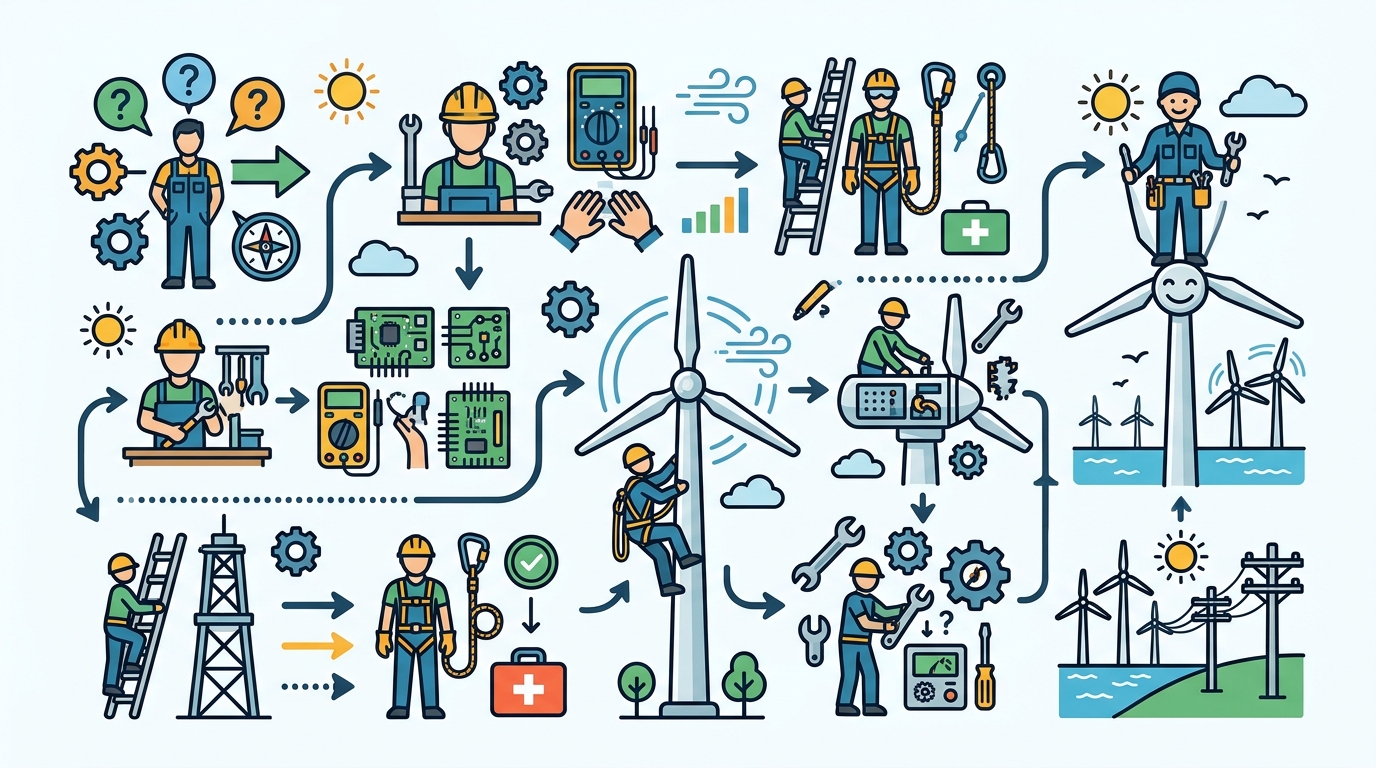
Switching into wind turbine technician work from another job realistically takes about 12 to 24 months from first research to first day on site, depending on whether you take a short certificate, an associate degree, or an apprenticeship — apprenticeships run longer than classroom routes (NES Fircroft, undated). The entry bar is a postsecondary nondegree award plus long-term on-the-job training once you are hired, and work experience in a related occupation is not required to enter the role (U.S. Bureau of Labor Statistics, 2025), which is why people arrive from vehicle repair, HVAC, the military and even retail management.
The real obstacles are rarely academic. They are climbing fitness, time away from home, and the months when tuition is going out and your old pay has stopped.
The Transition Timeline
Treat this as a planning skeleton, not a guarantee. Stages overlap, and the biggest variable is which training route you pick.
Months 1-3 — Still employed, researching. You stay in your current job and do unpaid homework: what the work involves (electrical and hydraulic systems, braking systems, programmable logic control, tower climbing, rescue, safety, first aid and CPR all appear in standard coursework, per the U.S. Bureau of Labor Statistics, 2025), where the turbines are near you, and whether you can live with nights away. Check the current official outlook page before you commit — an earlier edition of the same handbook reported a larger projected employment figure and growth rate for the occupation (U.S. Bureau of Labor Statistics, 2024) than the current edition does (U.S. Bureau of Labor Statistics, 2025), so the numbers move between editions.
Months 2-5 — Physical and medical readiness. Still employed. You find out, privately, whether you can climb a ladder in harness repeatedly, work at height and perform a self-rescue, all of which appear in standard training (U.S. Bureau of Labor Statistics, 2025). This stage is where most people self-select out, and it is better to learn it now than after you have paid tuition.
Months 4-9 — Training enrolment and study. Still employed if you can be. Technicians typically attend a technical school or community college for a postsecondary certificate in wind energy technology or an associate's degree (U.S. Bureau of Labor Statistics, 2025). Evening and part-time cohorts exist; full-time day cohorts force the income question early.
Months 8-14 — Safety credentials and applications. You add industry safety training. Global Wind Organisation (GWO) Basic Safety Training is the common one; GWO is a non-profit industry association set up by turbine manufacturers and operators to set common health and safety training standards recognised across employers globally (Wikipedia entry on the Global Wind Organisation, undated). Applications go out while you are still drawing a salary.
Months 12-18 — Resignation and first role. You leave the old job once an offer and a start date are signed, not before. Expect relocation or heavy travel in the first posting, plus a wait between your start date and your first full pay cycle.
Months 18-30 — First year in the role. Entry technicians receive long-term on-the-job training (U.S. Bureau of Labor Statistics, 2025). You are paid, supervised, and still learning the specific turbine platforms your employer runs. Employers often direct workers to the certifications they need (U.S. Bureau of Labor Statistics, 2025), so further credentials arrive on their schedule, not yours.
Step-by-Step Plan
- While employed (Months 1-3): list every wind farm, owner-operator and service contractor within commuting or rotation distance. If the answer is none, the honest decision is relocation or a different career — settle that before you spend money.
- While employed (Months 2-4): book a medical check and start conditioning — grip, core, ladder work, carrying tools at height. Training covers tower climbing, rescue and self-rescue (U.S. Bureau of Labor Statistics, 2025); you will be expected to bring a casualty down, not just yourself.
- While employed (Months 2-5): translate your current job on paper. An HVAC installer, auto technician, elevator mechanic, aircraft maintainer or farm equipment mechanic already has fault-finding and hydraulics. An electrician has the electrical safety half. A retail manager or warehouse supervisor has the shift discipline, safety paperwork and incident reporting that service contractors care about. Name the overlap system by system in your application.
- While employed (Months 3-6): choose your route and price it. Compare a postsecondary certificate against an associate's degree (U.S. Bureau of Labor Statistics, 2025), and both against an apprenticeship — 'Wind Turbine Technician' is listed as an apprenticeship title vetted by industry and approved by the U.S. Department of Labor for use in a Registered Apprenticeship Program (O*NET OnLine, undated), and a UK careers guide describes a Level 3 advanced apprenticeship as the equivalent route into engineering maintenance work (Lilach Bullock, undated). Apprenticeships pay you while you train, which solves the income problem, but they run longer than classroom routes (NES Fircroft, undated).
- While employed (Months 4-9): enrol, and ask the registrar for the evening, weekend or hybrid cohort before you assume you must quit. Tell your current employer only when you have a plan you can execute.
- While employed (Months 8-12): complete GWO Basic Safety Training or confirm in writing that your future employer provides it. Accredited providers publish course prices and separate recertification prices (Nunez Community College, undated; Iowa Lakes Community College Continuing Education, undated), and some employers hire first and train after — asking costs nothing.
- While employed (Months 10-14): apply widely and accept that the first offer may be a travelling blade or construction crew rather than a site-based maintenance post. Do not resign until a start date is in writing.
- After leaving (Months 14-18): give notice, arrange health cover and any licence transfers, and set up your relocation or rotation logistics. Keep your cash buffer untouched until the first full pay cycle lands.
- After leaving (Months 18-30): work the long-term on-the-job training period deliberately (U.S. Bureau of Labor Statistics, 2025). Log every platform, every fault type and every certification your employer sends you to. That log is what gets you off the travelling crew and onto a site team.
Before You Quit Your Job Checklist
Each item is a yes or no. If any is a no, you are not ready to resign.
- I have at least 6 months of living expenses in accessible cash, calculated from my actual outgoings, not an estimate.
- I have a written offer with a start date, or an apprenticeship place confirmed in writing.
- My training is finished or paid in full, with a completion date in writing from the school.
- I have completed or booked GWO Basic Safety Training, or hold written confirmation that my employer provides it.
- I hold current first aid and CPR certification — both are standard coursework subjects (U.S. Bureau of Labor Statistics, 2025) — with the expiry date in my calendar.
- I have checked whether my country, state or province requires an electrical licence, work-at-height registration or medical certificate for this work, and I hold the documents or have submitted the applications. Requirements differ by state and by country, so check the regulator where the site actually is, not where you live now.
- I have passed a climb and rescue assessment, or a comparable physical test, and hold the dated record.
- I have a backup income plan I could start within 30 days — contract work in my old trade, shift work, or a return offer — if the new role does not survive probation.
- I know how pay is structured in the roles I applied for: base rate, overtime, per diem for travel, and any bonus. I have checked current pay ranges on my country's official statistics source — the U.S. Bureau of Labor Statistics for the United States, the Office for National Statistics for the UK, Statistics Canada, the Australian Bureau of Statistics — rather than relying on job-ad claims.
- I have told my household what the first year looks like — nights away, rotations, weather call-outs — and they have agreed to it.
Certifications and Costs
Prices and course lengths differ by provider, by state and by country. Treat this as a list of what to price, then confirm each figure directly with the provider before you budget.
| Requirement | Provider or Path | Cost | Time to Complete |
|---|---|---|---|
| Postsecondary certificate in wind energy technology | Technical school or community college (U.S. Bureau of Labor Statistics, 2025) | Tuition set by the school and by residency status; ask for the published per-credit rate plus tools and fees | Shorter than the degree route; reported program durations vary by provider (Best Trade Schools, undated) |
| Associate's degree in wind turbine technology | Community college (U.S. Bureau of Labor Statistics, 2025) | The costliest route; individual colleges publish program cost and in-state tuition examples (Dreambound, undated; SkillPointe, undated), so request the full cost sheet from yours | The longest of the classroom routes (Best Trade Schools, undated) |
| GWO Basic Safety Training | A GWO-accredited training provider; GWO is a non-profit industry association set up by turbine manufacturers and operators to set common safety training standards recognised across employers globally (Wikipedia entry on the Global Wind Organisation, undated) | Priced per course by the accredited provider (Nunez Community College, undated); recertification is priced separately (Iowa Lakes Community College Continuing Education, undated). Many employers pay for it — ask before you self-fund | Covers four certification sections (Iowa Lakes Community College Continuing Education, undated) |
| First aid and CPR certification | Community training provider, ambulance service or employer | Free to low cost — often run at no charge by employers or community programmes; confirm with the provider | Short course, usually run over consecutive days |
| WTT-I credential | National Fire Protection Association (NFPA). Eligibility includes completing training courses covering the exam blueprint, or holding a minimum amount of field experience as a wind turbine technician (NFPA, undated) | Exam fee set by NFPA; check the current fee before you plan for it | One exam sitting; prep time depends on your route |
| Registered Apprenticeship or Level 3 advanced apprenticeship | 'Wind Turbine Technician' is an approved apprenticeship title for U.S. Department of Labor Registered Apprenticeship Programs (O*NET OnLine, undated); a UK careers guide describes the Level 3 advanced apprenticeship route (Lilach Bullock, undated) | No tuition to you in most cases — you are paid while training | Longer than classroom routes (NES Fircroft, undated) |
Certification is not mandatory for the occupation, but common subjects include workplace electrical safety, tower climbing and self-rescue, and employers often direct workers to the certifications they need (U.S. Bureau of Labor Statistics, 2025). That is an argument for buying the minimum up front and letting your employer fund the rest. The occupation sits in a Job Zone meaning medium preparation is needed — vocational training, related on-the-job experience, or an associate's degree (O*NET OnLine, undated).
Frequently asked questions
I'm 48. Am I too old to start?
Age is a real concern in this trade roughly between 45 and 60, and it is physical rather than attitudinal — the barrier is repeated tower climbing, rescue capability and tolerance for confined space, not your birth year. Deal with it at Months 2-5 of the timeline by passing a climb and rescue assessment before you spend tuition money, and keep the dated record for the checklist item. The structural points in your favour: work experience in a related occupation is not required to enter the role, and most of the projected annual openings over the decade come from replacement needs as people leave the occupation rather than from growth alone (U.S. Bureau of Labor Statistics, 2025).
Can I train without quitting my current job?
Often yes, and it is the single best way to protect your finances. Ask specifically for evening, weekend or hybrid cohorts at step 5 of the plan (Months 4-9), and keep your resignation at step 7 — after a written start date, not before. If no part-time cohort exists near you, the apprenticeship route pays you while you train, at the cost of a longer run than classroom training (NES Fircroft, undated).
What is the realistic financial hit?
Three lines: tuition for a certificate or associate's degree, GWO Basic Safety Training if your employer will not fund it — the course covers four certification sections and recertification is priced separately (Iowa Lakes Community College Continuing Education, undated) — and the income gap between your last payslip and your first full one. That gap is why the checklist asks for 6 months of cash rather than 3. Entry roles are travel-heavy, so price relocation or rotation travel before you accept, and check current pay ranges on your country's official statistics source, such as the U.S. Bureau of Labor Statistics for the United States.
Does a certificate get me hired as fast as an associate's degree?
Both are standard routes: technicians typically complete a postsecondary certificate in wind energy technology or an associate's degree, and the occupation needs only medium preparation — vocational training, related on-the-job experience, or an associate's degree (U.S. Bureau of Labor Statistics, 2025; O*NET OnLine, undated). The certificate gets you to Months 8-14 of the timeline faster and cheaper, since associate degree programs run the longest of the classroom routes (Best Trade Schools, undated). Decide at step 4, in Months 3-6, by looking at what employers within reach of you actually ask for.
Sources
- U.S. Bureau of Labor Statistics — Wind Turbine Technicians : Occupational Outlook Handbook (2025)
- U.S. Bureau of Labor Statistics — Wind Turbine Technicians : Occupational Outlook Handbook (print version) (2024)

Written by
Wyatt covers work outside the office: construction, logistics, repair, and the people who keep things running. He's skeptical of career advice that assumes everyone sits at a desk.


