Electrician vs. Plumber: Which Career Fits You?
Both train on the job and need a state licence, but one works live circuits and code books while the other handles water, waste and heavy pipe.
Quick answer
- Pay for both is published in the same place: the U.S. Bureau of Labor Statistics Occupational Outlook Handbook (2025) lists a median annual wage for electricians and a separate one for plumbers, pipefitters and steamfitters — compare those two figures directly.
- Neither route needs a degree, but the licensing differs in who runs it: the U.S. Bureau of Labor Statistics (2025) says most states require electricians to pass a test and hold a licence, while plumbing licensing is set by state or local plumbing boards.
- Daily tasks split cleanly: electricians read blueprints and inspect transformers and circuit breakers with testing devices to the National Electrical Code, while plumbers cut, join and pressure-test pipe and clear blocked drains.
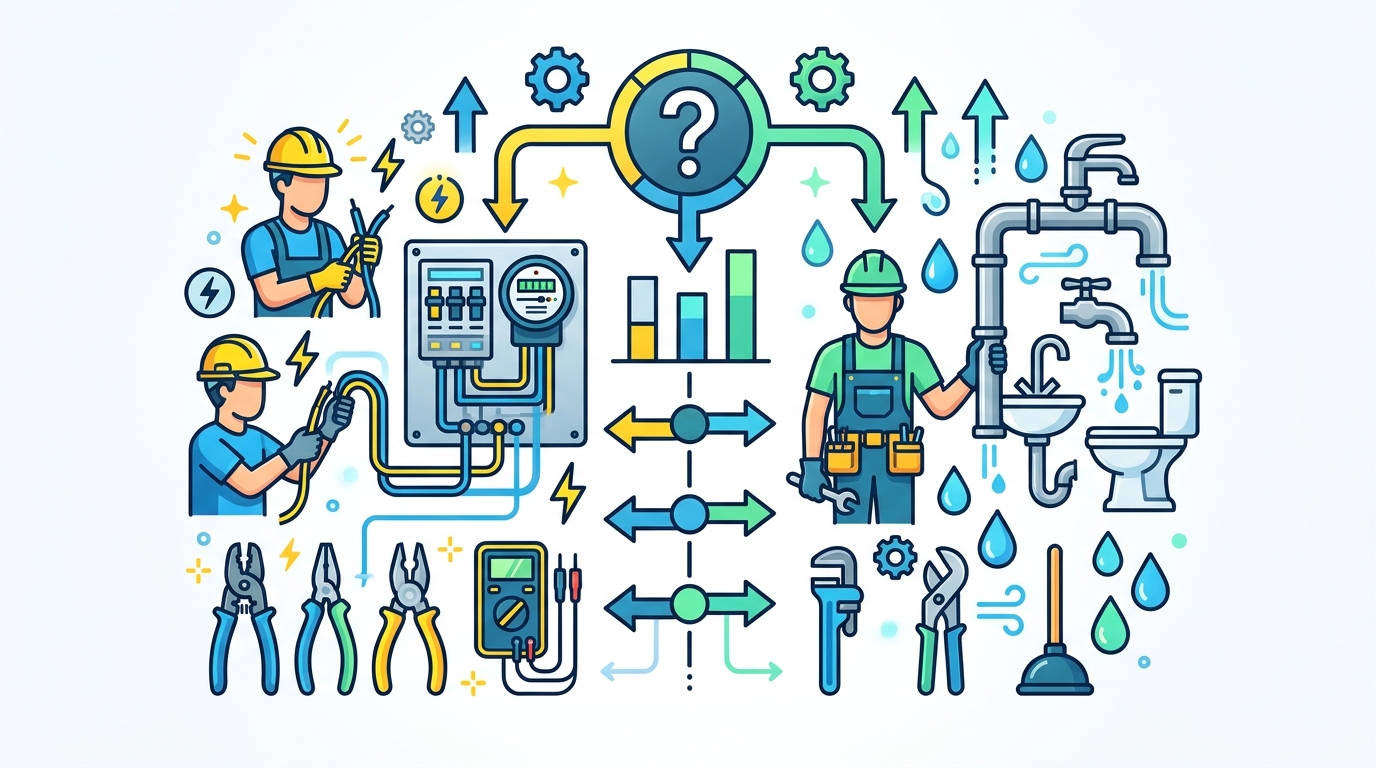
Electricians and plumbers are both skilled trades you can enter without a four-year degree, learning through a paid apprenticeship rather than classroom study alone. The U.S. Bureau of Labor Statistics (2025) describes electricians as installing, maintaining and repairing electrical power, communications, lighting and control systems; plumbing work centres instead on water supply, drainage, waste and gas or heating pipework.
The real choice is about the materials and risks you want to handle every day: live conductors and code compliance, or water, waste and the lifting that comes with pipe. This guide compares the two on pay, training, physical demands, schedule and outlook, then shows what each one actually looks like in the first hour of a shift.
Side-by-Side Comparison
These are the two occupations as they are classified in the United States: Electricians and Plumbers, Pipefitters, and Steamfitters. Both have a profile in the U.S. Bureau of Labor Statistics Occupational Outlook Handbook, and both profiles carry the same five headline categories. Read them side by side on the day you decide, so you are comparing figures from the same edition.
| Category | Electrician | Plumber (Plumbers, Pipefitters, and Steamfitters) |
|---|---|---|
| Median pay | The U.S. Bureau of Labor Statistics (2025) publishes a median annual wage for electricians in its Occupational Outlook Handbook profile. | The same handbook publishes a separate median annual wage for plumbers, pipefitters and steamfitters (U.S. Bureau of Labor Statistics, 2025). Compare the two figures directly on those pages. |
| Typical entry-level education | Listed as a typical entry-level education level by the U.S. Bureau of Labor Statistics (2025); most electricians then learn the trade through an apprenticeship. | Listed on the plumbers profile in the same 2025 handbook; entry is likewise apprenticeship-based rather than degree-based. |
| Training and licensing | Apprenticeship of a set length with paid on-the-job training hours per year; most states require passing a test and holding a license, with requirements varying by state (U.S. Bureau of Labor Statistics, 2025). After the apprenticeship you are a journey worker, and can advance to master electrician after meeting further requirements. | Apprenticeship route, with licensing set by state or local plumbing boards. Check your state's licensing board for the exact exam and hour requirements. |
| Physical demands | Ladders, lifts and crawl spaces; bending conduit, pulling cable, kneeling in ceiling voids. The hazard is live conductors, so testing dead and locking off is routine. | Lifting and carrying pipe, cast-iron soil stack and water heaters; working in trenches, under floors and in crawl spaces. The hazard is heavy lifting plus contact with waste water. |
| Schedule type | The U.S. Bureau of Labor Statistics (2025) states the typical work schedule on the electricians profile, including overtime and shift patterns. | The plumbers profile states its own schedule pattern; emergency call-out work (burst pipes, no heat) is common in service plumbing. |
| Growth outlook | The U.S. Bureau of Labor Statistics (2025) publishes a projected percentage change for electricians for 2025–35, plus the number of electrician jobs and projected annual openings over the decade. | The same 2025 handbook publishes a projected percentage change and annual openings for plumbers, pipefitters and steamfitters. |
One more practical difference: electricians may be required to hold a driver's license (U.S. Bureau of Labor Statistics, 2025), because the work is van-based and spread across sites. Service plumbing is van-based for the same reason. Outside the United States, use your own national labour or statistics agency and your state or provincial licensing body — the trade titles and the licence names change at the border.
Day-to-Day Differences
Picture the first hour of a weekday for each.
The electrician on a commercial fit-out starts at the drawings. The U.S. Bureau of Labor Statistics (2025) lists reading blueprints as a core duty, and it is literally the first thing that happens: you mark out where the panel, conduit runs and lighting circuits go against the architect's plan and the National Electrical Code, then confirm the circuit you are cutting into is dead with a non-contact tester and a multimeter before locking off the breaker. The next forty minutes might be bending and clipping conduit to that mark. On a service call instead, the first hour is diagnostic — inspecting components such as transformers and circuit breakers and using testing devices to find the fault before any tool comes out.
The plumber's first hour on a service round is usually reactive. You isolate the stop valve, drain down the section, then cut out a failed length of copper or PEX and remake the joint — press fittings, solder or push-fit — before refilling and pressure-testing for leaks. On a blocked line you run a drain camera or an auger first and read what comes back. On new construction, the first hour is setting pipe to a fall through joists and stacking the fixtures for rough-in.
Both jobs end up kneeling in the same crawl space. The difference is that one of you is thinking about current and code, and the other about pressure, gravity and water.
Which Career Is Right for You
- Choose electrician if you are willing to sit and pass a state licensing exam: the U.S. Bureau of Labor Statistics (2025) notes most states require electricians to pass a test and be licensed, and the code study that goes with it is ongoing, not a one-off.
- Choose electrician if you want a clearly mapped ladder: you finish an apprenticeship as a journey worker and can advance to master electrician after meeting additional requirements (U.S. Bureau of Labor Statistics, 2025), which changes what you can pull permits for.
- Choose electrician if you would rather diagnose than lift — much of the work is inspecting transformers and circuit breakers and tracing faults with testing devices, and the heaviest routine item is usually a coil of cable or a spool of conduit.
- Choose plumber if repeated heavy lifting does not put you off: water heaters, cast-iron stack and long pipe lengths are part of the normal day, and trench and under-floor work comes with it.
- Choose plumber if you are comfortable with waste water and drains as a daily reality, including the clearing calls that come with service work.
- Choose plumber if you want work that comes to you as emergencies — burst pipes and no-heat calls — and you would rather earn call-out and overtime hours than hold fixed site hours.
- Choose either if you need to earn while training and cannot fund a four-year degree: both are apprenticeship trades with paid on-the-job training hours, and both expect you to hold a driver's license for van-based work (U.S. Bureau of Labor Statistics, 2025, for electricians).
Frequently asked questions
Which pays more starting out, an electrician or a plumber?
Starting pay in both trades is usually set by apprenticeship year — a percentage of the journey worker rate that steps up as you complete hours — rather than by a single national figure. For the qualified rate, compare the median annual wage on the electricians profile with the one on the plumbers, pipefitters and steamfitters profile in the U.S. Bureau of Labor Statistics Occupational Outlook Handbook (2025). Use the same edition for both so the figures are from the same year, and check your state's data for local differences.
Do both trades need a licence?
The U.S. Bureau of Labor Statistics (2025) states that most states require electricians to pass a test and be licensed, and that requirements vary by state. Plumbing is licensed state by state too, usually through a state or local plumbing board. In both cases the licence is tied to documented apprenticeship hours plus an exam, so confirm the hour count with your own state board before you start.
Which trade takes longer to qualify in?
Both run on apprenticeships measured in years and in logged hours. The U.S. Bureau of Labor Statistics (2025) says most electricians learn through an apprenticeship of a set length that includes paid on-the-job training hours each year, with technical instruction alongside it. Plumbing apprenticeships are structured the same way; the exact length for each is published on their respective handbook profiles and by your state's apprenticeship agency.
Which one has the better job outlook?
The U.S. Bureau of Labor Statistics (2025) publishes a projected percentage change for electricians for 2025–35, along with the current number of electrician jobs and the projected number of annual openings over the decade. The plumbers, pipefitters and steamfitters profile carries the equivalent projections. Compare those two projected growth rates directly rather than relying on general claims that either trade is 'in demand'.
Sources
- U.S. Bureau of Labor Statistics — Electricians : Occupational Outlook Handbook (2025)

Written by
Priya tracks wages, layoffs, and the slow shifts in what counts as a stable job. She writes for readers trying to make sense of numbers that rarely match their own experience.