How to Become a Claims Adjuster
The work mixes field inspections, estimating software and state-by-state license rules, so what it takes to start depends heavily on where you plan to work.
Quick answer
- Fastest path: a high school diploma or equivalent, a state prelicensing course of roughly 20 to 40+ hours (National Adjuster Authority, undated), then the state exam — weeks rather than years in states that allow it.
- Typical timeline: a few weeks to a few months to get licensed and placed, then several months of supervised work on small claims before larger, more complex ones (U.S. Bureau of Labor Statistics, 2025).
- Minimum credential: a high school diploma or equivalent for entry-level roles, plus an adjuster license in the 35 US states that require one (U.S. Bureau of Labor Statistics, 2025; Kaplan Financial Education, undated).
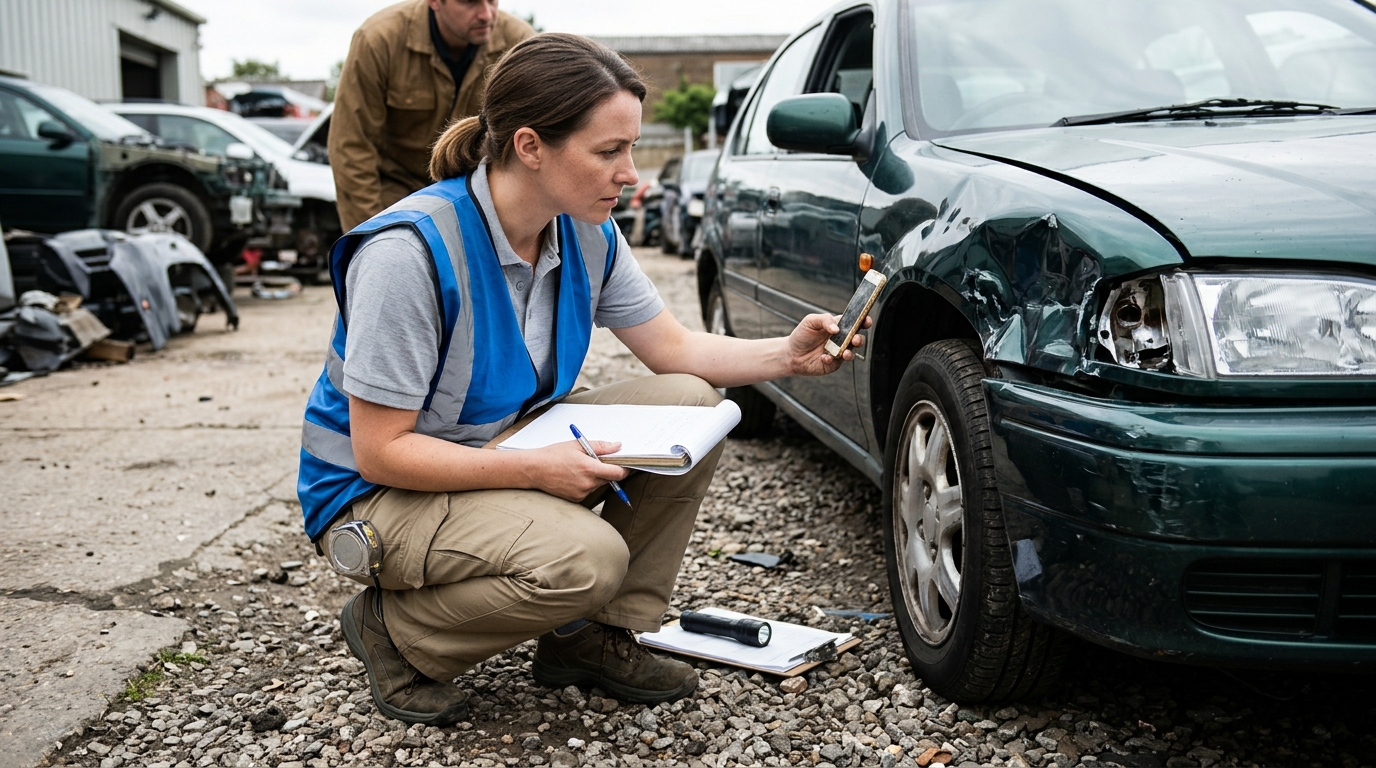
Claims adjusters, appraisers, examiners and investigators evaluate insurance claims to decide what an insurer owes (U.S. Bureau of Labor Statistics, 2025). In the United States, the usual entry route is a high school diploma or equivalent plus a state adjuster license where one is required, followed by supervised work on small claims; some employers want a bachelor's degree or prior insurance experience instead (U.S. Bureau of Labor Statistics, 2025).
How long it takes depends almost entirely on where you work. Licensing rules vary by state in the US and by country elsewhere, so the first thing to settle is which regulator you answer to.
Is This Career Right for You?
Most people in this occupation work full time and often work outside the office, inspecting properties such as damaged automobiles and buildings (U.S. Bureau of Labor Statistics, 2025). That means driving between losses, climbing into attics and onto roofs, photographing damage, measuring rooms and writing estimates afterwards — not sitting at one desk all day.
Hours split by specialty. Adjusters often arrange schedules around evening and weekend appointments with policyholders, which makes their schedules irregular, and insurance investigators often work early mornings, evenings and weekends; auto damage appraisers typically work regular hours and rarely work weekends (U.S. Bureau of Labor Statistics, 2025). If you need predictable hours, auto damage appraisal is the steadier end of the field.
There is real physical risk. Workers inspecting damaged buildings must be careful around hazards such as collapsed roofs and floors and weakened structures (U.S. Bureau of Labor Statistics, 2025). Ladders, crawl spaces and storm-damaged sites are part of the job.
This suits people who are comfortable working alone on the road, can hold a difficult conversation with someone whose house has just burned, and can write a defensible estimate in software rather than prose. It does not suit anyone who needs fixed office hours, dislikes heights or confined spaces, or wants to avoid conflict — claims decisions are frequently disputed by the person receiving them. Demand is also tight: employment is projected to decline, with about 21,600 openings projected each year on average over the decade, mostly to replace workers who leave (U.S. Bureau of Labor Statistics, 2025).
Steps to Becoming a Claims Adjuster
- Finish secondary education (or a degree, if you are aiming higher). A high school diploma or equivalent is typically required for entry-level claims adjuster, examiner or investigator roles, although some positions need a bachelor's degree or insurance-related work experience (U.S. Bureau of Labor Statistics, 2025). ONET places the occupation in Job Zone Four, considerable preparation needed, where most occupations require a four-year degree, though 13% of survey respondents said a high school diploma or equivalent is required (ONET OnLine, U.S. Department of Labor, undated). A bachelor's degree takes three to four years.
- Pick a lane. Staff adjuster for a carrier, independent or catastrophe adjuster, public adjuster, auto damage appraiser, or investigator. Auto damage appraisers typically hold a postsecondary nondegree award or have experience identifying and estimating automotive repair costs (U.S. Bureau of Labor Statistics, 2025). Allow a week of research.
- Check your state or country's licensing rules before paying for anything. Requirements vary by state: some have few requirements, others require prelicensing education, a licensing exam, or both, and in some states adjusters employed by insurance companies do not need their own license because they work under the company license (U.S. Bureau of Labor Statistics, 2025). Thirty-five US states require an insurance adjuster license (Kaplan Financial Education, undated). State licensing board information is available from CareerOneStop (U.S. Bureau of Labor Statistics, 2025).
- Complete prelicensing education. Hour requirements range from 20 hours — for example, general lines adjusters in states such as Florida under Florida Statute Section 626.221 — up to 40 or more hours in states with more rigorous rules (National Adjuster Authority, undated). Most people finish in one to four weeks part time.
- Pass the state adjuster exam. Most states require a state-specific exam, with passing scores varying but most requiring 70% or higher (GetLicenseMap, 2026). Fees differ widely: state listings show Arkansas with an exam, 24 CE hours and a $119 fee, and California with an exam, 24 CE hours and fees of roughly $450 to $500 (GetLicenseMap, 2026).
- Learn the estimating software. Xactimate is described as the industry's leading estimating software for adjusters (AdjusterPro, 2026). Budget several weeks of practice; a four-day catastrophe deployment course covering customer service, scoping techniques and mock inspections is open to licensed adjusters with Xactimate training (Insurance Business Magazine, undated).
- Get supervised entry-level experience. At the start of their careers, adjusters, examiners and investigators work on small claims under the supervision of an experienced worker before being assigned larger, more complex ones (U.S. Bureau of Labor Statistics, 2025). Auto damage appraisers typically receive on-the-job training lasting several months under an experienced appraiser (U.S. Bureau of Labor Statistics, 2025).
- Apply to independent adjusting firm rosters and keep your license active. One industry guide recommends joining firm rosters and maintaining the license with continuing education credits as the next steps to launch a catastrophe adjusting career (AdjusterPro, 2026). Continuing education requirements govern renewal (National Adjuster Authority, undated).
- Advance with a designation. The Associate in Claims (AIC) is awarded by The Institutes on completion of four national exams, with a program of four 13-week courses, and is most appropriate for experienced adjusters, claims supervisors and examiners (International Risk Management Institute, undated). Plan on roughly a year or more alongside full-time work.
Education and Certification Options
| Path | Typical time | Approximate cost | Required or preferred |
|---|---|---|---|
| High school diploma or equivalent | Standard secondary schooling | Varies by country | Required minimum for entry-level adjuster, examiner and investigator roles (U.S. Bureau of Labor Statistics, 2025) |
| Bachelor's degree | Three to four years | Varies widely by institution and country | Needed for some positions; ONET rates the occupation Job Zone Four, though 13% of respondents said a high school diploma suffices (ONET OnLine, undated) |
| State prelicensing course plus licensing exam | 20 hours in states such as Florida, up to 40+ hours elsewhere (National Adjuster Authority, undated) | Varies by state: Arkansas $119; California about $450-$500, each with 24 CE hours (GetLicenseMap, 2026) | Required in 35 US states (Kaplan Financial Education, undated); some states exempt adjusters working under a company license (U.S. Bureau of Labor Statistics, 2025) |
| Postsecondary nondegree award or repair-estimating experience, plus on-the-job training | Several months of supervised training (U.S. Bureau of Labor Statistics, 2025) | Varies by provider | Typical for auto damage appraisers (U.S. Bureau of Labor Statistics, 2025) |
| Catastrophe adjuster training, including a four-day deployment course | Four days (Insurance Business Magazine, undated) | Varies by school | Preferred by independent firms; the course is open to licensed adjusters with Xactimate training (Insurance Business Magazine, undated) |
| Associate in Claims (AIC), The Institutes | Four 13-week courses and four national exams (IRMI, undated) | Varies; check The Institutes for current fees | Preferred for experienced adjusters, supervisors and examiners (IRMI, undated) |
Outside the United States, check the insurance regulator or supervisory authority in your own country, as none of the state rules above apply.
Where to Find Claims Adjuster Jobs
- Insurance carrier career pages. Staff adjuster roles sit inside the claims departments of property and casualty insurers, and in some states these adjusters work under the company's license rather than their own (U.S. Bureau of Labor Statistics, 2025).
- Independent adjusting firm rosters. Applying to IA firm rosters is a recommended step for launching a catastrophe adjusting career, alongside keeping your license active with continuing education credits (AdjusterPro, 2026). Rosters are how deployment work is allocated after storms.
- CareerOneStop. Use it to confirm your state licensing board's requirements before applying, since rules vary by state (U.S. Bureau of Labor Statistics, 2025).
- catadjuster.org. The site hosts adjuster training resources and industry notices, including announcements about NFIP claims adjuster presentations (catadjuster.org, 2025).
- Catastrophe adjusting schools. Veteran Adjusting School, founded in 2012, describes itself as the first catastrophe-adjuster-specific vocational school in the country (catadjuster.org, 2025); schools of this type often feed graduates to firm rosters.
- The Institutes. Working towards the Associate in Claims designation puts you in contact with experienced adjusters, claims supervisors and examiners, the audience the program is aimed at (IRMI, undated).
- Auto repair and appraisal employers. If you already identify and estimate automotive repair costs, that experience is the typical entry route into auto damage appraisal (U.S. Bureau of Labor Statistics, 2025).
- Public adjusting firms. These represent policyholders rather than insurers, and public adjusters may face separate or additional licensing requirements in some states (U.S. Bureau of Labor Statistics, 2025).
Frequently asked questions
How much does it cost to get licensed?
It depends entirely on the state. Published state listings show Arkansas requiring an exam with 24 continuing education hours and a $119 fee, while California requires an exam with 24 CE hours and fees of roughly $450 to $500 (GetLicenseMap, 2026). On top of that you may pay for prelicensing education of 20 hours in states such as Florida under Florida Statute Section 626.221, or 40 or more hours in stricter states (National Adjuster Authority, undated). Check your own state board through CareerOneStop before committing (U.S. Bureau of Labor Statistics, 2025).
Do I need a license at all?
Not everywhere. Licensing requirements vary by state: some have few requirements, while others require prelicensing education, an exam, or both, and in some states adjusters employed by insurance companies work under the company's license (U.S. Bureau of Labor Statistics, 2025). Thirty-five US states require an insurance adjuster license (Kaplan Financial Education, undated). Outside the US, the rules are set by your national insurance regulator, not by any of these.
How hard is the exam?
Most states require a state-specific adjuster licensing exam, and while the passing score varies, most require 70% or higher (GetLicenseMap, 2026). The prelicensing course — 20 hours at the lower end, 40 or more hours in more rigorous states — is designed to cover the exam content (National Adjuster Authority, undated). Keeping the license afterwards means meeting continuing education requirements at renewal.
Do I need a degree to get hired?
Usually no for entry level. A high school diploma or equivalent is typically required, though some positions need a bachelor's degree or insurance-related work experience (U.S. Bureau of Labor Statistics, 2025). O*NET classifies the occupation as Job Zone Four, considerable preparation needed, while 13% of survey respondents said a high school diploma or equivalent is required (O*NET OnLine, U.S. Department of Labor, undated).
How is the pay structured?
It varies by employer and by whether you are a salaried staff adjuster at a carrier, an independent adjuster working from firm rosters, or an auto damage appraiser. Independent and catastrophe work is often tied to deployments and claim volume rather than a fixed schedule, which is why schedules are irregular (U.S. Bureau of Labor Statistics, 2025). For current figures, check the U.S. Bureau of Labor Statistics Occupational Outlook Handbook if you are in the United States, or your national statistics agency elsewhere. Bear in mind that employment is projected to decline, with about 21,600 openings a year on average over the decade, mostly replacing people who leave (U.S. Bureau of Labor Statistics, 2025).
Sources
- U.S. Bureau of Labor Statistics — Claims Adjusters, Appraisers, Examiners, and Investigators : Occupational Outlook Handbook (2025)
- AdjusterPro — How to Become a CAT Adjuster: A Step-by-Step Guide (2026-07)

Written by
Desmond writes about the mechanics of job searching: resumes, interviews, the long silence after applying. He's fascinated by how much of getting hired depends on luck dressed up as skill.