How to Become a Flight Attendant Without a Degree
A high school diploma plus one to two years of customer-facing work gets you to the application; the airline supplies the specialized training after hiring.
Quick answer
- A degree is not required: the occupation is rated as usually needing a high school diploma or GED (O*NET OnLine, 2026), and some airlines merely prefer applicants with some college coursework (U.S. Bureau of Labor Statistics, 2025).
- Realistic timeline: 1 to 2 years of service work before your first application (U.S. Bureau of Labor Statistics, 2025), then several weeks to a few months of airline initial training after hiring — PSA Airlines runs a paid four-week course in Charlotte, North Carolina (PSA Airlines).
- Restaurant, hotel and resort service work transfers directly, as do sales roles involving close public contact (U.S. Bureau of Labor Statistics, 2025).
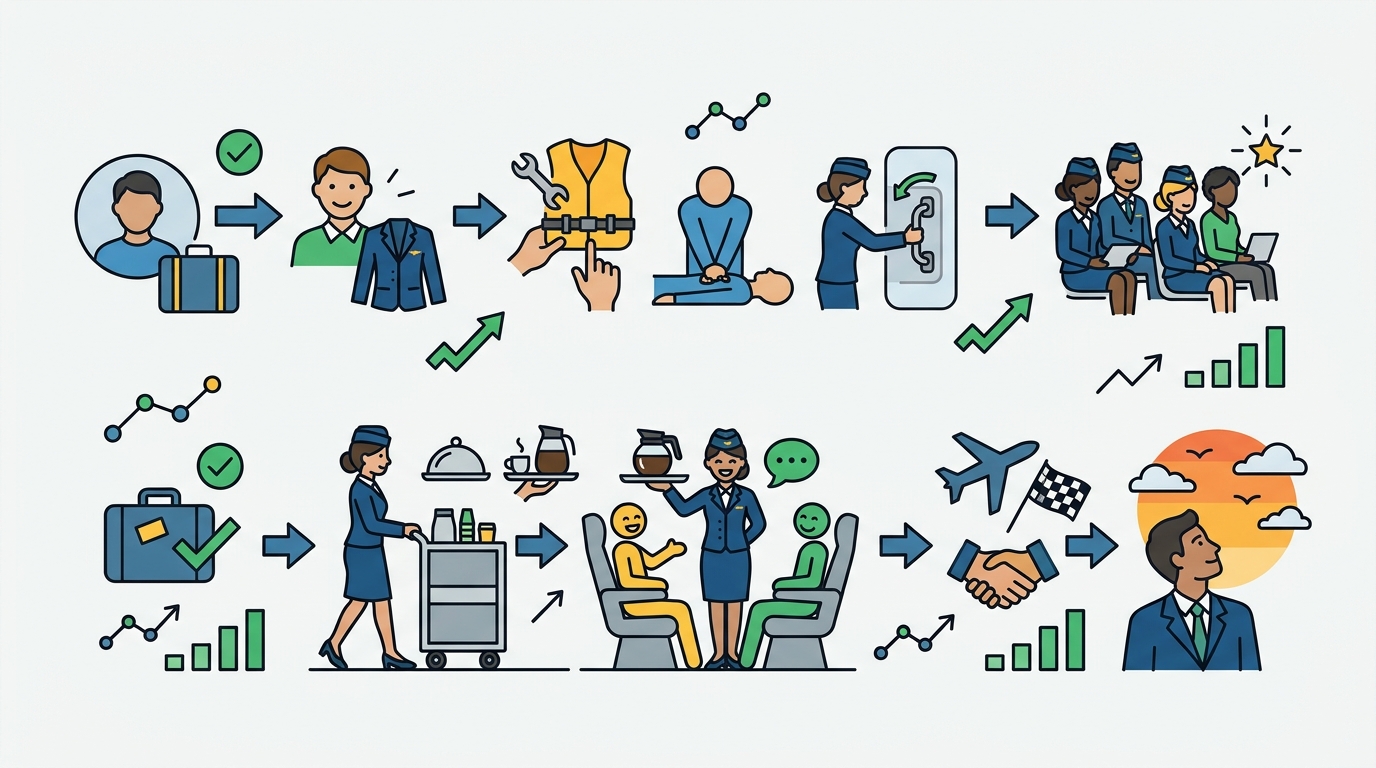
You do not need a college degree to work as cabin crew. In the United States, flight attendants typically need a high school diploma or the equivalent plus work experience in customer service, and the specialized training and federal certification come from the airline after you are hired (U.S. Bureau of Labor Statistics, 2025).
That makes this one of the few aviation jobs where the employer, not the applicant, funds the licensing pathway. Your task as a career changer is to assemble service experience, clear the fixed eligibility gates, and get through a competitive hiring process — not to buy a credential first.
Who Successfully Makes This Transition
Restaurant, hotel and resort staff. The U.S. Bureau of Labor Statistics (2025) names customer service positions in restaurants, hotels or resorts as the typical background, with 1 or 2 years of it before a first cabin crew job. Employers accept that in place of a degree because the hiring screen is behavioural. A server who has handled an allergy incident, or a front-desk agent who has rebooked a stranded guest at midnight, has already shown composure under pressure and exact rule-following — the two things airlines test for.
Retail and inside sales with close public contact. Sales roles involving close public contact sit in the same group of qualifying backgrounds (U.S. Bureau of Labor Statistics, 2025). They prove you can read a stranger quickly, de-escalate, and refuse something politely. They also come with attendance records and contactable supervisors, which matters because every hire passes a background check (U.S. Bureau of Labor Statistics, 2025).
Bilingual speakers from any service field. Flight attendants working international flights may need fluency in a foreign language (U.S. Bureau of Labor Statistics, 2025). A second language can move you up a shortlist faster than coursework, because carriers staff specific routes and cannot teach fluency inside a four-week course.
None of these backgrounds need topping up with a degree, for a structural reason: the technical content — aircraft systems, evacuation drills, medical response — is delivered by the airline under federal training rules after you are hired (U.S. Bureau of Labor Statistics, 2025).
Traditional Path vs. Alternative Path
| Path | Time to Entry | Upfront Cost | Credential Required | Typical Starting Pay |
|---|---|---|---|---|
| Degree-first | 2 to 4 years of study, then the same 1 to 2 years of service experience employers expect (U.S. Bureau of Labor Statistics, 2025), then several weeks to a few months of airline initial training | Tuition and fees you fund yourself for 2 or 4 years, before any airline is involved | No degree is mandated; some airlines prefer applicants with some college courses or a degree (U.S. Bureau of Labor Statistics, 2025) | Set by the airline's seniority pay scale, not by your education — check the current median in the BLS Occupational Outlook Handbook (May 2025) or O*NET OnLine (2025) |
| No-degree | 1 to 2 years of customer service work, then an airline hiring cycle, then initial training of several weeks to a few months (U.S. Bureau of Labor Statistics, 2025) | No tuition for the credential; the airline provides the specialized training after hiring (Assessment.com), and PSA Airlines' four-week initial course is paid with hotel accommodation included (PSA Airlines) | High school diploma or GED (O*NET OnLine, 2026) plus the FAA Certificate of Demonstrated Proficiency, issued after training (U.S. Bureau of Labor Statistics, 2025) | The same scale as degree holders; new hires usually begin on reserve status (Assessment.com) |
Two points are worth underlining. Unlike pilots, flight attendants do not normally pay for years of independent FAA training before applying (Assessment.com) — the cost sits with the employer. And pay here is usually structured around flight hours, per diem for time away from base, and a seniority step scale rather than a flat salary, so compare offers on the scale and the monthly hour guarantee, and verify current figures against the BLS Occupational Outlook Handbook rather than recruitment posts. Outside the United States the certifying body and rules differ; check your own national civil aviation authority.
Step-by-Step Alternative Path
- Finish the high school diploma or GED. This is the education level the occupation is rated at (O*NET OnLine, 2026; My Next Move, U.S. Department of Labor). If you left school early, complete a GED before applying — airlines verify it, and nothing later in the sequence substitutes for it.
- Spend 1 to 2 years in a public-facing service job. Target restaurants, hotels or resorts, or a sales role with close public contact, which the U.S. Bureau of Labor Statistics (2025) names as the usual preparation. Keep a written log of incidents you handled — a medical emergency, an intoxicated customer, an evacuation — because these become your interview answers. My Next Move (U.S. Department of Labor) links to Apprenticeship.gov as a training finder if you want structured customer service training alongside the job.
- Clear the fixed eligibility gates before you apply. You must meet the minimum age, typically 18 or 21 depending on the airline; be eligible to work in the United States; hold a valid passport; pass a background check and drug test; have vision correctable to at least 20/40; and meet any airline-set height requirement (U.S. Bureau of Labor Statistics, 2025). Get the passport issued first — an application in progress will not satisfy a recruiter.
- Apply directly through airline careers pages, including regional carriers. Regionals such as PSA Airlines run their own initial training programs (PSA Airlines). Expect a recorded video interview, online assessments, and a group or face-to-face interview day, followed by background and drug screening (Assessment.com).
- Complete initial training and earn the FAA certificate. Training runs for several weeks or a few months at the airline's flight training center and must be completed for certification (U.S. Bureau of Labor Statistics, 2025); PSA Airlines' version is four weeks in Charlotte, North Carolina, paid, with some weekend sessions (PSA Airlines). The content follows 14 CFR Part 121 subparts N and O, including programmed hours and airplane-type-specific knowledge and skill requirements (U.S. Federal Aviation Administration). Passing earns the FAA Certificate of Demonstrated Proficiency (U.S. Bureau of Labor Statistics, 2025).
- Fly your initial operating experience, then take a reserve line. New hires typically start on reserve status, on call for assignments (Assessment.com). Plan to live near or commute to your assigned base from day one.
- Keep the certificate current. Complete new training for each aircraft type you work and recurrent training every year (U.S. Bureau of Labor Statistics, 2025). Add a second language if you want international routes, since fluency may be required for that flying (U.S. Bureau of Labor Statistics, 2025).
What to Have Ready Instead of a Degree
- A high school diploma or GED certificate you can produce as a document, matching the education level the occupation is rated at (O*NET OnLine, 2026).
- 12 to 24 months of documented service employment in a restaurant, hotel, resort or public-contact sales role, with dates and job titles the airline can verify (U.S. Bureau of Labor Statistics, 2025).
- Two or three reachable supervisor references from those roles, warned in advance that a background check is coming (U.S. Bureau of Labor Statistics, 2025).
- A valid passport in hand, with enough remaining validity to clear international routes (U.S. Bureau of Labor Statistics, 2025).
- Proof you meet the physical gates: vision correctable to at least 20/40, plus the ability to meet airline-set height and reach requirements at an in-person assessment (U.S. Bureau of Labor Statistics, 2025).
- A clean background and readiness for a drug test as a condition of hire (U.S. Bureau of Labor Statistics, 2025).
- Six to eight rehearsed, specific stories of safety enforcement, conflict de-escalation and rule-following from your service jobs — your substitute for coursework in the interview.
- Evidence of any second-language fluency, which carriers use for international staffing (U.S. Bureau of Labor Statistics, 2025).
- Practical availability: several weeks to a few months free for training away from home (U.S. Bureau of Labor Statistics, 2025; PSA Airlines), willingness to relocate to an assigned base, and open availability for reserve.
Frequently asked questions
Will recruiters quietly screen out applicants with no college at all?
Some airlines do state a preference for applicants who have taken college courses or hold a degree (U.S. Bureau of Labor Statistics, 2025), so on a crowded shortlist it can act as a tiebreaker. What carries more weight is documented service work and a clean screening record, because those predict performance on the aircraft. If you have no college credit, make your public-contact history and any second language the loudest things on your application.
Do non-degree hires get paid less than colleagues with degrees?
No. Compensation runs off the airline's seniority scale and flight-hour structure, so two people in the same training class sit on the same step regardless of education. Published medians for the occupation are available from the U.S. Bureau of Labor Statistics for May 2025 and from O*NET OnLine for 2025 — use those rather than numbers quoted in job ads.
Is there actually hiring demand for this route?
Employment is projected to grow from 2025 to 2035 much faster than the average for all occupations, with about 18,500 openings projected each year on average (U.S. Bureau of Labor Statistics, 2025). The occupation is also flagged as a Bright Outlook career, meaning new opportunities are rated very likely (My Next Move, U.S. Department of Labor). Competition for individual classes at well-known carriers remains heavy, which is why regional airlines are the usual entry point.
Could I be rejected for something other than education?
Yes. The common stumbling blocks are not meeting the airline's minimum age of 18 or 21, lacking a valid passport, failing the background check or drug test, or missing the vision and height requirements (U.S. Bureau of Labor Statistics, 2025). Sort the passport and any correctable vision issue early. If your situation raises work authorisation questions, take those to a qualified immigration professional rather than a recruiter.
What if I want to do this outside the United States?
The structure is often similar — employer-provided training rather than a self-funded degree — but the certification is issued under different rules. The FAA Certificate of Demonstrated Proficiency and 14 CFR Part 121 requirements apply to U.S. operations only, so check the cabin crew requirements published by your own country's civil aviation authority before planning a timeline.
Sources
- U.S. Bureau of Labor Statistics — Flight Attendants : Occupational Outlook Handbook (2025)
- O*NET OnLine (U.S. Department of Labor) — 53-2031.00 - Flight Attendants (2026)

Written by
Desmond writes about the mechanics of job searching: resumes, interviews, the long silence after applying. He's fascinated by how much of getting hired depends on luck dressed up as skill.