How to Become a Home Health Aide With No Experience
Most of the work is learned on the job, but which training hours and competency checks you need depends on your state and the type of agency hiring you.
Quick answer
- A degree is not the entry requirement: the U.S. Bureau of Labor Statistics (2025) reports that education requirements for home health and personal care aides vary by employer and that some positions require no formal educational credential.
- Where formal training is required, it is measured in hours rather than years: New York's standardized Home Health Aide Training Program is 75 hours of combined classroom and supervised practical training (New York State Department of Health, 2021), commonly scheduled over 2 to 6 weeks.
- Nursing assistant experience in a hospital, documented out-of-state aide training, recent nursing coursework and military medic or medical technician training can qualify you for a competency evaluation instead of the full 75-hour program in New York (New York State Department of Health, 2021).
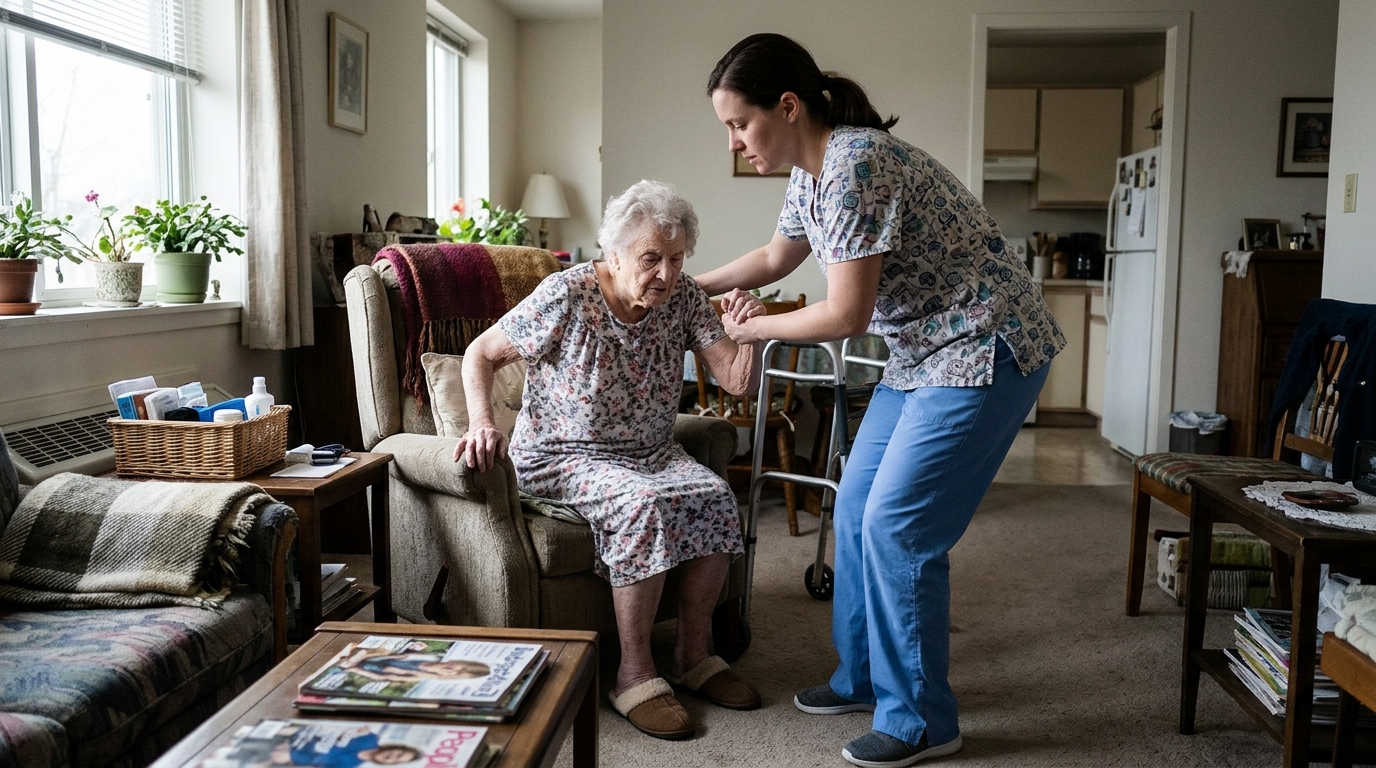
You can start as a home health aide without prior caregiving work. The U.S. Bureau of Labor Statistics (2025) lists no work experience in a related occupation as an entry requirement, says education requirements vary by employer with some positions requiring no formal credential, and describes training as short-term and often completed on the job.
What changes the picture is who hires you. Certified home health and hospice agencies that receive payments from federally funded programs such as Medicare must comply with regulations covering aides' employment (U.S. Bureau of Labor Statistics, 2025), and some states require a licence or certification involving training, a background check and a competency exam. Outside the United States, check your national or regional health regulator, because the hours and tests differ.
Who Successfully Makes This Transition
Retail, hospitality and food service workers. Agencies hire from these jobs constantly because the transferable parts are punctuality, working alone without supervision, handling an upset person calmly, and following a procedure the same way every shift. None of the clinical content is assumed: training typically covers personal hygiene, reading and recording vital signs, infection control and basic nutrition (U.S. Bureau of Labor Statistics, 2025), and it is taught from scratch. Employers accept a shop or restaurant record in place of a credential because the qualification that matters is the certificate of completion you earn after training, not what you did before.
Family and unpaid carers. If you have looked after a parent, partner or disabled relative, you already know transfers, bathing, meal preparation and medication reminders in a home setting. That counts with hiring managers because the occupation's main entry hurdles are a background check and a competency evaluation, not a diploma.
Nursing assistants, nursing students and military medics. These backgrounds can shorten the path outright. In New York, a nursing assistant with recent full-time hospital experience, an individual with documented out-of-state home health aide or nurse aide training, an aide re-entering the field, a nursing student with documented recent coursework mastering home health aide tasks, and veterans trained as military medical technicians or medics are all eligible to complete a competency evaluation program only, in lieu of the standardized 75-hour training (New York State Department of Health, 2021). Other states set their own equivalents, so ask the training program before you enrol.
Traditional Path vs. Alternative Path
| Path | Time to Entry | Upfront Cost | Credential Required | Typical Starting Pay |
|---|---|---|---|---|
| Postsecondary nondegree program first (community colleges and vocational schools offer these for the occupation, U.S. Bureau of Labor Statistics, 2025) | Usually 1 academic term, roughly 4 to 16 weeks of classes before you apply for jobs | Paid by you: tuition at the school's published per-program or per-credit rate, plus background-check and CPR/first aid course fees — ask the college's admissions office for the current rate | Certificate of completion, plus state certification or licensure where the state requires training, a background check and a competency exam (U.S. Bureau of Labor Statistics, 2025) | The same occupational wage scale as the on-the-job route; the U.S. Bureau of Labor Statistics (2025) publishes a median annual and hourly wage for home health and personal care aides |
| Hired first, trained on the job (typical on-the-job training for the occupation is short term, U.S. Bureau of Labor Statistics, 2025) | Commonly 2 to 8 weeks from application to first solo client, including the training hours | Often nothing for the training itself when the agency runs it in-house; you may still pay for the background check and CPR/first aid certification | Certificate of Completion issued after the full training program or the competency evaluation alone (New York State Department of Health, 2021), plus any state certification | Agency entry rate, set by the payer source, your state's wage rules, shift type and whether the client is private-pay |
Neither column carries a reliable national figure, because rates differ by state, by agency, by whether hours are funded publicly or privately, and by overnight or weekend premiums. Look up the current median hourly and annual wage in the U.S. Bureau of Labor Statistics Occupational Outlook Handbook entry for home health and personal care aides, then compare it with the rate written on the agency's own offer. Outside the United States, use your national statistics agency's published pay data for care workers.
Step-by-Step Alternative Path
- Call your state board of health and write down the rule that applies to you. Some states require home health aides to hold a licence or certification involving training, a background check and a competency exam (U.S. Bureau of Labor Statistics, 2025), and the board is the body that confirms the hours and the exam. Ask three things: is certification required, how many training hours, and which training programs are state-approved.
- Apply to agencies that train their own new hires. Target Medicare-certified home health agencies and hospice agencies, which must comply with federal regulations regarding aides' employment (U.S. Bureau of Labor Statistics, 2025) and therefore run or arrange approved training, and private-pay home care agencies in your area. Say plainly on the application that you have no experience and are available for training dates.
- Complete an approved Home Health Aide Training Program. In New York, the program must include classroom and supervised practical training totalling a set minimum of 75 hours, split between classroom hours and supervised practical hours, with maximum trainee-to-approved-Nurse-Instructor ratios for each (New York State Department of Health, 2021). Expect hands-on practice with a volunteer or "pseudo-patient" in a laboratory setting, because federal regulation specifies that a mannequin cannot be used for supervised practical training (New York State Department of Health, 2021).
- If you have a related background, ask about the competency evaluation route before you enrol. Bring documentation — nursing assistant employment records, out-of-state aide training certificates, nursing school transcripts, or military medical technician records — and ask the program whether you qualify to be evaluated in lieu of the full training. If you demonstrate competency in some but not all required content, the program must provide additional training and reevaluate you only in the areas needing remediation (New York State Department of Health, 2021).
- Get first aid and CPR certification. Aides may be required to obtain certification in first aid and cardiopulmonary resuscitation (U.S. Bureau of Labor Statistics, 2025); ask your hiring agency or state board of health which providers' cards they accept, then book the course before your start date rather than after.
- Clear the background check and collect your Certificate of Completion. The certificate is issued on successful completion of either the full training program or the competency evaluation alone (New York State Department of Health, 2021). Keep the original and a scan — it is the document agencies ask for at every future interview.
What to Have Ready Instead of a Degree
- Certificate of Completion from a state-approved Home Health Aide Training Program, or from a competency evaluation program taken in its place (New York State Department of Health, 2021).
- A written record of your training hours, showing the classroom portion and the supervised practical portion separately — New York's program totals 75 hours across both (New York State Department of Health, 2021), and other states set their own minimum.
- Current first aid and CPR certification cards, with expiry dates you can quote at interview (U.S. Bureau of Labor Statistics, 2025).
- Proof you have cleared a criminal background check, which is part of the certification process in states that require a licence or certification (U.S. Bureau of Labor Statistics, 2025).
- Your state registry or certification number, if your state issues one, so a scheduler can verify you in a single phone call.
- Prior-credential documents, if you have them: nursing assistant certification and hospital employment letters, out-of-state aide or nurse aide training certificates, nursing coursework transcripts, or military medical technician or medic training records — these are the categories that can qualify you for competency evaluation only (New York State Department of Health, 2021).
- A one-page skills list naming what you have been evaluated on: personal hygiene, taking and recording vital signs, infection control and basic nutrition (U.S. Bureau of Labor Statistics, 2025).
- Three contactable references, ideally a former supervisor who can speak to reliability, your training program's nurse instructor, and a family whose relative you cared for.
- Practical availability evidence: driving licence and vehicle or a transport plan, and the days and shift times you can genuinely cover, including weekends and overnights.
Frequently asked questions
Will an agency really hire me with no caregiving history at all?
The U.S. Bureau of Labor Statistics (2025) lists no work experience in a related occupation as a requirement for entering this job, so an empty caregiving résumé is normal for new hires. What an employer checks instead is that you can pass a background check, complete the training it is obliged to provide or verify, and show up reliably. Be direct in the application about having no experience and ask when the next training cohort starts.{}
Do employers treat on-the-job trainees as less qualified than college-program graduates?
Both routes end in the same evidence: a certificate of completion and, where the state requires it, a competency exam result and certification. Hiring managers at certified agencies care that your paperwork satisfies the federal and state rules they are audited against, which the New York State Department of Health (2021) describes as consistent across its training approval process. A college certificate can help if you later move into a different health role, but it is not what gets you onto a care schedule.
Is the pay different depending on how I trained?
Pay is attached to the role and the payer, not to where you learned the skills, so two aides with identical duties can earn different rates at different agencies in the same town. The variables that move it are the state you work in, whether the hours are publicly funded or private-pay, shift timing, and overtime. Check the current median hourly and annual wage published by the U.S. Bureau of Labor Statistics for home health and personal care aides before you accept an offer.
Is this a stable field to enter with no experience?
The U.S. Bureau of Labor Statistics (2025) publishes both the number of people employed as home health and personal care aides and a projected employment growth figure for 2025–35; look up the current entry rather than relying on general claims. Stability at the individual level also depends on your agency's client mix and whether you can take weekend and overnight work. Ask at interview how many hours a week new aides typically receive in their first 3 months.
Sources
- U.S. Bureau of Labor Statistics — Home Health and Personal Care Aides : Occupational Outlook Handbook (2025)
- New York State Department of Health, Division of Home and Community Based Services — Guide to Operation of a Home Health Aide Training Program (2021-08)

Written by
Priya tracks wages, layoffs, and the slow shifts in what counts as a stable job. She writes for readers trying to make sense of numbers that rarely match their own experience.