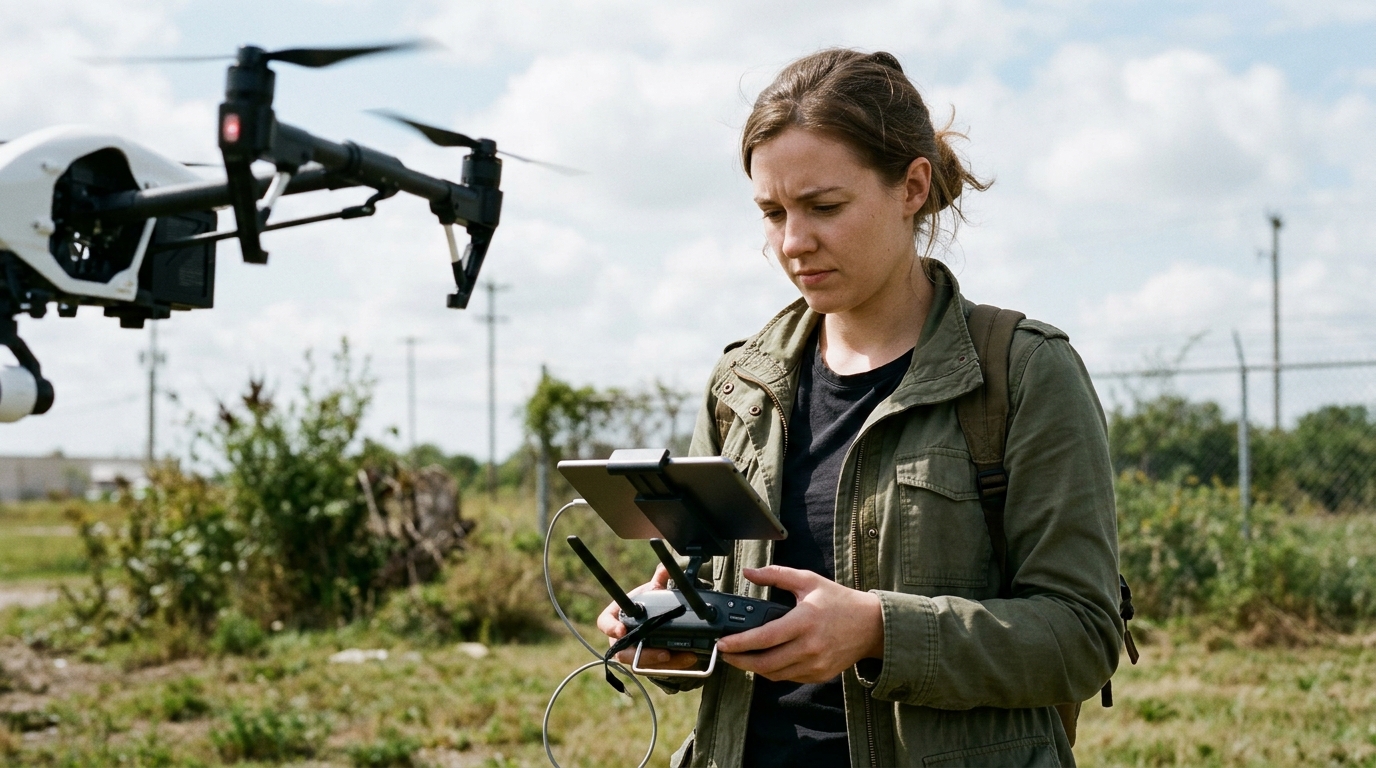
How to Get Your Commercial Drone Pilot License
The FAA's Part 107 Remote Pilot Certificate is the US route into paid drone work — here is how the exam, the IACRA paperwork and recurrency fit together.
Quick answer
- There is no degree or flight-hour prerequisite: first-time applicants must meet the FAA's minimum age and the other eligibility conditions it publishes for the Remote Pilot Certificate (Federal Aviation Administration, 2026-06-09).
- First-time pilots must pass the FAA's initial aeronautical knowledge exam for small unmanned aircraft at an FAA-approved Knowledge Testing Center, with the question count, passing score and subject areas set out in the FAA's official standards document for the test.
- The certificate is specific to the United States and to FAA Part 107 operations, and is kept current by completing the FAA's free online recurrent training course on the recurrency cycle the FAA sets (Federal Aviation Administration, 2026-06-09).

A commercial drone licence in the United States means the FAA Remote Pilot Certificate with a small UAS rating, issued under the Federal Aviation Administration's Small UAS Rule (Part 107). You need it before you fly a drone commercially (Federal Aviation Administration, 2026-06-09), and the path runs through one aeronautical knowledge exam at an FAA-approved Knowledge Testing Center, an online application in IACRA, and a TSA security background check.
Outside the United States the structure looks similar, but the issuing authority is your own national civil aviation regulator — check its drone pages before buying study material.
Why This Credential Matters
In the United States the Federal Aviation Administration is the only body that issues this credential. Obtaining a Remote Pilot Certificate is required in order to fly a drone commercially under the FAA's Small UAS Rule, Part 107 (Federal Aviation Administration, 2026-06-09). "Commercially" is broader than most beginners expect: if a flight furthers a business purpose — photos for a property listing, roof images for an insurance claim, progress shots for a builder — it falls under Part 107 rather than recreational rules.
The employers and clients who buy drone work ask for the certificate before anything else:
- Real estate and marketing agencies buying aerial stills and video
- Construction, surveying and engineering firms tracking site progress and volumes
- Utility, telecom and energy companies inspecting towers, lines and solar arrays
- Insurance carriers and independent adjusters doing roof and catastrophe inspections
- Public safety agencies — fire, search and rescue, law enforcement — running their own UAS programmes
- Film and television production companies, and agricultural service providers
To a hiring manager the certificate signals that you can read airspace classifications and know where you may not fly without authorisation, that you understand weather, loading and performance limits, and that you have passed a TSA security background check, which is completed as part of the application (Federal Aviation Administration, 2026-06-09). You must keep the certificate easily accessible during all UAS operations (Federal Aviation Administration, 2026-06-09), and clients commonly ask to see it before signing a contract.
Be clear about scope. This credential is United States–specific and does not transfer to other countries, and a foreign drone qualification cannot be substituted for it. Holding it does not authorise every flight either — controlled airspace, night work and operations over people each carry their own Part 107 requirements.
Step-by-Step Path to Certification
- Confirm you meet the first-time pilot eligibility requirements. The FAA sets a minimum age for a first-time drone pilot under Part 107, along with the other eligibility conditions for the Remote Pilot Certificate (Federal Aviation Administration, 2026-06-09). Read the FAA's own eligibility page rather than a forum summary.
- Create an IACRA profile and obtain your FAA Tracking Number (FTN). The first step in the certification process is obtaining an FTN by creating a profile in IACRA, the FAA's Integrated Airman Certification and Rating Application system, before registering for the knowledge test (Federal Aviation Administration, 2026-06-09). Write the FTN down; you will quote it when booking the exam and again when applying.
- Study to the FAA's published standards. The FAA publishes the official standards document describing what the Remote Pilot knowledge test covers (Federal Aviation Administration, 2026-06-09). Topic areas include regulations, airspace classification, weather effects, loading and performance, emergency procedures, crew resource management, radio communication, the physiological effects of drugs and alcohol, aeronautical decision-making, airport operations, maintenance and preflight inspection, and night operation (Federal Aviation Administration, 2026-06-09). Work through sectional charts until reading airspace is automatic.
- Schedule and sit the initial aeronautical knowledge exam. Applicants must schedule an appointment at an FAA-approved Knowledge Testing Center and bring a government-issued photo ID (Federal Aviation Administration, 2026-06-09). You receive a Knowledge Test Exam ID with your result; keep the printed report.
- Complete FAA Form 8710-13 in IACRA. After passing, complete FAA Form 8710-13, the FAA Airman Certificate and/or Rating Application, electronically via IACRA, entering your Knowledge Test Exam ID (Federal Aviation Administration, 2026-06-09). It may take time after the test date for the result to appear in IACRA before the application can be completed (Federal Aviation Administration, 2026-06-09).
- Clear the TSA security background check and print your temporary certificate. Once the check is complete, a confirmation email provides instructions to print a temporary Remote Pilot Certificate from IACRA (Federal Aviation Administration, 2026-06-09). That temporary certificate lets you start working.
- Receive and carry the permanent certificate. It is sent by mail once all other FAA-internal processing is complete (Federal Aviation Administration, 2026-06-09).
If you already hold a Part 61 pilot certificate and completed a flight review within the period the FAA specifies, there is an alternate path: instead of the standalone knowledge test, complete the FAA's named initial online training course for Part 61 holders, then apply (Federal Aviation Administration, 2026-06-09).
Exam and License Details
| Detail | Specification |
|---|---|
| Credential | FAA Remote Pilot Certificate with a small UAS rating, under Part 107 (Federal Aviation Administration, 2026-06-09) |
| Exam | The FAA's initial aeronautical knowledge exam for small unmanned aircraft, required of all first-time pilots (Federal Aviation Administration, 2026-06-09) |
| Number of questions | Fixed by the FAA and published in its official standards document for the Remote Pilot knowledge test; confirm the current count there before booking |
| Passing score | Set by the FAA and published alongside those test standards; your score report states the result and your Knowledge Test Exam ID |
| Fee | Set and collected by the FAA-approved Knowledge Testing Center you book with, so the amount follows that center's published price — confirm it at booking |
| Where it is taken | In person at an FAA-approved Knowledge Testing Center, by appointment, with government-issued photo ID (Federal Aviation Administration, 2026-06-09) |
| Retake policy | Governed by the FAA's rules for airman knowledge tests, including the waiting period before a retest; each attempt is booked and paid for separately |
| Application | FAA Form 8710-13, filed electronically in IACRA using your FTN and Knowledge Test Exam ID (Federal Aviation Administration, 2026-06-09) |
| Security vetting | TSA security background check, completed as part of the IACRA application (Federal Aviation Administration, 2026-06-09) |
| Renewal requirement | Complete the FAA's free online recurrent training course for Part 107 holders on the recurrency cycle the FAA sets; holders who also have a current Part 61 flight review complete a different free recurrent course instead (Federal Aviation Administration, 2026-06-09) |
| Geographic validity | United States only, for operations under FAA Part 107 |
Realistic Timeline
Treat the study estimates as planning figures for a self-paced beginner, not FAA requirements.
- Week 1 — eligibility and setup. Read the FAA's first-time pilot eligibility requirements, then create your IACRA profile and obtain your FAA Tracking Number. This is an evening's work and must happen before you register for the test.
- Month 1 — core study. Using the FAA's standards document, work through regulations, airspace classification and weather. Plan 15 to 20 hours if charts are new to you.
- Month 2 — remaining topics and practice tests. Cover loading and performance, emergency procedures, crew resource management, radio communication, airport operations, maintenance and preflight inspection, and night operation. Book your testing center appointment once practice scores are steady; busy centers run 2 to 4 weeks out.
- Month 2 to 3 — sit the exam. Attend with government-issued photo ID and keep the score report safe.
- Month 3 — apply in IACRA. File Form 8710-13 with your Exam ID, allowing several business days after the test date for the result to post first.
- Month 3 to 4 — security check and temporary certificate. When the check clears, the confirmation email explains how to print the temporary certificate, and paid flights can begin with it accessible on every job.
- Month 4 onward — permanent certificate and recurrency. The card arrives by mail after FAA-internal processing. Diarise the free online recurrent course before your knowledge recency lapses.
A focused candidate with some aviation background can compress this to 4 to 6 weeks end to end; a part-time beginner is more realistically looking at 3 to 4 months.
Frequently asked questions
Can I use this certificate to fly commercially in another country?
No. The Remote Pilot Certificate authorises commercial drone operations in the United States under FAA Part 107 and carries no standing with other national aviation regulators. If you take contracts abroad you need the credential issued by that country's civil aviation authority, and you should read its rules weeks before travelling with aircraft.
What should I budget overall, beyond the test appointment?
The one unavoidable cost is the knowledge test charge published by the testing center you choose. Everything else is optional and within your control: studying from the FAA's own free standards and handbooks costs nothing, while prep courses, practice-question subscriptions and printed sectional charts add to the total. Price the appointment first, then decide how much study support you actually want.
What happens if I do not pass on the first attempt?
You rebook a fresh appointment and pay again once the FAA's required interval between attempts has elapsed. Your score report names the subject areas where you lost marks, so target revision there instead of restudying everything. Repeat candidates most often come unstuck on airspace and chart interpretation.
Does the certificate ever expire outright?
The certificate itself is not reissued on a cycle, but your ability to exercise its privileges depends on keeping aeronautical knowledge current through the FAA's free online training. If that recency lapses you stop being eligible to operate under Part 107 until the training is completed again. Set a calendar reminder a month ahead, because clients will ask you to confirm you are current.
Sources
- Federal Aviation Administration — Become a Certificated Remote Pilot (2026-06-09)

Written by
Marisol steers Jobladderhq's coverage of hiring trends and the strange rituals of modern recruiting. She's drawn to the gap between what job ads promise and what the work actually feels like. Her editing hand favors clarity over jargon, always.