Medical Biller Job Description: Duties, Skills, and Salary
Turning clinical notes into paid claims is detailed, deadline-driven desk work, and this guide covers what that looks like before you commit to training.
Quick answer
- Core task: build, submit and follow up claims using the diagnosis and procedure code sets your payers require, inside a practice management or billing system.
- Settings include hospitals, physician and dental practices, outpatient surgery centres, labs and third-party billing companies; remote and hybrid roles are common.
- Pay is normally an hourly wage or annual salary — check your national statistics agency (BLS in the US, ONS in the UK, Statistics Canada, ABS in Australia) for current figures.
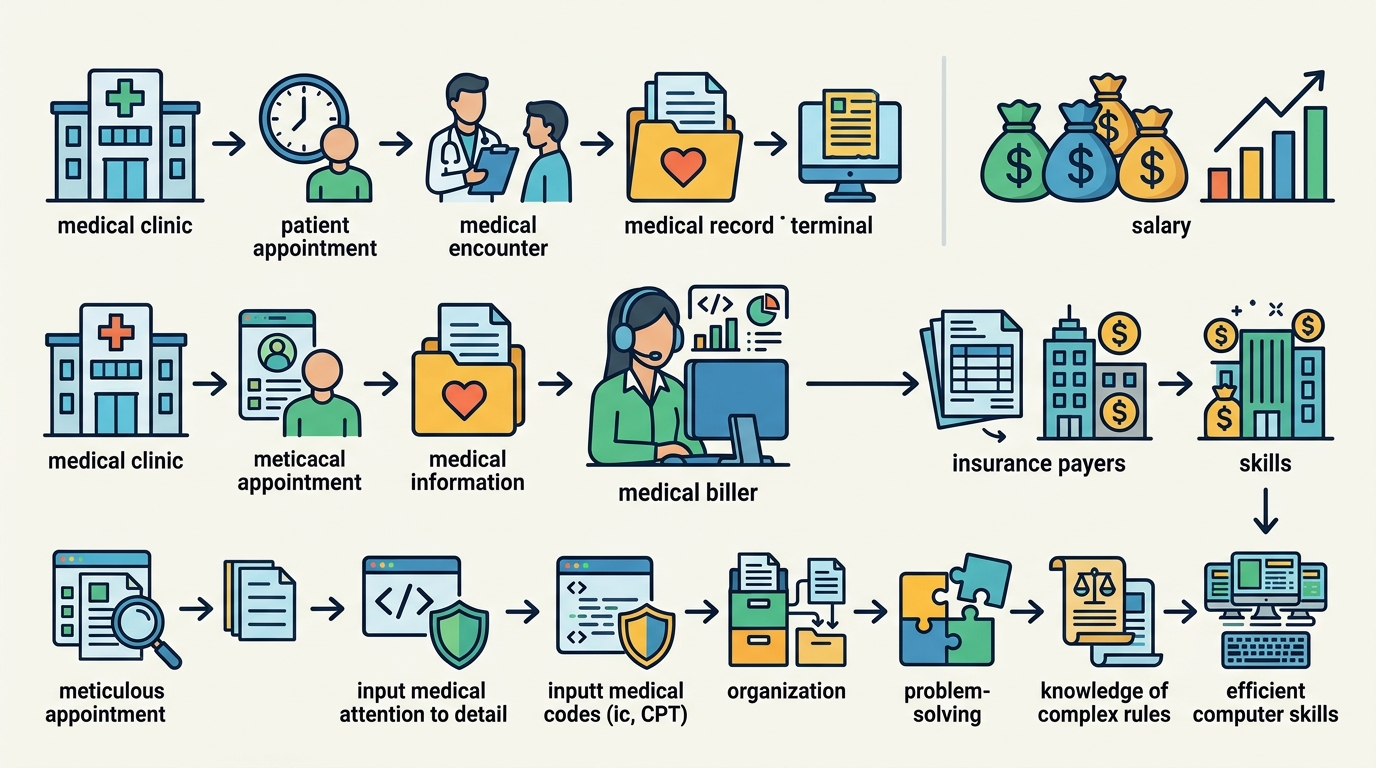
A medical biller turns the services a clinician provided into a coded claim, sends it to the patient's insurer or health fund, and follows the money until the account is settled. The work is screen-based: practice management software, payer portals, denial queues and patient statements, with bursts of phone and email contact.
Entry is usually through a short certificate or on-the-job training rather than a degree, though the credential expected and the job title used differ by country and employer.
What a Medical Biller Does
A medical biller is the link between a clinical encounter and the payment for it. After a patient is seen, the biller checks that the diagnosis and procedure codes on the chart are complete, confirms insurance or health fund coverage, builds the claim in the billing system, and submits it to the payer through a clearinghouse or payer portal. When the payer responds, the biller posts the payment, works any rejection or denial, appeals where appropriate, and bills the patient for the remaining balance.
The job exists wherever clinical services are paid for by a third party: hospital revenue cycle departments, physician group practices, dental and optometry clinics, outpatient surgery centres, behavioural health clinics, imaging centres and laboratories, home health and hospice agencies, and third-party billing companies that handle claims for many small practices at once. Insurers and health funds also hire people with billing experience to work the other side of the claim.
In smaller practices one person codes, bills and handles patient accounts. In large hospital systems the roles split: coders assign codes, billers submit and chase claims, and separate staff handle collections. Entry-level billers usually post charges and fix simple rejections; experienced billers own denials, appeals and aging reports. Titles vary — medical billing specialist, patient account representative, revenue cycle specialist — so read the duty list rather than the title.
A Typical Day
- Opens the practice management system and reviews the day's work queue: unbilled encounters, claim edits and rejections from the overnight submission batch.
- Runs eligibility and benefits checks for scheduled patients through payer portals, flagging lapsed coverage or services needing prior authorisation.
- Compares encounter documentation in the electronic health record against the assigned diagnosis and procedure codes, and queries the clinician or coder when the note does not support what was billed.
- Scrubs claims and corrects what the clearinghouse flags — mismatched modifiers, missing referring provider details, invalid patient identifiers — then releases the batch.
- Posts payments from electronic remittance advice files and paper explanation-of-benefits documents, reconciling them against the day's deposits.
- Works the denial list: reads the denial reason code, gathers supporting documentation, and resubmits or writes an appeal inside the payer's filing deadline.
- Pulls the accounts receivable aging report and chases claims past 30, 60 and 90 days, logging payer reference numbers in the account notes.
- Takes patient calls about statements, explains what the insurer covered and why a balance remains, and sets up payment plans where the practice allows.
Salary and Job Outlook
Pay for medical billers is almost always a straight hourly wage or annual salary; commission is rare, though some third-party billing companies pay production bonuses tied to collections. Figures differ sharply by country, by state or region, and by whether the employer is a hospital system, a small practice or an outsourced firm, so the table describes what shapes pay rather than quoting a number.
| Experience level | What shapes pay at this level | Where to check current figures |
|---|---|---|
| Entry (0–2 years) | Hourly wage at the practice's administrative band; duties limited to charge posting and simple rejections. | National statistics agency wage tables for the occupation code |
| Mid (2–5 years) | Higher band for staff who work denials and appeals independently across several payer rule sets. | Agency wage tables plus current job postings in your region |
| Experienced / lead (5+ years) | Team lead or revenue cycle analyst rates; often requires certification and multi-specialty experience. | Agency wage tables, professional association salary surveys |
| National median | Published per occupation, not per job title — billing duties sit across more than one classification. | Official national wage data for the current release year |
Where to look: in the United States, the Bureau of Labor Statistics Occupational Employment and Wage Statistics under Medical Records Specialists (29-2072) and Billing and Posting Clerks (43-3021); in the UK, the ONS Annual Survey of Hours and Earnings under the relevant SOC codes; in Canada, Statistics Canada and Job Bank under the applicable NOC; in Australia, ABS earnings data and Jobs and Skills Australia. Take the figure from the most recent release and note its year. For outlook, use the official projections series — BLS Employment Projections in the US, or your national employment agency's equivalent.
Skills and Qualifications
Hard skills and credentials you can obtain and prove:
- Working knowledge of the diagnosis code set used in your country (ICD-10-CM in the US, ICD-10 or ICD-11 variants elsewhere) and the procedure code set your payers require (CPT and HCPCS in the US).
- Hands-on use of at least one electronic health record with an integrated billing module, plus clearinghouse and payer portal navigation.
- Spreadsheet skills for aging reports and reconciliation: filtering, pivot tables, basic formulas.
- Patient privacy compliance training for your jurisdiction (HIPAA in the US, UK GDPR and NHS information governance, provincial health privacy legislation in Canada, the Privacy Act in Australia).
- A recognised certification where employers expect one: in the US, the AAPC's Certified Professional Biller (CPB) or Certified Professional Coder (CPC), or AHIMA's Certified Coding Specialist (CCS). Elsewhere, a health administration or medical office certificate from a recognised college.
- Typing and ten-key accuracy, since rejections often come from transposed digits.
Soft skills, judged at interview and on the job:
- Persistence on the phone with payer representatives, including knowing when to escalate.
- Non-defensive explanation of bills to patients upset about a balance.
- Written clarity for appeal letters that must cite policy language and documentation.
- Comfort with deadlines set by someone else, since timely filing limits are fixed.
How to Get Started
- Confirm the entry requirement where you live (1–2 weeks). Read 15–20 current postings for medical biller, patient account representative and revenue cycle specialist roles in your area. Note which require certification, which accept a secondary school qualification plus training, and which name specific software.
- Complete a billing and coding programme (3–12 months). Community colleges, technical institutes and professional associations run certificates covering medical terminology, the code sets, payer rules and claim workflow. Choose one whose award employers in your country recognise.
- Sit a certification exam if your market expects one (2–3 months of study). In the US that usually means the CPB or CPC through AAPC, or the CCS through AHIMA; these require membership and continuing education to stay active.
- Get supervised exposure to real claims (3–6 months). Look for an externship built into your course, a front-desk or medical records role in a clinic, or a temporary post in a hospital patient accounts department.
- Build a software line on your CV. List every EHR, billing platform and clearinghouse you have used, the specialties you have billed, and the payer types handled — government schemes, private insurers, workers' compensation.
- Apply to third-party billing companies and large practices first. They hire in volume, train new billers on their own workflow, and are the usual route into hospital revenue cycle teams later.
Frequently asked questions
Do you need a degree to be a medical biller?
In most countries a degree is not the standard route; a secondary school qualification plus a billing and coding certificate is typical, and some practices train administrative staff on the job. Where a credential is expected, it is usually a certification such as the CPB, CPC or CCS in the US, or a college medical office certificate elsewhere. Revenue cycle analyst and management roles are the ones that more often list an associate or bachelor's degree.
What is the difference between a medical biller and a medical coder?
A coder reads clinical documentation and assigns the diagnosis and procedure codes; a biller takes those codes, builds the claim, submits it and pursues payment. In small practices one person does both, which is why training programmes usually cover them together. In hospitals the functions sit in separate departments with different credentials.
Is being a medical biller stressful?
The pressure comes from fixed timely filing deadlines, month-end collection targets and calls with patients who did not expect a balance. It is not physically demanding, but it is sustained screen work with a queue that refills daily. People who dislike repeated payer phone calls and denial paperwork tend to find it wearing.
Can medical billers work from home?
Yes — claim submission, denial work and payment posting can all be done remotely, and third-party billing companies in particular hire remote staff. Employers usually require a secure private workspace and compliance with health privacy rules in your jurisdiction, and many expect six to twelve months on site first. Roles tied to front-desk check-in or paper mail handling stay on site.
How long does it take to become a medical biller?
A certificate programme typically runs three to twelve months depending on full or part-time study, plus two to three months of preparation if you sit a certification exam. Many people start applying before results arrive, using externship or clinic reception experience. Reaching senior or lead level usually takes a further three to five years of multi-specialty claim work.

Written by
Wyatt covers work outside the office: construction, logistics, repair, and the people who keep things running. He's skeptical of career advice that assumes everyone sits at a desk.