What Does a Plumber Do? A Day in the Life
Inside the callouts, pipe cuts and pressure tests that fill a plumber's shift, plus the apprenticeships, licences and pay sources worth checking first.
Quick answer
- Most plumbers, pipefitters and steamfitters learn the trade through an apprenticeship combining paid on-the-job hours each year with classroom instruction (U.S. Bureau of Labor Statistics, 2025).
- Most US states and some localities require plumbers to be licensed, typically after several years of experience and a passing exam (U.S. Bureau of Labor Statistics, 2025); UK gas heating work requires Gas Safe Register listing (National Careers Service).
- Evening and weekend work is common because of emergency call-outs (U.S. Bureau of Labor Statistics, 2025).
A plumber installs, tests, repairs and maintains the pipes, fixtures and appliances that move water, waste, gas and steam through buildings. The work spans homes, businesses, factories and construction sites, and mixes planned installation jobs with emergency breakdowns that can land in the evening or at a weekend (U.S. Bureau of Labor Statistics, 2025).
Most people enter through a paid apprenticeship rather than a degree, and in many countries you need a licence or registration before you can work unsupervised — especially on gas.
What a Plumber Does
A plumber keeps liquids and gases moving safely through a building — clean water in, waste water out, and in many roles heating or process pipework as well.
Core duties for plumbers, pipefitters and steamfitters include preparing cost estimates, reading blueprints, installing pipes and fixtures, inspecting and testing pipe systems, troubleshooting malfunctioning systems, and maintaining and repairing existing plumbing (U.S. Bureau of Labor Statistics, 2025). UK tasks are described similarly: installing and repairing water, heating and drainage systems; cutting, shaping and joining pipes and fittings; servicing gas and oil-fired central heating systems and radiators; responding to emergency call-outs; and fitting weather-proof materials and flashings to roofs, chimneys and walls (National Careers Service).
The settings are wherever pipes exist: houses and flats, offices, shops, schools, hospitals, hotels, factories and plant rooms, and new-build or refurbishment construction sites (U.S. Bureau of Labor Statistics, 2025). Some plumbers work for a contractor on new installations, some for a maintenance firm or facilities team, and some are self-employed on domestic call-outs.
Duties split by experience. Apprentices and plumber's mates carry and prepare materials, cut pipe runs, strip out old fittings and work under supervision. Licensed or qualified plumbers price jobs, sign off testing, interpret drawings and regulations, and take responsibility for whether a system is safe to use.
A Typical Day
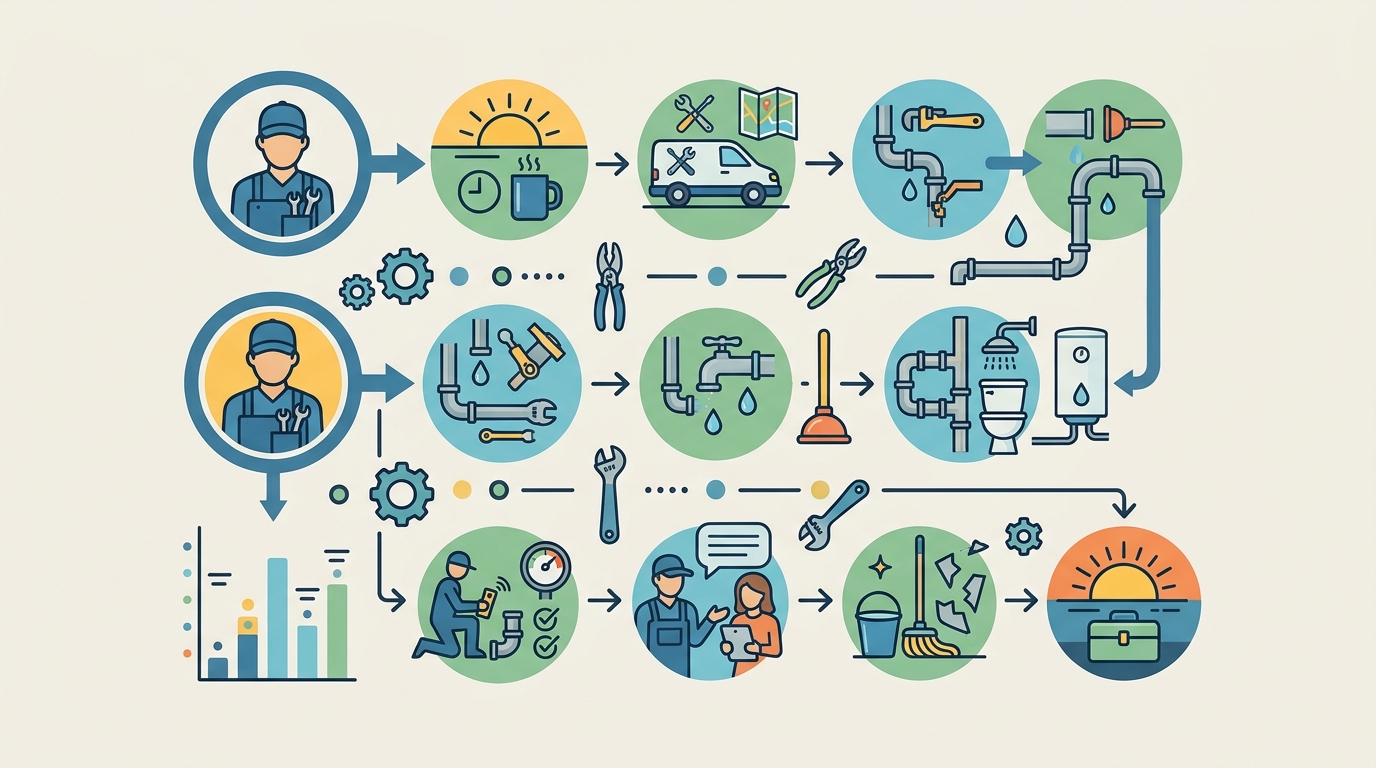
- Checks the job list and call-out queue on a phone or tablet scheduling app, then loads fittings into the van against a stock list.
- Opens the first installation visit by reading blueprints or site drawings to confirm pipe runs and fixture positions (U.S. Bureau of Labor Statistics, 2025).
- Isolates the system before work starts, shutting off steam, water or other gases and liquids from pipe sections using valve keys or wrenches (O*NET OnLine, U.S. Department of Labor).
- Cuts, shapes and joins pipe and fittings using drills, saws, welding torches and press fitting tools (U.S. Bureau of Labor Statistics, 2025).
- Fits sanitaryware, radiators, valves and appliances, then refills and pressure-tests for leaks before closing up walls or floors.
- Breaks off for an emergency call-out — a burst pipe or blocked waste — clearing it with drain cleaning tools or camera rods and making the system safe (U.S. Bureau of Labor Statistics, 2025; National Careers Service).
- Services a gas or oil-fired central heating system and radiators, logging the checks on a service record (National Careers Service).
- Prepares a cost estimate for follow-up work, listing labour hours and materials (U.S. Bureau of Labor Statistics, 2025).
- Closes job sheets, reorders van stock and books the next visit.
Salary and Job Outlook
Pay is usually an hourly rate for employed plumbers, a training rate that steps up through each apprenticeship year, and job-priced or day-rate work if you are self-employed. Overtime and call-out premiums can form a large share of take-home pay. Rates vary by country, region, employer, licence level and gas qualifications, so check a current published figure.
| Stage | How pay usually works | Where to check the current figure |
|---|---|---|
| Entry (apprentice or mate) | Training wage rising each apprenticeship year; vacancies state an annual wage | Find an Apprenticeship listings (UK); local apprenticeship sponsors elsewhere |
| Mid (qualified or licensed) | Hourly rate plus overtime and call-out premiums | U.S. Bureau of Labor Statistics Occupational Outlook Handbook (2025); National Careers Service average salary range (UK); Job Bank hourly wage range (Canada) |
| Experienced (supervisor, gas-registered, self-employed) | Higher hourly or day rate; self-employed plumbers price per job and carry costs | Same national sources, filtered by region or province |
| National median | The U.S. Bureau of Labor Statistics publishes a median annual wage for plumbers, pipefitters and steamfitters, with stated amounts the lowest 10 percent earn below and the highest 10 percent earn above (2025) | Occupational Outlook Handbook |
Sources: U.S. Bureau of Labor Statistics (2025); National Careers Service, UK; Job Bank, Employment and Social Development Canada.
The U.S. Bureau of Labor Statistics also publishes a projected growth rate for the occupation for 2025–35 and a projected number of annual openings over the decade (2025). Check both before judging demand locally.
Skills and Qualifications
Hard skills and credentials you can obtain and prove
- Completion of a recognised apprenticeship — most plumbers, pipefitters and steamfitters learn this way, with paid on-the-job hours each year (U.S. Bureau of Labor Statistics, 2025).
- A plumbing licence: most US states and some localities require one, typically after set years of experience and a passing exam (U.S. Bureau of Labor Statistics, 2025).
- Gas Safe Register listing for domestic gas heating work in the UK, plus a CSCS card or equivalent to work on a construction site (National Careers Service).
- Blueprint reading, including pipe schedules and isometrics (U.S. Bureau of Labor Statistics, 2025).
- Competent use of drills, saws, welding torches, press fitting tools and drain cleaning tools (U.S. Bureau of Labor Statistics, 2025).
- Pressure and leak testing, isolating sections with valve keys and wrenches, and troubleshooting faults (U.S. Bureau of Labor Statistics, 2025; O*NET OnLine).
- Estimating labour and materials for a job (U.S. Bureau of Labor Statistics, 2025).
- A full driving licence, since most plumbers travel between sites with a stocked van.
- Physical capability for kneeling, lofts and crawl spaces, lifting cylinders, and roof work.
Soft skills
- Explaining faults and costs to customers facing water damage or no heating.
- Methodical fault-finding when the obvious cause is not the real one.
- Rescheduling jobs when an emergency call-out cuts into the day.
- Working safely alongside electricians, joiners and site supervisors.
How to Get Started
- Check the entry requirement for your country. The U.S. Bureau of Labor Statistics states a typical entry-level education for the occupation (2025), and ONET places it in Job Zone Three, medium preparation — usually one or two years of combined on-the-job and informal training through a recognised apprenticeship (ONET OnLine).
- Pick a route in. UK options are a college course such as plumbing studies or plumbing and domestic heating, a T Level in Building Services Engineering for Construction, a Level 3 Advanced Apprenticeship such as Plumbing and Domestic Heating Technician, work as a plumber's mate, or direct application with experience (National Careers Service). Elsewhere, start with apprenticeship sponsors and trade bodies registered in your state or province.
- Apply for an apprenticeship and expect it to run the number of years set by your national scheme, with paid on-the-job hours each year plus technical instruction (U.S. Bureau of Labor Statistics, 2025). Listings state the wage up front.
- Get site-ready while training: a CSCS card or local equivalent, health and safety training and a driving licence (National Careers Service).
- Log your hours and keep evidence of installations, tests and sign-offs — licensing bodies want documented experience.
- Sit the licensing exam for your state or locality once you meet the experience requirement (U.S. Bureau of Labor Statistics, 2025), and add gas registration if you want heating work.
- Apply to plumbing and heating firms, maintenance contractors, facilities teams and housing providers, listing your tickets and the systems you have worked on.
Frequently asked questions
Do you need a degree to be a plumber?
No. Plumbers, pipefitters and steamfitters most commonly learn through an apprenticeship rather than higher education (U.S. Bureau of Labor Statistics, 2025), and O*NET classes the occupation as medium preparation (O*NET OnLine). What you usually do need, in most US states and some localities, is a licence requiring documented years of experience plus a passing exam (U.S. Bureau of Labor Statistics, 2025). UK routes include a college course, a Level 3 Advanced Apprenticeship or starting as a plumber's mate (National Careers Service).
Is being a plumber stressful?
The pressure comes from specific causes. Emergency call-outs mean evening and weekend work is common (U.S. Bureau of Labor Statistics, 2025), so your day can be rearranged by someone else's burst pipe. The physical side — kneeling, crawl spaces, lifting cylinders, roof flashings — adds fatigue, and customers are often anxious about water damage or no heating.
How long does it take to become a qualified plumber?
It depends on the scheme. In the United States, most plumbers complete an apprenticeship lasting a set number of years with paid on-the-job hours each year plus technical instruction (U.S. Bureau of Labor Statistics, 2025). In the UK, a Level 3 Advanced Apprenticeship such as Plumbing and Domestic Heating Technician is a standard route, alongside college courses (National Careers Service). Licensing then adds its own experience requirement.
What tools does a plumber use every day?
Drills, saws, welding torches, press fitting tools and drain cleaning tools are the standard kit (U.S. Bureau of Labor Statistics, 2025). Valve keys and wrenches shut off steam, water or other gases and liquids from pipe sections before work starts (O*NET OnLine). Most plumbers also carry pressure-testing equipment and a van stocked with pipe, fittings and common spares.
Can you work on gas boilers as a plumber?
Not automatically. In the UK, working on domestic gas heating systems requires being on the Gas Safe Register (National Careers Service), which is separate from general plumbing qualifications. Other countries run their own gas registration or endorsement schemes, so check with your national, state or provincial regulator before taking gas work.
Sources
- U.S. Bureau of Labor Statistics — Plumbers, Pipefitters, and Steamfitters : Occupational Outlook Handbook (2025)
- O*NET OnLine (U.S. Department of Labor) — 47-2152.00 - Plumbers, Pipefitters, and Steamfitters

Written by
Marisol steers Jobladderhq's coverage of hiring trends and the strange rituals of modern recruiting. She's drawn to the gap between what job ads promise and what the work actually feels like. Her editing hand favors clarity over jargon, always.