What Does a Social Worker Do? A Day in the Life
From morning case notes to afternoon home visits and court reports, here is how the hours break down and what training the work actually demands.
Quick answer
- A bachelor's degree in social work (BSW) is the most common requirement for entry-level nonclinical roles; clinical social workers typically need a master's (MSW), generally two years (U.S. Bureau of Labor Statistics, 2025).
- All US states require clinical social workers to be licensed, and some states also require a licence or credential for nonclinical roles (U.S. Bureau of Labor Statistics, 2025).
- The US median annual wage was $61,780 in May 2025, with the lowest 10 percent under $42,790 and the highest 10 percent over $100,090 (U.S. Bureau of Labor Statistics, 2025).
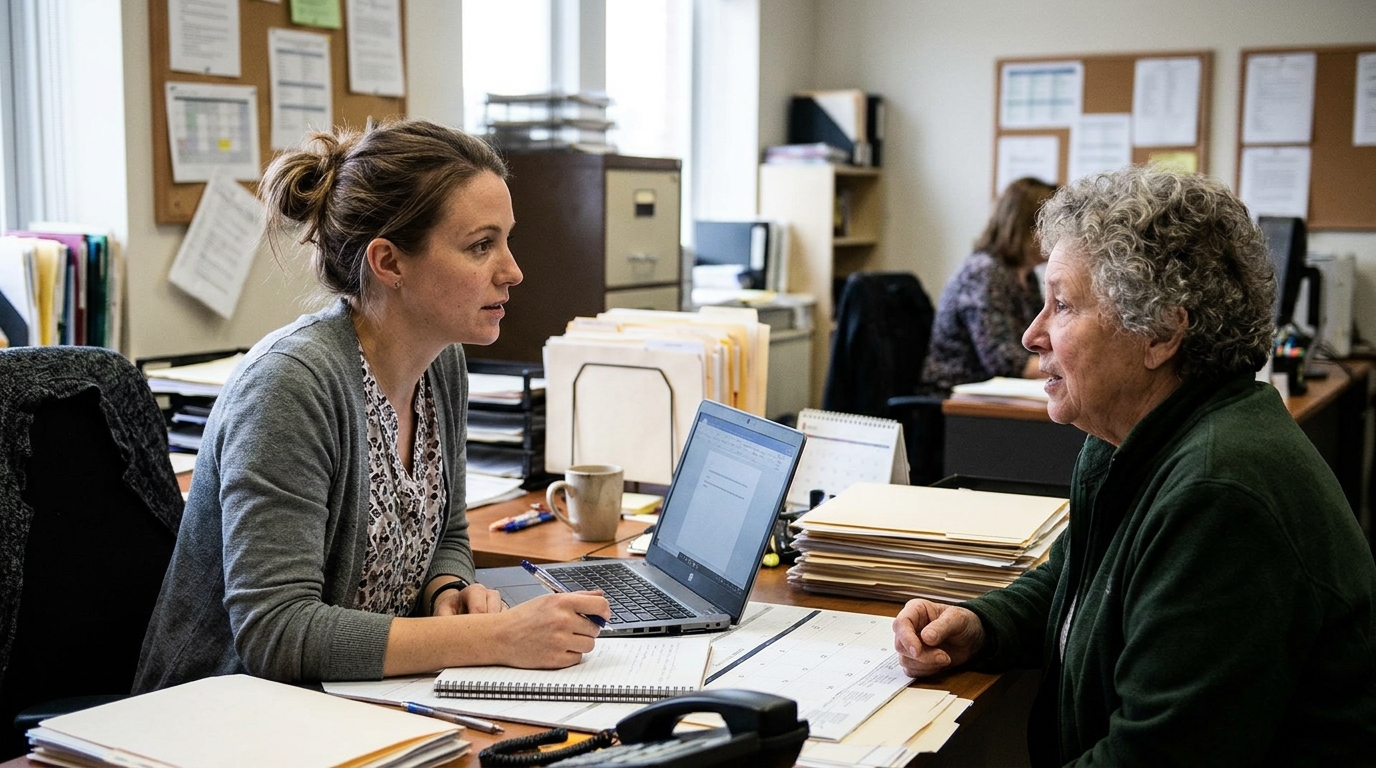
A social worker helps individuals, families and groups prevent and cope with problems in everyday life, while clinical social workers also diagnose and treat mental, behavioural and emotional problems (U.S. Bureau of Labor Statistics, 2025). Day to day that means assessing needs, referring people to community resources, responding to crises, monitoring progress and keeping case files up to date (U.S. Bureau of Labor Statistics, 2025).
The job exists in child welfare and human service agencies, healthcare providers and schools (U.S. Bureau of Labor Statistics, 2025), so your week looks different depending on which you join. Entry routes, licensing and pay are set nationally or by state, so check the rules where you intend to work.
What a Social Worker Does
Social workers help individuals, groups and families prevent and cope with problems in their everyday lives; clinical social workers also diagnose and treat mental, behavioural and emotional problems (U.S. Bureau of Labor Statistics, 2025).
The core tasks hold across settings: identifying people and communities who need help, assessing clients' needs and goals, helping clients adjust to life changes, researching and referring clients to community resources, responding to crisis situations, monitoring progress and maintaining case files and records. Some also provide psychotherapy services (U.S. Bureau of Labor Statistics, 2025).
You will find these roles in child welfare and human service agencies, healthcare providers and schools (U.S. Bureau of Labor Statistics, 2025). In the United States the largest employers are state and local government excluding education and hospitals (27 percent), individual and family services (17 percent), ambulatory healthcare services (15 percent), hospitals (10 percent) and educational services (10 percent) (U.S. Bureau of Labor Statistics, 2025).
The work splits into recognised specialities. Of about 816,100 social worker jobs in 2025, child, family and school social workers accounted for 405,100, healthcare social workers 194,800 and mental health and substance abuse social workers 138,900 (U.S. Bureau of Labor Statistics, 2025). A school-based worker acts as liaison between students, homes, schools, family services, child guidance clinics, courts, protective services and doctors (O*NET OnLine); a hospital-based worker spends more time on discharge planning and arranging care after a patient leaves the ward.
A Typical Day
No two caseloads look alike, but a day in an agency, hospital or school team usually runs roughly like this:
- Opens the electronic case management system at the start of shift to check overnight referrals, crisis notes and any on-call handover.
- Prioritises the caseload by deadline and risk, flagging visits tied to a court date, discharge date or statutory review.
- Interviews clients individually, in families or in groups, assessing their situations, capabilities and problems to determine what services are required (O*NET OnLine).
- Travels to home, ward or classroom visits, carries out safety checks and records observations the same day.
- Refers clients to community resources — housing, food assistance, benefits, substance use treatment — and confirms the referral was received, not just sent.
- Responds to crisis situations as they come in (U.S. Bureau of Labor Statistics, 2025), which can displace the rest of the planned day.
- Attends a case conference with teachers, nurses, probation officers or court staff, acting as liaison between them (O*NET OnLine).
- Maintains case history records and prepares reports (O*NET OnLine), including court or review documents with fixed formats and deadlines.
Entry-level nonclinical workers spend most of this time on assessment, referral and case coordination. Experienced clinical social workers carry the same administrative load but also diagnose and treat mental, behavioural and emotional problems and provide psychotherapy (U.S. Bureau of Labor Statistics, 2025), usually in therapy sessions blocked into the day.
Salary and Job Outlook
| Level or measure | Annual pay (United States) |
|---|---|
| Entry level — lowest 10 percent | Less than $42,790 |
| National median, all social workers | $61,780 |
| Experienced — highest 10 percent | More than $100,090 |
| Child, family and school social workers (median) | $59,550 |
| Healthcare social workers (median) | $67,880 |
| Hospitals, highest-paying top industry (median) | $77,440 |
| Individual and family services (median) | $51,980 |
Source: U.S. Bureau of Labor Statistics, May 2025. Percentile bands describe the wage distribution rather than years of service, but pay generally rises with experience, licence level and setting.
Overall US employment of social workers is projected to grow 6 percent from 2025 to 2035, faster than the average for all occupations, with about 69,100 openings projected each year on average (U.S. Bureau of Labor Statistics, 2025). Growth for child, family and school social workers is projected at 3 to 4 percent, described as average, for 2025–2035 (O*NET OnLine, 2025).
These figures are United States data only. Elsewhere, check your national statistics agency, social care regulator or the published pay scales of government employers, since salary bands, grade steps and on-call allowances differ by country and employer.
Skills and Qualifications
Hard requirements you can obtain and prove
- A bachelor's degree in social work (BSW), the most common requirement for entry-level nonclinical positions (U.S. Bureau of Labor Statistics, 2025). Child, family and school social work sits in Job Zone Four, Considerable Preparation Needed, where most occupations require a four-year degree (O*NET OnLine).
- A master's degree in social work (MSW) for clinical roles, generally two years to complete (U.S. Bureau of Labor Statistics, 2025).
- Supervised training and experience after the MSW, the length of which varies by state and may take several years, then a clinical exam to be licensed (U.S. Bureau of Labor Statistics, 2025).
- A licence: all US states require clinical social workers to be licensed, and some states also require nonclinical social workers to hold a licence or credential (U.S. Bureau of Labor Statistics, 2025). Outside the US, a national social work regulator usually handles registration.
- Working competence with an electronic case management or health record system, and report writing to statutory and court standards.
- A driving licence where the post involves home visits across a district — check the advert.
Soft skills, and why each matters here
- Communication skills, for explaining options to clients and writing records others rely on (U.S. Bureau of Labor Statistics, 2025).
- Compassion, because you work with people during illness, family breakdown or crisis.
- Interpersonal skills, for negotiating with schools, courts, clinicians and protective services who may disagree.
- Organisational skills, because review, report and court deadlines run in parallel across a caseload.
- Problem-solving skills, for building a workable plan when the obvious resource is waitlisted (U.S. Bureau of Labor Statistics, 2025).
How to Get Started
- Check the licensing rules where you plan to work before you enrol. In the US requirements vary by state, and some states license nonclinical social workers too (U.S. Bureau of Labor Statistics, 2025); elsewhere a national regulator sets registration standards. This determines which degree counts.
- Complete a bachelor's degree in social work from a programme the regulator recognises — the usual route into nonclinical casework (U.S. Bureau of Labor Statistics, 2025). Treat the supervised field placement as your audition; many first jobs come from it.
- Take an entry-level post in child welfare, a human service agency, a healthcare provider or a school (U.S. Bureau of Labor Statistics, 2025) to build assessment, referral and record-keeping experience on a real caseload.
- To practise clinically, enrol in an MSW, generally two years (U.S. Bureau of Labor Statistics, 2025), then complete the supervised training and experience your state requires, which may take several years. Log your supervision hours in the format the board will ask for.
- Pass the clinical exam, obtain your licence (U.S. Bureau of Labor Statistics, 2025), and keep it current through the continuing education cycle your regulator sets, rechecking the rules if you move between states or countries.
Frequently asked questions
Do you need a degree to be a social worker?
Yes. Social workers typically need a bachelor's or master's degree in social work, and a BSW is the most common requirement for entry-level nonclinical positions (U.S. Bureau of Labor Statistics, 2025). Clinical social workers typically need an MSW, which generally takes two years. Child, family and school social work sits in Job Zone Four, Considerable Preparation Needed (O*NET OnLine).
Is being a social worker stressful?
The pressure points are concrete: responding to crisis situations, carrying a caseload while keeping case files and reports current, and working evenings, weekends and holidays to see clients or attend meetings, sometimes on call (U.S. Bureau of Labor Statistics, 2025). Court deadlines and statutory review dates do not move when a crisis lands. Ask about caseload size, on-call frequency and supervision at interview, as these vary sharply by employer.
What is the difference between a clinical and a nonclinical social worker?
Nonclinical social workers assess needs, help clients adjust to life changes, refer them to community resources and monitor progress (U.S. Bureau of Labor Statistics, 2025). Clinical social workers also diagnose and treat mental, behavioural and emotional problems and may provide psychotherapy. In the US, clinical practice requires an MSW, supervised experience whose length varies by state, a clinical exam and a licence.
Where do most social workers work?
In the United States the largest employers are state and local government excluding education and hospitals (27 percent), individual and family services (17 percent), ambulatory healthcare services (15 percent), hospitals (10 percent) and educational services (10 percent) (U.S. Bureau of Labor Statistics, 2025). The biggest single speciality is child, family and school social work, at 405,100 of about 816,100 jobs in 2025.
Sources
- U.S. Bureau of Labor Statistics — Social Workers : Occupational Outlook Handbook (2025)
- O*NET OnLine / National Center for O*NET Development — 21-1021.00 - Child, Family, and School Social Workers

Written by
Priya tracks wages, layoffs, and the slow shifts in what counts as a stable job. She writes for readers trying to make sense of numbers that rarely match their own experience.