What Does an Electrician Do? A Day in the Life
Inside the hours, tools and code checks of the electrical trade, from morning blueprint set-out to the test meter that finally locates a fault.
Quick answer
- Most electricians learn through a 4- or 5-year apprenticeship with about 2,000 hours of paid on-the-job training a year plus classroom instruction (U.S. Bureau of Labor Statistics, 2025).
- In the US, most states require electricians to pass a licensing exam covering the National Electrical Code and state or local codes; requirements vary by state (U.S. Bureau of Labor Statistics, 2025).
- Almost all electricians work full time, with schedules that may include evenings and weekends, and overtime is common (U.S. Bureau of Labor Statistics, 2025).
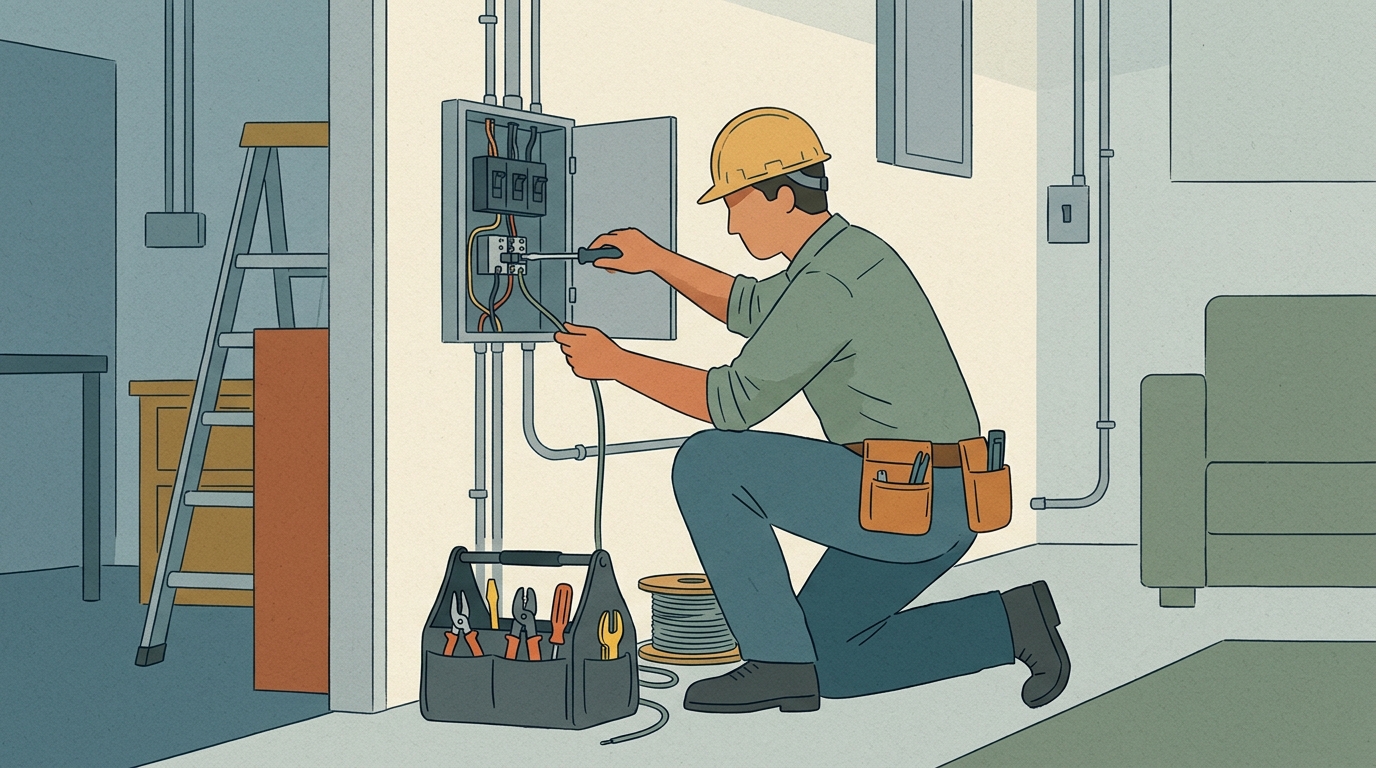
An electrician installs, maintains and repairs electrical power, communications, lighting and control systems in homes, businesses and factories (U.S. Bureau of Labor Statistics, 2025). The day mixes physical installation work, fault-finding with test instruments, and paperwork proving the job meets the electrical code.
Most electricians learn through a paid apprenticeship rather than a degree, and in most places need a licence before working unsupervised.
What an Electrician Does
Electricians install, maintain and repair electrical power, communications, lighting and control systems in homes, businesses and factories (U.S. Bureau of Labor Statistics, 2025). The work exists wherever current has to be carried safely: new-build housing and apartment blocks, commercial fit-outs such as offices, shops and restaurants, hospitals and schools, manufacturing plants, warehouses and distribution centres, utilities and renewable-energy sites, and in-house maintenance departments that keep a single building running.
The core tasks hold across those settings. Electricians read blueprints or technical diagrams, install and maintain wiring, control and lighting systems, inspect components such as transformers and circuit breakers, identify problems using testing devices, repair or replace wiring and equipment with hand tools and power tools, and follow regulations based on the electrical code (U.S. Bureau of Labor Statistics, 2025). They also prepare sketches or follow blueprints to work out where wiring and equipment should sit, so the installation conforms to building and safety codes (O*NET OnLine, U.S. Department of Labor).
Construction electricians spend most of their time installing systems into a building that is still going up. Maintenance electricians spend most of their time diagnosing and fixing systems that already exist, often under pressure to restore production or power quickly.
Apprentices mainly drill, pull cable, terminate devices and move materials under supervision. After completing an apprenticeship, electricians are considered journey workers and may perform duties on their own, subject to local or state licensing requirements, and with further experience may advance to master electrician (U.S. Bureau of Labor Statistics, 2025).
A Typical Day
- Loads conduit, cable reels, boxes and breakers onto the van against the day's material list before leaving the yard.
- Attends the site toolbox talk, confirms isolations and lock-out/tag-out on the circuits to be worked, and signs the permit paperwork.
- Reads the blueprints or prepares sketches to set out wiring, outlets, panels and equipment, marking walls and decking so the rough-in conforms to building and safety codes (O*NET OnLine, U.S. Department of Labor).
- Drills and bends conduit, pulls cable through walls and ceilings, and mounts boxes, lighting and control gear using hand tools and power tools (U.S. Bureau of Labor Statistics, 2025).
- Switches after lunch to terminations: landing conductors in a distribution panel, labelling circuits and torquing connections to the stated values.
- Inspects circuit breakers, transformers and switchgear and traces faults with testing devices — test lamps, ammeters, insulation testers or an oscilloscope, depending on the system (U.S. Bureau of Labor Statistics, 2025; O*NET OnLine, U.S. Department of Labor).
- Repairs or replaces defective wiring and equipment, re-tests the circuit and records the readings before energising.
- Updates the job sheet or maintenance work order, notes variations for the supervisor and orders materials for the next phase.
Call-outs break this pattern. Overtime is common and schedules may include evenings and weekends (U.S. Bureau of Labor Statistics, 2025), so a fault on a production line can replace the planned day entirely.
Salary and Job Outlook
Pay changes every year and differs sharply by country, state and sector, so check the current published figure rather than a number quoted in an article. In the US, the Bureau of Labor Statistics publishes a median annual wage for electricians together with the earnings of the lowest 10 percent and the highest 10 percent (U.S. Bureau of Labor Statistics, May 2025). Elsewhere, use the national statistics agency or trade regulator.
| Stage | How pay is usually structured | Where to check the current figure |
|---|---|---|
| Apprentice (entry) | A percentage of the journey worker rate, stepping up as each year of the 4- or 5-year apprenticeship is completed | Apprenticeship sponsor's wage schedule; national labour statistics agency |
| Journey worker (mid) | Full hourly rate once the apprenticeship is finished and licensing is met, plus overtime, shift and call-out premiums | U.S. Bureau of Labor Statistics occupational wage data, May 2025 (US); national statistics agency elsewhere |
| Master electrician (experienced) | Higher hourly or salaried rate, often with permits, estimating and supervision attached | Same wage sources, filtered by state or region |
| National median | A single median annual wage, with the lowest 10 percent below it and the highest 10 percent above | U.S. Bureau of Labor Statistics, May 2025 |
US employment of electricians is projected to grow much faster than the average for all occupations from 2025 to 2035, and the Bureau also publishes a projected number of annual openings averaged over the decade, most from workers transferring occupations or leaving the labour force (U.S. Bureau of Labor Statistics, 2025).
Skills and Qualifications
Hard skills and credentials you can obtain and show
- A high school diploma or equivalent, the typical entry-level education for the occupation (U.S. Bureau of Labor Statistics, 2025).
- Completion of a 4- or 5-year apprenticeship, about 2,000 hours of paid on-the-job training a year plus technical instruction (U.S. Bureau of Labor Statistics, 2025).
- A pass in the licensing exam. In the US most states require a licence, and the test covers the National Electrical Code plus state and local codes; requirements vary by state (U.S. Bureau of Labor Statistics, 2025).
- A current electrician's licence or identification card, renewed as governmental regulations require (O*NET OnLine, U.S. Department of Labor).
- Blueprint and schematic reading, plus the applied mathematics and electrical theory taught in apprenticeship classes (U.S. Bureau of Labor Statistics, 2025).
- Competence with power construction equipment, measuring devices, power tools and testing equipment including oscilloscopes, ammeters and test lamps (O*NET OnLine, U.S. Department of Labor).
- Safety and first-aid practices, covered in apprenticeship technical instruction (U.S. Bureau of Labor Statistics, 2025).
- Physical capacity for ladder work, confined spaces, overhead drilling and lifting cable reels, plus a driving licence for site-to-site travel.
Soft skills
- Clear communication with other trades, inspectors and customers whose power you are about to shut off.
- Methodical fault-finding: working a circuit back step by step instead of guessing.
- Coordinating, supervising or training others — ONET places electricians in the job zone requiring considerable preparation (ONET OnLine, U.S. Department of Labor).
- Self-discipline about code compliance when nobody is watching the back of the panel.
How to Get Started
- Finish high school or an equivalent qualification, the typical entry-level education for the occupation, taking mathematics, physics and any technical drawing courses available (U.S. Bureau of Labor Statistics, 2025).
- Decide between applying straight to an apprenticeship and doing a pre-apprenticeship or technical college course first. Classroom theory helps at interview but does not replace the on-the-job hours.
- Apply to apprenticeship programmes run by unions, contractor associations or individual employers, usually at one or two intakes a year, and prepare for an aptitude test and interview.
- Complete the apprenticeship — typically 4 or 5 years, with about 2,000 hours of paid on-the-job training a year plus instruction in electrical theory, blueprint reading, mathematics, code requirements and safety and first-aid practices (U.S. Bureau of Labor Statistics, 2025). With electrical experience from the military or construction, ask whether you qualify for a shortened apprenticeship based on experience and testing (U.S. Bureau of Labor Statistics, 2025).
- Sit the licensing exam where your jurisdiction requires one. In the US most states require a test on the National Electrical Code and state or local codes, with requirements varying by state, so check with your state or local licensing board before booking (U.S. Bureau of Labor Statistics, 2025).
- Work as a journey worker, performing duties on your own subject to local or state licensing rules, and keep your licence or identification card current (U.S. Bureau of Labor Statistics, 2025; O*NET OnLine, U.S. Department of Labor). Later, consider the master electrician route or specialise in industrial controls, data cabling or renewables.
Frequently asked questions
Do you need a degree to be an electrician?
No. The typical entry-level education is a high school diploma or equivalent, and most electricians learn the trade through a 4- or 5-year apprenticeship (U.S. Bureau of Labor Statistics, 2025). What you usually do need is a licence: in the US most states require an exam on the National Electrical Code and state or local codes, with requirements varying by state. Outside the US, check the national or provincial licensing authority.
Is being an electrician stressful?
The pressure comes from specific causes rather than the work in general. Schedules may include evenings and weekends and overtime is common, which cuts into personal time (U.S. Bureau of Labor Statistics, 2025). Fault-finding on a stopped production line or a hospital circuit carries time pressure, and ladders, confined spaces and overhead work accumulate physically over a career.
How long does it take to become a qualified electrician?
Most routes take four to five years of apprenticeship, with around 2,000 hours of paid on-the-job training each year plus classroom instruction (U.S. Bureau of Labor Statistics, 2025). Licensing exams usually come at the end of that period. Workers with electrical experience from the military or the construction industry may qualify for a shortened apprenticeship based on experience and testing.
What is the difference between an apprentice, a journey worker and a master electrician?
An apprentice works under supervision while completing paid on-the-job hours and technical instruction. After finishing the apprenticeship an electrician is considered a journey worker and may perform duties independently, subject to local or state licensing requirements (U.S. Bureau of Labor Statistics, 2025). With further experience, a journey worker can advance to master electrician, a level that in many jurisdictions carries permit-pulling and supervisory authority.
Are electricians in demand?
In the US, employment of electricians is projected to grow much faster than the average for all occupations from 2025 to 2035, and the Bureau of Labor Statistics projects a number of annual openings averaged over the decade, most from workers transferring occupations or leaving the labour force (U.S. Bureau of Labor Statistics, 2025). Demand elsewhere tracks construction activity and grid investment, so check your national statistics agency's occupational projections.
Sources
- U.S. Bureau of Labor Statistics — Electricians : Occupational Outlook Handbook (2025)
- O*NET OnLine (U.S. Department of Labor/Employment and Training Administration) — 47-2111.00 - Electricians - Summary Report

Written by
Noor writes personal essays and interviews about career changes, burnout, and starting over. She's interested in the stories people tell themselves about what a job is supposed to mean.